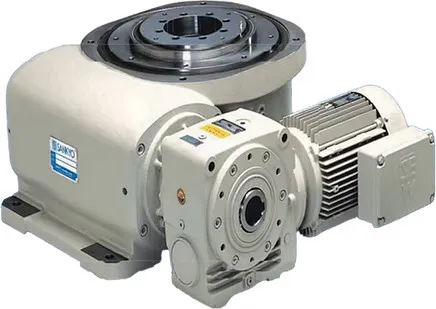

Every manufacturer eventually hits the same wall: the machine is accurate, but it is not fast enough. Operators add more stations, engineers tweak programs, and still the cycle time barely moves. In most cases the bottleneck is not the process itself but the motion between the steps. That is exactly where a High-Speed Rotary Indexer changes the game. It moves a workpiece from one position to the next quickly, stops it precisely, and holds it steady while the actual work happens.
In this blog, we will look at how this technology works, where it fits, what to check before buying, and how to keep it running for years.
What Is a High-Speed Rotary Indexer?
A rotary indexer is a mechanical or servo-driven device that rotates a part or a fixture through fixed angular steps, such as 45°, 90° or 180°, and then stops it with high accuracy. The "high-speed" version is designed to complete these moves in a fraction of a second without losing positioning accuracy or damaging the load.
Instead of an operator manually repositioning a component, the indexer does it automatically, the same way, every single cycle. That repeatability is what makes assembly lines, inspection stations and machining cells so much more productive.
How It Works
Most units are built around one of two drive principles.
Cam-driven indexers use a precisely ground cam and follower system. The cam profile controls acceleration and deceleration, so the output moves smoothly and stops with almost no backlash. These are loved for their durability and consistent timing.
Servo-driven indexers use a servo motor with a gearbox or direct drive. They are programmable, so you can change the index angle, speed and dwell time from the controller without changing any hardware.
Both designs deliver an index and dwell motion: the output rotates, stops, and stays locked while a tool, sensor or robot works on the part. The shorter the index time, the more cycles you get per hour.
The Role of the Rotary Indexing Table
In many factories, the indexer is paired with a rotary indexing table. The table is the round plate on which fixtures, pallets or components are mounted. As the indexer turns the table step by step, each station around its edge performs a different operation, such as drilling, tapping, welding, assembly, labeling or testing.
The benefit is simple: while one station is working, every other station is working at the same time. A part is completed with each index, which multiplies throughput without needing a bigger floor space. A well-designed rotary indexing table also keeps the layout compact and makes it easier to automate loading and unloading.
Key Benefits for Manufacturers
1. Shorter cycle times. Fast, smooth moves reduce non-productive time. Even saving half a second per cycle adds up to thousands of extra parts every month.
2. Excellent repeatability. Because the stopping position is mechanically controlled, positional errors do not build up over a long production run.
3. Better quality. A rigid, vibration-free dwell gives tools and sensors a stable platform, which means cleaner cuts, tighter assembly fits and more reliable inspections.
4. Lower labour dependence. Automated indexing reduces manual handling and operator fatigue, and it improves workplace safety.
5. Longer service life. Quality units are built to handle millions of cycles with minimal maintenance.
6. Compact footprint. One central unit serves many stations, so you save valuable shop floor space.
Where Is It Used?
The flexibility of this equipment explains its popularity across industries.
- Automotive: Assembly of small components, valve and sensor testing, and welding fixtures.
- Electronics: PCB handling, component placement, soldering and optical inspection.
- Packaging: Filling, capping, sealing and labeling of bottles, tubes and sachets.
- Medical devices: Precise assembly of syringes, catheters and diagnostic parts under cleanroom conditions.
- Machining: Multi-side drilling, milling and tapping of a part in a single setup.
- Consumer goods: Toy, appliance and cosmetic product assembly lines.
How to Choose the Right Unit
Buying on price alone is a common mistake. Before you finalise a supplier, check these points.
Load and inertia. Calculate the total weight and moment of inertia of the table, fixtures and parts. An undersized indexer will wear out quickly or lose accuracy.
Indexing steps and angle. Decide how many stations you need. Common options are 2, 4, 6, 8, 12 and more.
Cycle time target. Work backwards from your daily production goal to the index time and dwell time you need.
Accuracy and backlash. For precision work, ask for the stated positioning accuracy and repeatability in arc-seconds.
Drive type. Choose cam-driven for fixed, high-volume jobs, and servo-driven where you need flexibility and frequent changeovers.
Mounting and integration. Confirm flange sizes, through-hole options for cables or air lines, and compatibility with your PLC or controller.
Supplier support. Look for technical guidance, spare parts availability and a clear warranty.
Maintenance Tips for Long Life
A little care goes a long way.
- Follow the recommended lubrication schedule and use the specified oil grade.
- Never exceed the rated load or speed.
- Check mounting bolts and couplings regularly for looseness.
- Listen for unusual noise or vibration, as they are early warning signs.
- Keep the unit clean from dust, coolant and metal chips.
- Inspect seals and look for oil leakage during routine shutdowns.
- Record the temperature and cycle count so that preventive maintenance can be planned.
Trends to Watch
The industry is moving toward smarter motion. Servo-driven units with built-in diagnostics can now report temperature, torque and wear data in real time. Connected sensors allow predictive maintenance, so a bearing can be replaced before it fails. At the same time, demand for compact, lightweight designs is growing as factories try to fit more automation into less space. Companies that adopt these upgrades early are seeing better uptime and lower cost per part.
Final Thoughts
Speed without precision is useless, and precision without speed is expensive. A properly selected High-Speed Rotary Indexer gives you both, helping your line produce more parts, with better quality, using less space and less manual effort. Whether you are building a new assembly cell or upgrading an existing one, take time to define your load, cycle time and accuracy needs, and choose a partner who can support you after the sale. The right choice today can keep your production running smoothly for many years.
Frequently Asked Questions
1. What is a High-Speed Rotary Indexer used for?
It is used to rotate a part or table through exact angular positions at high speed and hold it still while a process such as drilling, assembly, welding, packaging or inspection is performed.
2. What is the difference between a rotary indexing table and a rotary indexer?
The indexer is the drive mechanism that creates the stepped rotation. The rotary indexing table is the circular platform mounted on it that carries the fixtures or parts. They work together as one system.
3. Should I choose a cam-driven or a servo-driven indexer?
Cam-driven units are ideal for fixed, high-volume production because they are very durable and give smooth, repeatable motion. Servo-driven units suit applications that need adjustable angles, speeds and quick changeovers.
4. How accurate is a high-speed indexer?
Quality units can achieve positioning accuracy within a few arc-seconds, depending on the design, load and gearing. Always check the manufacturer's specified accuracy and repeatability for your application.
5. How often does an indexer need maintenance?
It depends on the duty cycle and operating conditions, but most need periodic lubrication checks, bolt tightening and inspection of seals and bearings. Following the manufacturer's schedule keeps the unit reliable for millions of cycles.























Sign in to leave a comment.