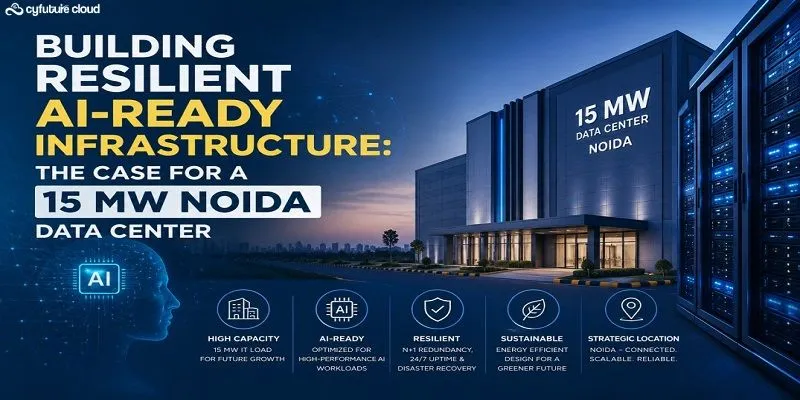

Data centers are the backbone of digital transformation — and nowhere is that more evident than in regions experiencing rapid cloud adoption, AI development, and enterprise digitization. A 15 MW Noida data center can act as a strategic hub for businesses that need scalable compute, low-latency connectivity, and robust operational resilience. This article explains why a 15 MW facility in Noida matters, how it should be architected for AI and cloud workloads, and what operational practices maximize uptime and efficiency.
Why 15 MW matters for this market
- Right-sized capacity. Fifteen megawatts places a facility within the sweet spot between small edge sites and hyperscale campuses. It’s large enough to host dense GPU clusters, private clouds, and enterprise colocation while remaining flexible for phased expansion.
- Cost and speed balance. A 15 MW project can be deployed faster and with lower initial capital expenditure than mega campuses, making it attractive for customers who require rapid provisioning of production-grade infrastructure.
- Local demand fit. Noida’s proximity to Delhi NCR’s enterprises, startups, and hyperscale network backbones makes a 15 MW data center an ideal regional node for compute-heavy workloads and latency-sensitive applications.
Design considerations for AI and GPU workloads
- High power density racks. AI training and inference demand racks that support 20–50 kW or more. The facility should be designed with modular power distribution and cooling infrastructure that can scale to those densities without disruptive retrofits.
- Modular electrical architecture. Use N+1 or 2N configurations for critical paths and design the busways and power distribution to accommodate sudden increases in rack-level consumption. Reserve capacity at the distribution level for GPU clusters, high-performance storage, and future accelerators.
- Efficient cooling systems. Hot-aisle containment, direct-to-chip liquid cooling for the densest racks, and chilled-water systems with variable-speed pumps and fans reduce PUE for high-density GPU deployments. Cooling plants should be sized for peak thermal loads plus contingency.
- Network fabric and low latency. A robust, low-latency networking backbone with multi-carrier fiber connectivity and direct interconnect options is essential. Provide layer-2/3 services, cross-connects in meet-me rooms, and high-throughput switching to support distributed training and data movement.
- Storage and I/O architecture. AI workloads require both high IOPS for training and large-capacity object storage for datasets. Architect a hybrid storage topology with NVMe-based tiering for hot datasets and resilient capacity tiers for long-term storage.
- Physical footprint and modularity. Use a pod-based data hall layout so compute pods can be provisioned independently. This supports phased deployment and isolates maintenance activities, improving availability.
Operational best practices
- Tiered redundancy. Implement redundancy at site, building, room, and rack levels. Critical systems — generators, UPS, fuel storage, and power distribution — should follow industry-proven redundancy practices aligned to required SLAs.
- Predictive maintenance and telemetry. Deploy sensors for temperature, humidity, vibration, and energy use across racks and infrastructure. Leverage telemetry and predictive analytics to reduce unscheduled downtime and optimize energy spend.
- Security and compliance. Provide multi-layered physical security (perimeter fencing, mantrap entry, biometric access) and follow best practices for logical security, network segmentation, and secure cross-connects. Align operational controls with applicable data protection and audit frameworks.
- Skilled operations and remote management. Staff trained in high-density cooling, power systems, and GPU infrastructure is essential. Combine on-site expertise with remote monitoring and control capabilities for 24/7 incident response.
Sustainability and energy strategy
- Renewable integration. Noida’s grid mix and India’s renewable growth make on-site or off-site renewable procurement viable. Incorporate power purchase agreements (PPAs), green tariffs, or renewable offset strategies to reduce carbon intensity.
- Energy-efficient design. Aim for a low PUE through efficient UPS systems, free cooling where feasible, and waste heat recovery for nearby facilities or district heating. Power usage effectiveness improvements lower OPEX and appeal to sustainability-conscious customers.
- Water-conservative cooling. Where water-cooled systems are used, include water-efficient chillers and closed-loop systems to minimize consumption. Consider hybrid approaches — air-plus-liquid cooling — to balance performance and resource use.
Connectivity and ecosystem benefits
- Regional peering hub. A 15 MW Noida data center can serve as a peering and interconnection point for cloud providers, ISPs, and enterprises, improving latency and reducing transit costs.
- Developer and enterprise proximity. Close access to major corporate offices, research institutions, and AI teams shortens deployment cycles and enables hybrid architectures where sensitive workloads remain on-prem or in private cloud nodes.
- Business continuity node. The site can act as a DR location for nearby campuses, allowing regional failover and compliance-aligned data residency options.
Commercial models and customer fit
- Colocation and dedicated cages. Offer flexible colocation options with rack-level and cage-level isolation for enterprises that require predictable physical access and security controls.
- Managed GPU and cloud services. Provide managed GPU hosting, cluster orchestration services, and bare-metal APIs that cater to AI teams not wanting to manage physical hardware lifecycle.
- Phased leasing and growth plans. Structure contracts to allow customers to scale from a few racks to multiple pods, easing capital commitment while signaling clear paths to scale.
Conclusion
A 15 MW Noida data center sits at the intersection of agility and capability — large enough to support GPU-dense AI workloads and enterprise clouds, yet small enough for quicker deployment and targeted investment. Thoughtful electrical and cooling design, strong connectivity, operational rigor, and sustainability measures will determine whether such a facility becomes a competitive regional hub. For teams building or selecting infrastructure in the Delhi NCR region, a well-architected 15 MW site offers the right balance of performance, cost, and scalability.
























Sign in to leave a comment.