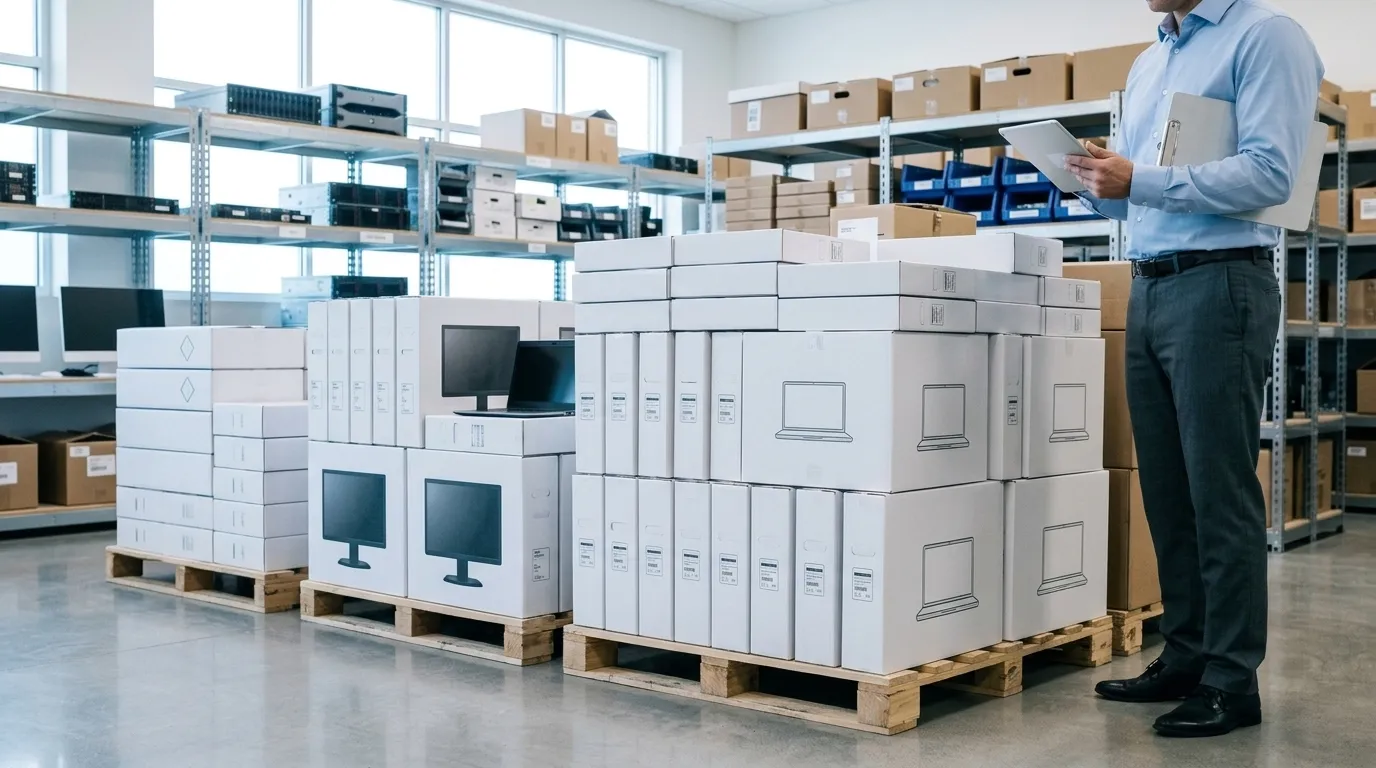

Every growing business eventually hits the same wall: the laptops are aging, the servers are groaning under new workloads, and the finance team is staring at a hardware refresh budget that seems to grow faster than revenue. If this sounds familiar, you are not alone. Companies scaling from twenty employees to two hundred often discover that piecemeal technology purchases quietly drain thousands of dollars a year in ways that never show up as a single alarming line item, just a slow, steady leak.
This is exactly where bulk IT hardware purchasing changes the equation. Instead of buying a laptop here and a monitor there whenever a new hire starts or an old machine dies, companies that plan ahead and buy bulk IT equipment in coordinated batches unlock pricing, logistics, and support advantages that simply are not available to one-off buyers. The savings are not theoretical either; they show up in vendor invoices, IT labor hours, and the overall total cost of ownership for every device deployed across the organization.
In this article, we will walk through five concrete ways bulk IT hardware purchasing helps growing businesses control costs without sacrificing performance or flexibility. Whether you are outfitting a new office, standardizing your fleet of laptops, or preparing for a hiring surge, these strategies apply directly to your situation.
1. Bulk IT Hardware Purchasing Unlocks Volume Discounts
The most obvious benefit, and the one most businesses recognize first, is straightforward volume pricing. Manufacturers and resellers build their pricing structures around order size because larger orders reduce their own per-unit costs for manufacturing, packaging, and shipping. When a business commits to purchasing fifty laptops instead of five, that commitment gives the vendor predictability, and vendors reward predictability with discounts.
Tiered Pricing Structures Favor Larger Orders
Most hardware vendors use tiered pricing models, where discounts increase at specific quantity thresholds. A company buying ten units might receive a modest five percent discount, while an order of one hundred units could qualify for fifteen or twenty percent off list price. Consequently, businesses that consolidate their annual hardware needs into fewer, larger orders often save considerably more than those who buy reactively throughout the year.
Negotiating Leverage With Vendors
Beyond published discount tiers, bulk IT hardware purchasing also opens the door to direct negotiation. Vendors are frequently willing to offer custom pricing, extended payment terms, or bundled accessories when a business demonstrates it is a repeat, high-volume customer. This negotiating leverage rarely exists for smaller, sporadic purchases, which means growing businesses that plan their hardware needs in advance gain real bargaining power they would otherwise miss.
2. Standardized Equipment Reduces IT Support Costs
Cost savings from bulk purchasing extend well beyond the initial invoice. When a business buys bulk IT equipment in standardized batches, it also standardizes the environment its IT team has to support, and that consistency pays dividends for years.
Fewer Configurations Mean Faster Troubleshooting
Supporting a mixed fleet of five different laptop models, each with its own drivers, firmware quirks, and replacement parts, takes far more time than supporting a uniform set of machines. IT staff can build a single deployment image, apply the same security patches, and diagnose issues faster when every device shares the same specifications. As a result, help desk tickets get resolved more quickly, and internal IT teams spend less time researching unfamiliar hardware.
Simplified Training and Documentation
Standardization also simplifies employee onboarding and internal documentation. New hires receive identical equipment with predictable setup steps, and IT teams can maintain a single knowledge base rather than juggling separate guides for every hardware variant. Over time, this reduces both training hours and the likelihood of costly configuration errors.
3. Bulk IT Hardware Purchasing Improves Budget Predictability
Growing businesses live and die by predictable budgeting, and unplanned hardware expenses can throw off quarterly forecasts in ways that are difficult to explain to stakeholders. Buying in bulk allows finance and IT leaders to plan hardware refresh cycles well in advance, converting what would otherwise be a series of unpredictable expenses into a single, forecastable investment.
Aligning Purchases With Growth Projections
Rather than reacting to hardware failures or last-minute hiring needs, companies that adopt bulk IT hardware purchasing strategies can align equipment orders with hiring forecasts and expansion plans. For instance, if a business expects to add thirty employees over the next two quarters, ordering the necessary laptops and monitors now, at a locked-in bulk rate, avoids both price volatility and the scramble of last-minute individual purchases later.
Locking in Prices Against Market Fluctuations
Hardware prices are notoriously sensitive to supply chain disruptions, component shortages, and currency fluctuations. Locking in bulk pricing ahead of time protects a business from these swings, since the negotiated rate typically holds for the duration of the order regardless of subsequent market changes. This kind of price stability is especially valuable for businesses operating on tight annual budgets.
4. Bulk Orders Reduce Shipping and Logistics Expenses
Shipping costs are often overlooked when businesses calculate the true cost of hardware acquisition, yet they can add up quickly when purchases happen piecemeal throughout the year. Bulk IT hardware purchasing consolidates these costs into fewer, more efficient shipments.
Consolidated Shipping Lowers Per-Unit Freight Costs
Ordering ten laptops in a single shipment costs considerably less per unit than ordering one laptop ten separate times, since freight charges, packaging materials, and handling fees are spread across the entire order. Additionally, many vendors offer free or discounted shipping once an order crosses a certain size threshold, further reducing the effective cost per device.
Fewer Deliveries Mean Less Administrative Overhead
Beyond freight costs, receiving fewer, larger shipments also reduces the administrative burden on office staff and IT teams. Processing a single delivery, verifying serial numbers, and updating asset inventories once is far more efficient than repeating that process every time a new employee starts. This translates into real labor savings that compound as the business continues to grow.
5. Bulk IT Hardware Purchasing Extends Equipment Lifecycle Management
Finally, one of the most underappreciated advantages of buying in bulk is the way it improves lifecycle management across the entire hardware fleet. When devices are purchased in coordinated batches, they also tend to reach end of life around the same time, which makes planning replacements and resale far more efficient.
Synchronized Refresh Cycles Simplify Planning
Rather than tracking dozens of individual warranty expiration dates and replacement schedules, IT teams managing a bulk-purchased fleet can plan a single, synchronized refresh cycle every three to five years. This reduces the administrative complexity of asset tracking and makes it easier to budget for future hardware investments well ahead of time.
Better Resale Value Through Uniform Fleets
When it comes time to retire hardware, uniform fleets are also easier to sell or trade in as a batch, since resellers and asset recovery companies often pay more for matched sets of equipment in similar condition. This recoups a portion of the original investment, further lowering the effective cost of the original bulk IT hardware purchasing decision.
Making Bulk Purchasing Work for Your Business
Bulk IT hardware purchasing is not simply about buying more equipment than you currently need. Instead, it is a deliberate strategy that aligns technology investments with business growth, reduces support overhead, stabilizes budgets, lowers logistics costs, and simplifies lifecycle management. For growing businesses trying to scale efficiently, these five advantages add up to meaningful savings that go far beyond the discount printed on an invoice.
As your business continues to expand, taking the time to forecast hardware needs, standardize equipment choices, and negotiate directly with vendors will pay off in ways that touch nearly every corner of your organization, from the finance department to the help desk. The businesses that plan ahead and buy bulk IT equipment strategically are the ones best positioned to scale without technology costs spiraling out of control.


























Sign in to leave a comment.