C-Section vs Normal Delivery: 8 Deciding Factors


Preparing for the arrival of a new family member is a transformative journey filled with important decisions, with the central milestone being the mode of delivery. Many expectant mothers outline a clear birth plan preferring a spontaneous vaginal delivery, while others may require an elective or unexpected surgical delivery due to specific clinical indicators.
When researching the best maternity hospital in Dubai for your antenatal care and delivery, understanding the physiological variables that influence these birth pathways helps reduce uncertainty as your due date approaches. Consulting an experienced obstetric team ensures that both maternal preferences and clinical safety guidelines are balanced seamlessly throughout every trimester.
Here are the eight primary clinical and physical factors that determine whether a spontaneous normal delivery is feasible or if a Caesarean section becomes the recommended route.
1. Fetal Presentation and Physical Positioning
The anatomical orientation of the baby within the uterus as labor approaches plays a fundamental role in determining the appropriate delivery mode. In a standard spontaneous delivery, the baby enters the birth canal head-first facing the mother's back, which is clinically referred to as the occiput anterior position.
However, if the baby remains in a breech orientation, where the feet or buttocks point downward toward the cervix, or a transverse orientation lying sideways across the abdomen near full term, a vaginal birth carries significant mechanical complications. While an external cephalic version (ECV) procedure can sometimes gently turn a breech baby manually in late pregnancy, persistent malpresentation typically warrants a planned Caesarean section to protect fetal safety.
2. Placental Location and Uterine Attachment
The precise anatomical location where the placenta attaches inside the uterine wall heavily dictates whether a normal vaginal birth can safely proceed without threatening maternal stability.
A condition known as placenta previa occurs when the placenta attaches near the lower uterine segment, partially or completely covering the internal opening of the cervix. As the cervix dilates during active labor, a low-lying placenta can detach prematurely and trigger severe, sudden maternal hemorrhage. In cases of confirmed complete placenta previa or acute placental abruption, where the placenta separates prematurely from the uterine wall, an immediate or planned C-section is medically imperative to safeguard both mother and child.
3. Labor Progression and Cervical Dilation Mechanics
Even when a pregnancy appears low-risk throughout the first and second trimesters, the dynamic progression of active labor itself serves as a crucial determinant during the hospital stay.
Occasional complications during active labor include failure to progress or prolonged labor arrest, where uterine contractions remain insufficient to dilate the cervix further, or the baby fails to descend through the pelvic floor despite adequate time and active pushing effort. When evaluating options across the best maternity hospitals in Dubai, pregnant women benefit from knowing that multidisciplinary labor wards continuously monitor these parameters to prevent maternal exhaustion, tissue trauma, and prolonged fetal stress by transitioning to a surgical delivery when clinically indicated.
4. Real-Time Fetal Heart Rate Tracings and Stress Indicators
Continuous electronic fetal monitoring throughout active labor provides essential diagnostic data regarding how well the baby tolerates the intense physical stress of uterine contractions.
If fetal heart rate tracings demonstrate persistent late decelerations, prolonged drops in baseline heart rate, or clear signs of oxygen deprivation, immediate clinical action is required by the medical team. If conservative measures - such as repositioning the mother onto her side, administering intravenous fluids, or adjusting labor-inducing medications - fail to stabilize the fetal heart rate, a prompt Caesarean delivery ensures a safe and rapid delivery before distress leads to further complications.
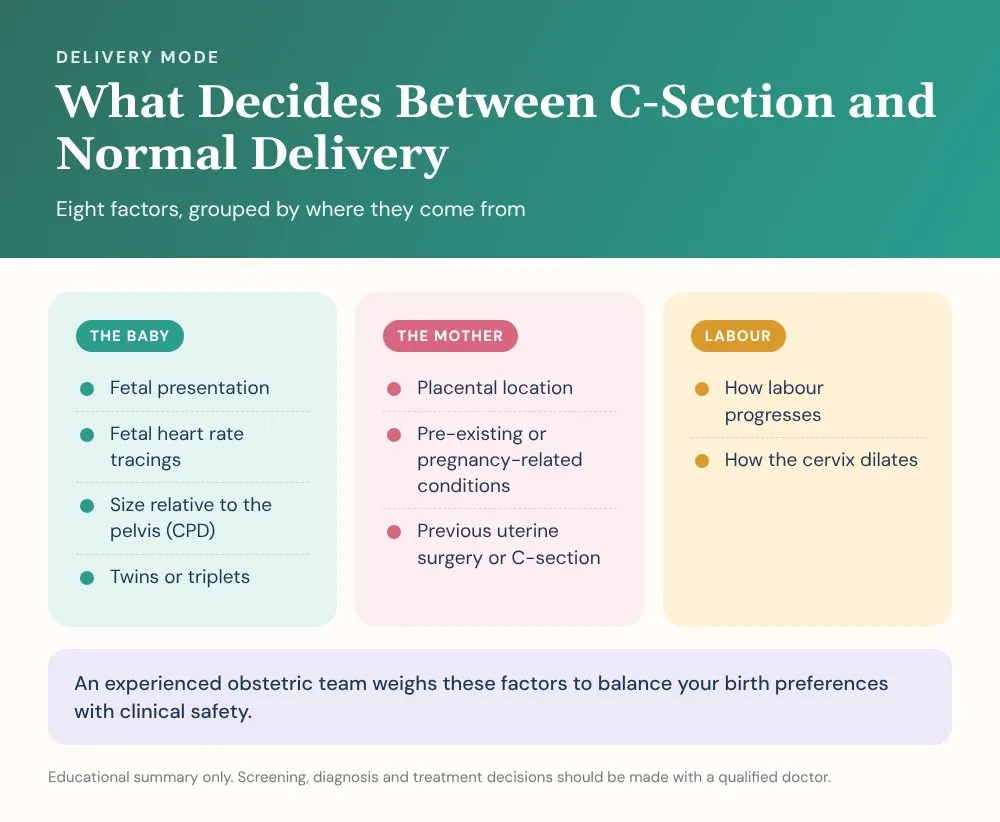
5. Maternal Health Conditions and Pre-Existing Medical History
A mother's overall systemic health prior to conception and throughout her gestational journey directly influences birth plan factors and safety thresholds.
Pre-existing or pregnancy-induced medical conditions - including severe gestational hypertension, pre-eclampsia, uncontrolled diabetes, active cardiac disease, or active viral infections such as genital herpes lesions - can make prolonged physical exertion during vaginal delivery risky. In such instances, a planned surgical delivery offers a controlled clinical environment to manage maternal vital signs, blood pressure, and metabolic stability safely.
6. Previous Uterine Surgeries and Prior C-Section History
A mother's past surgical history significantly affects whether a trial of labor after Caesarean (TOLAC) or Vaginal Birth After C-Section (VBAC) can be safely considered.
If a woman has previously undergone a Caesarean section with a low-transverse uterine incision, a successful VBAC may be an option under close medical supervision in a fully equipped hospital. However, if the prior C-section involved a classical vertical uterine incision, or if the mother has undergone extensive fibroid removal (myomectomy) penetrating the uterine cavity, the structural integrity of the uterine wall may be compromised. To prevent uterine rupture during intense contractions, an elective repeat C-section is usually recommended.
7. Fetal Size Relative to Maternal Pelvic Anatomy (CPD)
The anatomical relationship between the estimated weight of the baby and the physical dimensions of the maternal pelvis is carefully monitored during late-stage antenatal visits.
Cephalopelvic Disproportion (CPD) occurs when the baby's head is structurally too large or angled abnormally to pass safely through the mother's pelvic opening. While true anatomical CPD is relatively rare, conditions such as fetal macrosomia—where estimated fetal weight exceeds 4.5 kilograms, often associated with gestational diabetes—significantly increase the risk of shoulder dystocia during a normal delivery, making a planned C-section the safer clinical alternative.
8. Multiple Gestations (Twins or Triplets)
Carrying more than one baby automatically introduces unique mechanical and physiological variables into the labor and delivery process.
While delivering twins vaginally is entirely possible if the first twin is positioned head-down and the clinical team is experienced in twin deliveries, higher-order multiples such as triplets or quadruplets generally require a planned surgical delivery. Additionally, in twin pregnancies where the presenting baby is breech or where shared placental complications exist, a controlled operating room setting allows the medical team to manage the complex birth anatomy smoothly.
Frequently Asked Questions
What factors decide if a C-section is medically necessary?
A C-section becomes medically necessary when a vaginal delivery poses significant health risks to the mother or baby. Common clinical indicators include persistent breech or transverse fetal positioning, complete placenta previa, acute fetal distress, uterine rupture risks due to prior classical surgical incisions, severe pre-eclampsia, or prolonged arrest of labor progression.
Can a woman request a C-section without a medical reason in Dubai?
Yes, maternal request for Caesarean delivery (MRCD) can be discussed with your consulting obstetrician. Following guidelines established by international health bodies and local healthcare authorities, obstetricians will provide thorough clinical counseling regarding the risks, recovery timelines, and surgical implications of an elective C-section versus a vaginal delivery before confirming an informed decision.
Is a normal delivery always safer than a planned C-section?
For uncomplicated, low-risk pregnancies, an unassisted normal vaginal delivery is generally considered the preferred pathway due to shorter recovery times, lower infection risks, and reduced surgical complications. However, in the presence of specific maternal or fetal risk factors, a planned Caesarean delivery becomes the significantly safer option to protect both maternal and neonatal outcomes.
Determining the safest delivery method requires open, ongoing communication between you and your healthcare team throughout your pregnancy. When evaluating the best hospital for maternity in Dubai, families look for an accredited facility equipped with modern labor suites, surgical operating theaters, and dedicated neonatal care units. Choosing an established medical provider ensures that whether your journey leads to a natural birth or a surgical delivery, your care is handled with comprehensive clinical expertise and personalized attention.
To discuss your birth plan options or book an antenatal consultation, contact the maternity unit at Dubai London Hospital, which offers vaginal birth, with or without an epidural, as well as caesarean delivery.









Sign in to leave a comment.