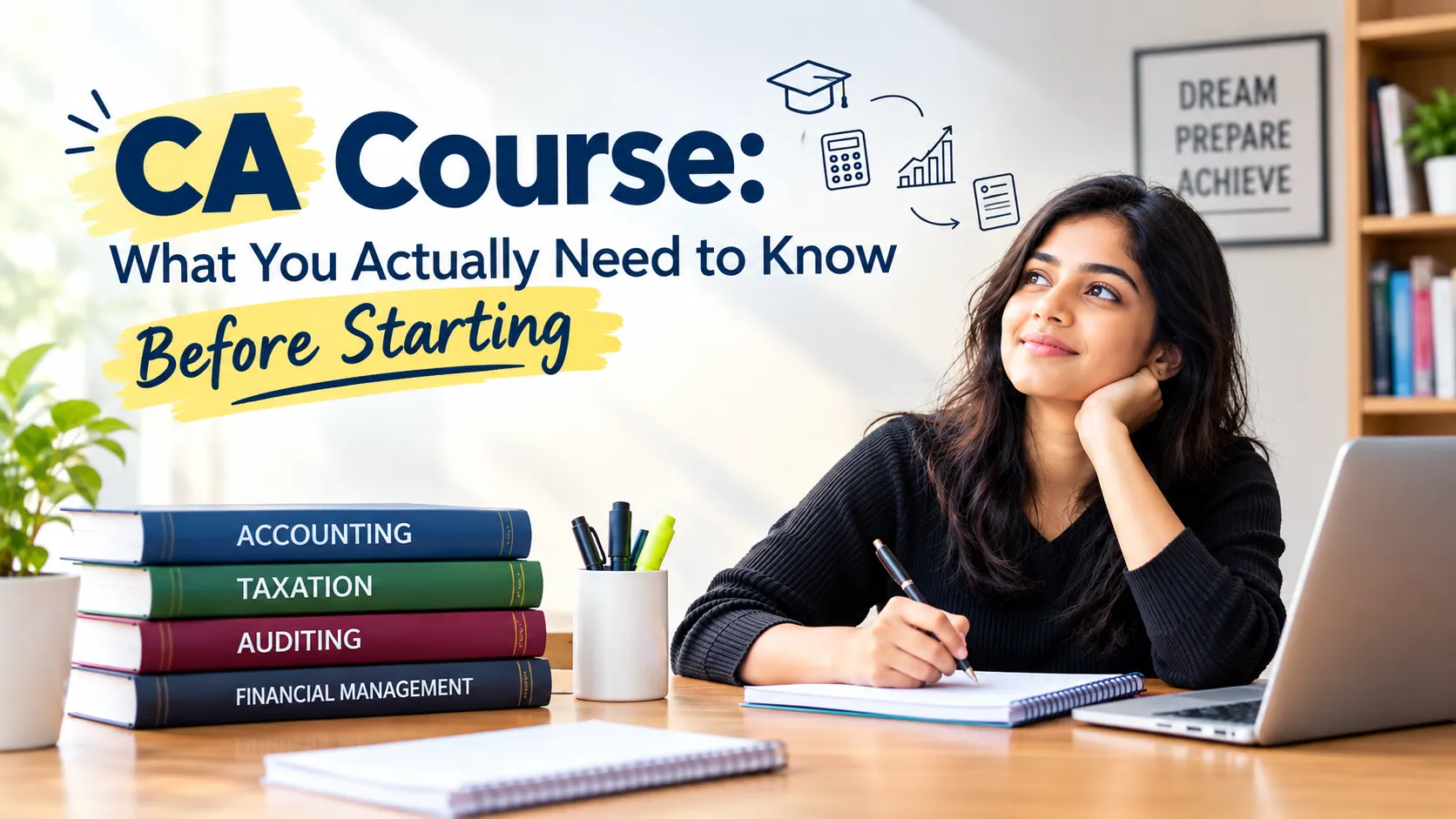

Choosing a professional course after school or graduation is a major decision. If you are interested in accounting, taxation, auditing, finance, and business management, becoming a Chartered Accountant (CA) could be a suitable career path to explore.
However, the CA journey requires more than an interest in numbers. It involves structured examinations, consistent preparation, practical training, and a long-term commitment to professional development.
Before enrolling in a course, it is important to understand the qualification process, eligibility requirements, study options, and career opportunities.
Here is what you should know before starting your CA journey.
What Is a Chartered Accountant?
A Chartered Accountant is a finance professional trained in areas such as accounting, auditing, taxation, financial reporting, and corporate finance.
CA professionals work with businesses, individuals, and organizations to manage financial records, meet regulatory requirements, analyze financial performance, and support important business decisions.
The qualification is awarded through the Institute of Chartered Accountants of India (ICAI), which regulates the CA profession in India.
A CA qualification can lead to opportunities in:
- Auditing and assurance
- Tax consultancy
- Financial accounting
- Corporate finance
- Management accounting
- Risk management
- Financial analysis
- Business consulting
The profession offers different career paths, allowing candidates to work in accounting firms, companies, financial institutions, or independent practice.
What Are the Stages of the CA Course?
The CA qualification involves different stages of education, examinations, and practical training. Understanding these stages helps students prepare for the journey more effectively.
1. CA Foundation
The CA Foundation is the entry-level examination for candidates following the Foundation route.
It introduces students to essential concepts in accounting, business laws, quantitative aptitude, and business economics.
The subjects help build the basic knowledge required for advanced professional studies.
Students should focus on understanding fundamental concepts rather than relying entirely on memorization.
2. CA Intermediate
After completing the applicable eligibility and examination requirements, students can progress to the CA Intermediate level.
This stage covers more advanced topics in accounting, taxation, auditing, financial management, and related areas.
The syllabus requires a deeper understanding of financial concepts and their practical applications.
Students may choose to prepare for the groups according to the applicable ICAI examination structure and their individual study plan.
3. Practical Training
Practical training is an important part of the CA qualification process.
It gives students exposure to real-world professional activities, including:
- Preparing financial statements
- Assisting with audits
- Understanding taxation procedures
- Maintaining accounting records
- Working with financial documentation
- Learning professional communication
This experience helps students understand how theoretical knowledge is applied in professional environments.
4. CA Final
The CA Final stage focuses on advanced professional knowledge and the application of accounting, auditing, taxation, financial reporting, and strategic concepts.
Candidates must complete the applicable examination, training, and other ICAI requirements to qualify as Chartered Accountants.
Since ICAI periodically updates its syllabus and qualification structure, students should always check the latest official requirements before beginning their preparation.
Who Can Enrol in a CA Course?
CA is open to candidates from different educational backgrounds, subject to the applicable ICAI eligibility requirements.
Students After Class 12
Students who have completed Class 12 can explore the CA Foundation route.
A commerce background may provide familiarity with accounting and business concepts, but students from other streams can also consider CA if they meet the eligibility criteria.
Graduates
Graduates may be eligible to enter the CA qualification through the applicable Direct Entry route, depending on their educational qualifications and the requirements prescribed by ICAI.
Students should verify the current eligibility conditions before applying.
Working Professionals
Professionals already working in accounting, finance, or business-related roles may also consider CA to strengthen their technical knowledge and career opportunities.
However, they should carefully assess the time commitment involved in examinations, training, and self-study.
Why Is Choosing the Right CA Coaching Centre Important?
CA preparation requires a structured approach. While self-study is important, many students prefer professional guidance to understand difficult topics, organize their preparation, and stay consistent.
A suitable coaching centre may provide:
- Experienced faculty
- Subject-wise classes
- Study materials
- Mock examinations
- Revision sessions
- Doubt-clearing support
- Progress tracking
- Examination preparation guidance
The right learning environment can help students develop better study habits and understand challenging concepts more clearly.
However, coaching alone does not guarantee success. Regular revision, practice, and individual effort remain essential.
How to Choose a CA Coaching Centre in Kerala
Kerala has several educational institutions and training providers offering professional accounting and finance education. Before selecting a coaching centre, students should consider their learning needs and long-term goals.
1. Check Faculty Experience
Experienced faculty can make complex accounting, taxation, and auditing topics easier to understand.
Look for instructors who can explain concepts clearly and provide practical examples.
2. Review the Course Structure
Understand how the coaching centre organizes its classes, revision sessions, study materials, and mock examinations.
A clear course structure can help students plan their preparation more effectively.
3. Consider Location and Learning Format
Students should decide whether they prefer classroom learning, online classes, or a combination of both.
For students looking for a Thrissur CA Coaching Centre, location, class timings, accessibility, and available learning support are important factors to consider.
4. Examine Student Support
Ask whether the institution provides doubt-clearing sessions, examination guidance, revision support, and regular assessments.
These services may help students identify areas where additional preparation is needed.
5. Understand the Fee Structure
Before enrolling, compare the course fees, study materials, examination-related expenses, and any additional charges.
A clear understanding of the total cost can help students plan their education budget.
What Is the Difference Between CA Coaching and CA Training?
Although the terms are sometimes used interchangeably, CA coaching and CA training can refer to different aspects of professional education.
CA coaching generally focuses on preparing students for examinations. It includes subject classes, practice tests, revision, and academic guidance.
CA training may refer to broader learning activities that develop accounting knowledge, practical skills, and professional understanding. In the context of the CA qualification, practical training is also a formal part of the professional journey.
Students should check what a particular institution includes when it uses terms such as CA Training Kerala or CA Training Center.
Understanding the course content and training structure is more important than relying on the name alone.
Are There CA Colleges in Kerala?
Students searching for CA Colleges In Kerala should first understand an important distinction.
Chartered Accountancy is a professional qualification regulated by ICAI. Students generally prepare through coaching institutions, educational providers, and self-study while completing the required ICAI registration, examinations, and training.
Some colleges may offer related academic programmes such as:
- Bachelor of Commerce
- Finance
- Accounting
- Business Administration
- Commerce with professional preparation
These degrees can help students build an academic foundation, but completing a college degree is not the same as obtaining the CA qualification.
Before choosing an institution, students should verify whether it provides CA examination preparation, a university degree, or another type of accounting programme.
What Does a CA Course in Kerala Cost?
The total cost of pursuing CA depends on several factors, including:
- ICAI registration and examination fees
- Coaching fees
- Study materials
- Travel and accommodation
- Additional revision or test series expenses
- Other education-related costs
The amount may vary depending on the learning format and the student's individual requirements.
Students should distinguish between official ICAI fees and coaching centre charges. For accurate and current registration and examination fees, it is best to consult the official ICAI website.
If you are researching a CA Course In Kerala, compare the complete cost of preparation rather than looking only at the initial admission fee.
What Skills Do You Need to Succeed in CA?
CA preparation requires a combination of academic understanding and personal discipline.
Strong Accounting Fundamentals
Accounting is a core part of the CA curriculum. A good understanding of basic accounting principles can help students approach advanced topics more confidently.
Time Management
The syllabus can be extensive, so students need to divide their study time between different subjects.
Creating a realistic timetable can make preparation more manageable.
Problem-Solving Ability
CA examinations require students to apply concepts to practical and theoretical questions.
Regular problem-solving practice can help improve accuracy and confidence.
Consistency
Studying regularly is often more effective than attempting to cover the entire syllabus shortly before examinations.
Small, consistent study sessions can support long-term preparation.
Patience and Adaptability
The CA journey can involve challenging subjects and demanding examination schedules.
Students should be prepared to review their progress, adjust their study methods, and continue learning.
What Career Opportunities Are Available After CA?
A CA qualification can open up opportunities across accounting, finance, taxation, and business management.
Chartered Accountancy Firms
Professionals may work in audit, taxation, accounting, and advisory services.
Corporate Finance Departments
Companies employ finance professionals for budgeting, financial reporting, compliance, and business analysis.
Tax Consultancy
CA professionals can work in taxation-related services, subject to applicable laws and professional regulations.
Banking and Financial Services
The qualification may be relevant to roles involving financial analysis, reporting, risk management, and advisory functions.
Independent Practice
Qualified Chartered Accountants may explore independent professional practice in accordance with applicable regulations.
The career path a student chooses will depend on their interests, skills, experience, and professional goals.
Common Mistakes Students Should Avoid Before Starting CA
Starting a professional qualification without proper planning can create unnecessary challenges.
Here are some common mistakes to avoid:
Choosing CA Without Understanding the Syllabus
Students should review the subjects, examination structure, and preparation requirements before enrolling.
Depending Entirely on Coaching
Coaching can provide guidance, but students must also dedicate time to self-study and revision.
Ignoring Practical Learning
Understanding how accounting and taxation work in real business situations can improve professional awareness.
Failing to Plan Study Time
Without a realistic timetable, it can become difficult to balance classes, revision, and other responsibilities.
Not Checking Official Requirements
ICAI may update examination patterns, eligibility rules, and training requirements. Students should refer to official announcements for the latest information.
Is CA the Right Course for You?
CA may be worth exploring if you are interested in accounting, finance, taxation, auditing, and business operations.
Before making a decision, ask yourself:
- Do I enjoy working with financial information?
- Am I interested in understanding business and taxation?
- Can I commit to a structured study schedule?
- Am I willing to prepare consistently for professional examinations?
- Have I researched the qualification and training requirements?
- Have I compared CA with other finance and accounting career options?
Answering these questions can help you understand whether the course aligns with your interests and long-term plans.
Final Thoughts
Starting a CA course is a significant academic and professional commitment. Understanding the qualification structure, eligibility requirements, coaching options, practical training, and career opportunities can help students make informed decisions.
Whether you are searching for a Chartered Accounting Course In Kerala, exploring CA coaching options, or comparing accounting career paths, take time to research the institution and understand what the course includes.
With proper planning, consistent preparation, and a clear understanding of the qualification process, students can approach their CA journey with greater confidence.
Interested in exploring CA preparation and accounting education options? Visit CAREP to learn more about available courses and training opportunities.

























Sign in to leave a comment.