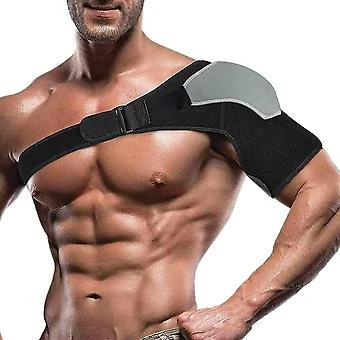

When we talk about a dislocated shoulder (usually the Glenohumeral Joint) the key concerns are: reducing the chance of recurrence, supporting healing of soft tissues (ligaments, labrum, capsule), protecting the joint from abnormal movement, and helping the person return to function. The idea of using a brace is appealing—after all, if you can externally stabilise the joint, perhaps you reduce the risk of it moving again. But what does the evidence say? Let’s dive in.
✅ What a shoulder brace can do
- Reduce harmful movement / joint excursion.
- A controlled lab/biomechanical study found that a specific immobiliser significantly reduced humeral‑head translation during abduction and internal/external rotation in patients with anterior instability.
- In plain terms: the brace limited how much the ball (humeral head) could move relative to the socket (glenoid) in risky planes of motion.
- Provide external support & psychological reassurance.
- While not strictly “proof” in clinical trials, many patients report feeling more secure with a brace on; this can encourage earlier movement or sport participation, or at least reduce fear of “popping out”. For example, in athlete‑studies:
“I just know that brace gives me confidence to commit to tackles …”
- Complement rehabilitation.
- Bracing is rarely a lone treatment. It often goes with soft‑tissue rehab, strengthening of the rotator cuff and scapular stabilisers, and activity modification. In the study of athletes using a “dynamic brace + rehab” they reported very good return to play and low re‑dislocation in that specific context. PubMed
What a shoulder brace does not reliably do (or at least the evidence is weak)
- Prevent recurrence on its own.
- Several good‐quality trials have failed to show a significant reduction in recurrent dislocation simply by choosing a brace/immobilisation position over another.
- One randomized trial found no difference: 37% recurrence with an external‐rotation brace vs 40% with traditional sling for first‑time anterior dislocations. PMC
- Another large trial was discontinued early and found: re‐dislocation 30% vs 24% (sling vs external rotation brace) and concluded “unlikely to provide clinical benefit”. PubMed
- Thus, while a brace may reduce motion, preventing recurrence depends on many other factors (age, tissue damage, sport, compliance, rehab).
- Fix structural damage or instability fully.
- If there is major tissue damage (e.g., a large bony Bankart lesion, Hill‑Sachs defect, severe labral tear) then bracing alone is unlikely sufficient; surgery is often required. A recent systematic review comparing surgical stabilisation vs nonoperative immobilisation underscores this.
- Ensure compliance & comfort.
- A brace that is uncomfortable or restricts daily life heavily will likely lead to poor compliance. One study reported high intolerance of the external rotation brace. PMC
- Also, bracing may restrict movement to the extent that it delays functional rehab or causes compensatory patterns.
🔍 So what is the “real” role of a shoulder brace after dislocation?
In short: supportive but not definitive.
- After a dislocation, the joint needs time to heal (capsule, ligaments, labrum). A brace or sling can give this soft tissue the “quiet” it needs.
- It helps temporarily limit extreme or vulnerable positions (e.g., full abduction+external rotation) while rehabilitation proceeds.
- It’s a adjunct: it doesn’t replace good rehabilitation (rotator cuff & scapular muscle strengthening, neuromuscular control), activity modification, and, when needed, surgical evaluation.
- It can help in certain populations: athletes in‐season, people with mild instability, or those who cannot undergo immediate surgery. But expectations need to be realistic: it reduces risk but does not eliminate risk.
🧭 Practical guidelines if you (or someone) has had a shoulder dislocation and is considering a brace
- Get the joint reduced and evaluated.
- Don’t rely on the brace for the acute event. Make sure the shoulder is properly reduced, imaged as needed, and the extent of soft‑tissue/bony injury is known.
- Use the brace for the right duration & setting.
- Typically, immobilisation (sling or brace) for a few weeks is used to relieve pain and allow early healing. Whether internal rotation, external rotation or a specific position is best remains debated. Literature suggests the position may not strongly influence recurrence.
- Choose a brace that fits, is comfortable, and allows the planned rehab.
- A brace that is too restrictive, unsupportive, or uncomfortable may reduce compliance. Check that it allows the prescribed physiotherapy exercises.
- Combine with a robust rehabilitation plan.
- Strengthening of the rotator cuff, scapular stabilisers, deltoid; neuromuscular control; gradually increasing activity. A brace can protect during the early phase, but rehab builds the long‑term stability.
- Reassess for underlying factors.
- If you’re young, active, in contact sports, have a large bony injury, or recurrent dislocations — surgical stabilisation may be indicated. A brace doesn’t replace this discussion.
- Know that ‘prevention’ of all dislocations is unlikely.
- Despite best efforts, recurrence rates after a first‑time dislocation can be significant — especially in younger, active individuals. SpringerOpen+1
- The brace helps reduce risk and support the joint, but you should not assume it gives complete immunity.
🧾 Final word
Yes — a shoulder brace can contribute meaningfully to stabilising a dislocated shoulder temporarily: by limiting risky movement, supporting soft‑tissue healing, and giving confidence during early rehabilitation. But it is not a guarantee of stability on its own — it doesn’t fix structural damage, it doesn’t replace rehabilitation, and the evidence for bracing alone reducing recurrence is modest.
If you tell me more about the case (first‑time dislocation vs recurrent, age, sport involvement, what brace you’re looking at, rehab status), I can walk you through which type of brace might be most suitable, how long to use it, and how it fits into your overall recovery plan. Would you like that?



























Sign in to leave a comment.