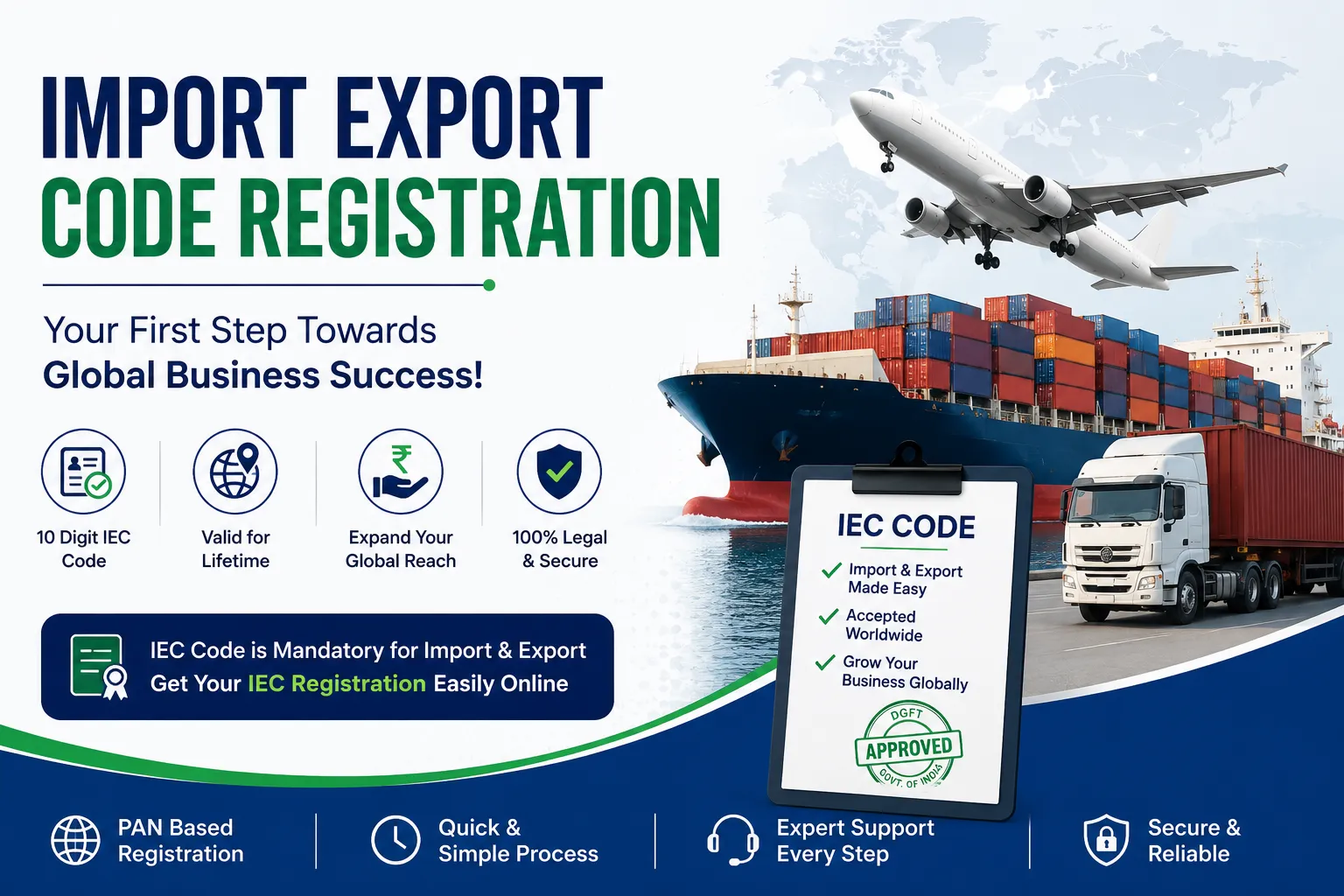

Import Export Code Registration is mandatory for almost every business or person exporting goods from India or importing goods into the country. A small list of exemptions exists under the Foreign Trade Policy — mainly for personal-use shipments, certain government bodies, and low-value trade with neighboring countries. Outside these narrow cases, exporting without an IEC is not legal, and customs will hold or reject the shipment.
What Is Import Export Code Registration?
An Import Export Code, or IEC, is a 10-digit number given out by the Directorate General of Foreign Trade (DGFT). It works like a passport for your goods at customs. Without it, a shipment simply cannot clear the port, and payments linked to export orders often get stuck too.
The code is tied to your PAN, so one business gets one IEC for life. No renewal headaches, though the rules do ask for a yearly online update between April and June, just to keep the record active.
Is IEC Mandatory for Every Exporter?
Yes, in almost all cases. The Foreign Trade (Development and Regulation) Act makes an IEC number compulsory before any commercial export or import. A trader, a manufacturer, a freelancer selling services abroad and claiming trade benefits, a large company shipping containers — all of them need this registration first.
Skipping it isn't a gray area. Customs officers check for a valid IEC at the time of filing a shipping bill, and no code means no clearance. Banks also ask for it while processing inward remittances tied to export payments.
Who Is Exempted From Import Export Code Registration?
A few categories genuinely don't need one. These exemptions come straight from the Foreign Trade Policy and its Handbook of Procedures.
People and entities exempted from IEC:
- Individuals importing or exporting goods for personal use only — not for trade, manufacturing, or farming
- Central Government or State Government ministries and departments carrying out official, non-commercial business
- Notified charitable institutions such as the Red Cross, certain UN agencies, and a handful of named organizations listed by DGFT
- Traders dealing with Nepal, Myanmar (via Indo-Myanmar border areas), or China, where a single consignment's value stays under Rs. 25,000 (Rs. 1 lakh for shipments through Nathula port)
Each of these exemptions applies to a narrow, specific situation. A shop owner exporting samples for feedback isn't automatically exempt just because the quantity is small — the goods have to be genuinely non-commercial.
Do Service Exporters Need an IEC Too?
Not always. If you're exporting services or technology and not claiming any benefit under the Foreign Trade Policy, you can operate without one. The moment you want to access an export incentive scheme, though, an IEC becomes necessary again — even for a pure service business.
This distinction trips up a lot of freelancers and consultants working with overseas clients. Getting paid through banking channels for services rendered doesn't need IEC by default. Chasing a duty benefit or a scheme reward does.
What Happens If You Export Without a Valid IEC?
Nothing good. A shipment without a valid code gets stopped right at the customs stage. Beyond the immediate delay, there are real business costs:
Shipping bills get rejected, so goods sit in a warehouse racking up demurrage charges
Export proceeds can't be realized properly through banking channels
Any GST refund or duty drawback claim tied to that export becomes far harder to process
Repeated attempts without registration can invite scrutiny from customs authorities
Compare this against the low cost of getting registered — a modest one-time government fee and a short online form — and the exemption route rarely makes practical sense for a genuine business.
How Does GST Registration Relate to IEC?
They aren't the same thing, and one doesn't replace the other. GST registration deals with domestic tax compliance. IEC registration deals specifically with cross-border trade clearance. A business can be GST-registered and still be blocked at customs without an IEC, and vice versa.
Since 2021, DGFT made IEC numbers match a firm's PAN directly, which has made the two systems talk to each other better, but they still serve separate legal purposes.
Applying for IEC: A Quick Look
The process itself is straightforward for anyone who has basic business documents ready:
- Apply online through the DGFT portal using Form ANF-2A
- Upload PAN, address proof, and bank account details
- Pay the government fee (currently a modest, fixed amount)
- Receive the certificate digitally, often within a few working days
- Proprietorship Firm, partnerships, LLPs, companies, trusts, and societies can all apply under their respective legal structure.
Summary
Operating as an exporter without Import Export Code Registration is legal only in a small set of exemptions — personal-use shipments, specific government bodies, notified charities, and low-value cross-border trade with a few neighboring regions. Every other commercial exporter, including most small businesses and manufacturers, needs a valid IEC before goods can move through customs. Given how affordable and quick the registration is, treating it as a first step rather than an afterthought saves real money and time down the road.
FAQ
Q1. Can a small exporter skip IEC registration if trade volume is low?
No. There's no general exemption based on business size or trade volume, apart from the specific low-value cross-border cases with Nepal, Myanmar, and China.
Q2. Is IEC required for one-time export shipments?
Yes, even a single commercial shipment needs a valid IEC unless it falls under personal-use or another listed exemption.
Q3. Does IEC registration expire?
No, it has lifetime validity, though an annual online update is required to keep the code active on the DGFT system.
Q4. Can one business have multiple IEC numbers?
No. Only one IEC is issued against a single PAN, regardless of how many products or trade lines the business handles.
Q5. Is IEC needed for importing goods for personal use, like online shopping from abroad?
No. Genuine personal-use imports don't require an IEC, provided they aren't linked to any commercial or business activity.

























Sign in to leave a comment.