
Introduction
Air travel has changed a lot in recent years. Today, passengers rely heavily on wireless technology like Bluetooth headphones, smartwatches, and fitness trackers. But even in 2026, many travelers still ask a common question — is Bluetooth actually allowed on a plane?
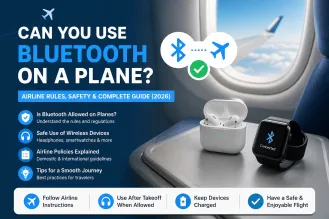
The answer is yes, but with certain conditions. Airlines allow Bluetooth usage in most cases as long as your device is in airplane mode and you follow safety instructions from the cabin crew. However, rules can slightly differ depending on the airline and aircraft type.
To make this clearer, let’s understand it through a real travel experience and detailed airline rules.
A Real Passenger Experience With Bluetooth on a Flight
A frequent traveler flying from Delhi to Dubai shared a simple experience that reflects how Bluetooth works on most flights today.
Before boarding, he downloaded movies and podcasts on his phone and carried his wireless AirPods for the journey. Once inside the aircraft, he followed the standard instruction and switched his phone to airplane mode.
Initially, he assumed Bluetooth would also be disabled automatically. But after checking his settings, he realized he could manually turn Bluetooth back on.
After takeoff and once the flight reached cruising altitude, he paired his AirPods without any issue. The entire journey became smooth, comfortable, and completely wire-free.
This is now a very common experience for modern air travelers.
Why Airlines Allow Bluetooth Devices Today
Bluetooth technology operates on low-power radio frequencies, which are not strong enough to interfere with aircraft systems. Because of this, aviation authorities like FAA and EASA allow its usage onboard under controlled conditions.
Modern aircraft are also designed to handle personal electronic devices safely. This is why Bluetooth usage is now widely accepted across most airlines.
Passengers commonly use:
- Wireless headphones like AirPods or Galaxy Buds
- Smartwatches for notifications
- Wireless keyboards and mice for work
- Portable entertainment devices
Airline Rules for Bluetooth Usage (Important Guidelines)
Even though Bluetooth is allowed, airlines still follow strict safety protocols:
- Airplane mode must be enabled before anything else
- Bluetooth can be used only after takeoff in most cases
- Use may be restricted during landing and taxiing
- Cabin crew instructions always override device settings
- Some aircraft may not support in-seat Bluetooth pairing
These rules ensure safety and prevent unnecessary distractions during critical flight phases.
Common Mistakes Travelers Make With Bluetooth
Many passengers still face small issues during flights because of simple mistakes:
- Forgetting to enable airplane mode first
- Trying to pair devices during boarding chaos
- Not charging wireless headphones before flight
- Ignoring crew announcements
- Assuming all airlines follow the same rules
Avoiding these mistakes makes your travel experience much smoother.
Benefits of Using Bluetooth on Flights
Bluetooth improves modern air travel in many ways:
- No tangled wires during long journeys
- Better comfort while watching movies or listening to music
- Easier device control during work or entertainment
- Cleaner and more organized seating space
For frequent travelers, Bluetooth has become almost essential.
Conclusion
Bluetooth usage on airplanes is now a normal part of modern flying. As long as airplane mode is enabled and airline instructions are followed, passengers can safely enjoy wireless devices throughout their journey.
With aviation technology improving every year, Bluetooth is becoming even more integrated into the in-flight experience.


























Sign in to leave a comment.