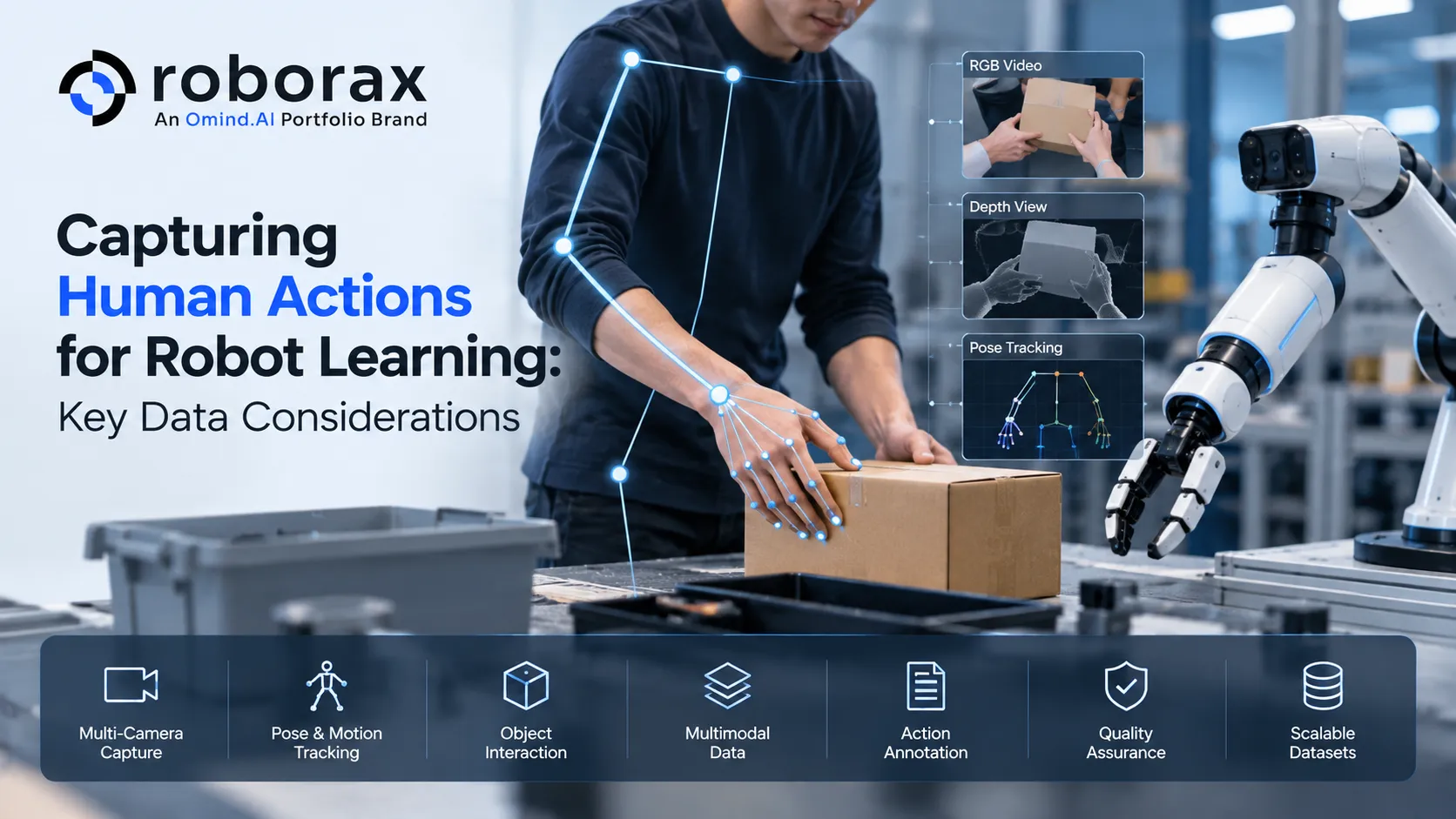

As robots move beyond controlled industrial environments into warehouses, homes, healthcare facilities, retail spaces, and other dynamic settings, they need more than visual recognition. They must understand how actions unfold, how objects respond to movement, and how to recover when conditions change. This is where human demonstrations become an important source of robotic training data.
Human demonstrations provide examples of how people approach tasks such as grasping, picking, placing, sorting, assembling, folding, navigating, and interacting with objects. When captured correctly, this information can support imitation learning, behavior cloning, reinforcement learning, and vision-language-action (VLA) systems.
However, recording a person performing a task is only the beginning. The value of Human Demonstration Data for Robot Learning depends on how actions, observations, environments, and outcomes are captured and structured.
Why Human Action Data Matters for Robot Learning
Humans naturally combine perception, planning, motor control, and correction while completing physical tasks. A person picking up an object does not simply execute a predefined trajectory. They continuously adjust their hand position based on the object's location, orientation, grip, and surrounding obstacles.
Capturing these behaviors gives robotics teams access to information that may be difficult to generate through simulation alone. Real-world demonstrations can expose variations in object placement, lighting, clutter, movement, contact, and human interaction.
Research on offline robot learning has also shown that demonstration quality, dataset coverage, and variation between demonstrations can significantly influence policy performance.
1. Define the Actions You Need to Capture
Before collecting data, robotics teams should determine what constitutes an action for the target application.
Depending on the robot and task, this could include:
- Hand or arm trajectories
- End-effector position and orientation
- Gripper opening and closing
- Body or joint movement
- Object interactions
- Contact events
- Tool usage
- Task transitions
- Corrections and recovery movements
For example, a dataset designed for warehouse picking may prioritize reaching, grasping, lifting, transporting, and placing. A household robotics dataset may require more complex sequences involving two-handed manipulation and interactions with deformable objects.
Clearly defining the action space helps ensure that the resulting robotic training data is relevant to the intended policy.
2. Capture Synchronized Multimodal Signals
Human action cannot be fully represented by video alone. A useful demonstration dataset connects what the person saw with what they did and what happened afterward.
Depending on the project, data collection may include:
- RGB or RGB-D video
- Egocentric camera footage
- Multiple external camera views
- Hand and body keypoints
- Pose and motion trajectories
- Object positions
- Robot state information
- Force or torque measurements
- Gripper states
- Timestamps
- Task and outcome metadata
Synchronization is particularly important. If video frames and action signals are misaligned, the model may learn the wrong relationship between an observed state and the corresponding action. Human demonstration systems therefore need reliable timestamps and consistent sampling procedures.
3. Account for the Human-Robot Embodiment Gap
One of the most important considerations when collecting Human Demonstration Data for Robot Learning is that humans and robots do not have identical physical capabilities.
A person may use five fingers, rotate their wrist freely, shift their body position, or use subtle contact forces that a robot cannot reproduce. Directly transferring such movements to a robot can therefore create an embodiment mismatch.
This does not make human demonstrations ineffective. Instead, the collection strategy should account for how human actions will eventually be mapped into the robot's action space.
For example, human hand trajectories may need to be converted into robot end-effector trajectories, while body movements may need to be translated into feasible navigation or manipulation commands.
The closer the capture methodology is to the robot's eventual control representation, the less information may be lost during retargeting.
4. Collect Diverse Demonstrations
A large dataset is not necessarily a useful dataset. Repeating the same action with the same object, environment, and starting position can encourage a model to memorize a narrow solution.
Effective datasets should introduce meaningful variation across:
- Object shapes and sizes
- Object orientations
- Starting positions
- Backgrounds
- Lighting conditions
- Workspace layouts
- Task sequences
- Human demonstrators
- Interaction speeds
- Successful and recovery scenarios
For example, 1,000 demonstrations of picking up the same box from the same location may provide less generalization than a smaller dataset covering many box types, positions, orientations, and workspace configurations.
Dataset coverage matters because a robot may encounter states during deployment that were not represented during training.
5. Include Corrections and Recovery Behaviors
Perfect demonstrations are useful, but they do not tell the complete story.
In real environments, humans make small mistakes. Objects slip, grasps fail, obstacles appear, and movements need to be corrected. These recovery behaviors can provide valuable information about how a task should continue after the robot deviates from an expected trajectory.
Instead of automatically discarding every imperfect demonstration, teams should determine whether the correction itself contains useful training information.
For example, a human attempting to pick up a cup may initially miss the handle, reposition their hand, and successfully grasp it. Capturing this sequence can teach a model how to respond to an off-nominal state.
The key is to label these episodes appropriately so successful execution, failure, correction, and recovery can be distinguished during training and evaluation.
6. Maintain Consistent Annotation and Metadata
Raw demonstrations should be accompanied by structured metadata that describes the context of each episode.
Useful fields can include:
- Task ID
- Demonstrator ID
- Environment
- Object category
- Recording setup
- Start and end timestamps
- Action sequence
- Task stage
- Success or failure status
- Failure type
- Recovery event
- Sensor configuration
- Quality-control status
Consistent metadata makes it easier to filter datasets, identify gaps, compare experiments, and create task-specific training subsets.
It also supports better dataset governance as the collection grows.
7. Build Quality Assurance Into Collection
Quality control should happen during data collection rather than only after thousands of demonstrations have been recorded.
Automated and human QA can check for:
- Missing frames
- Sensor synchronization errors
- Occlusions
- Tracking failures
- Excessive motion blur
- Incomplete demonstrations
- Incorrect task execution
- Hardware or recording errors
- Invalid action trajectories
Human reviewers can also assess whether the demonstration actually represents the intended task strategy.
This is especially important when data is collected from multiple operators. Human demonstrators naturally introduce behavioral differences, and inconsistent demonstrations can make learning more difficult.
8. Design Data Around the Robot's Evaluation Goals
The ultimate purpose of Human Demonstration Data for Robot Learning is not simply to create a large archive of human actions. It is to improve robot performance.
Therefore, collection should be connected to measurable evaluation criteria such as:
- Task success rate
- Completion time
- Grasp accuracy
- Collision rate
- Recovery success
- Generalization to new objects
- Performance in unseen environments
Training loss alone may not accurately represent real-world robot performance. Studies of offline robot learning have found that model selection and policy performance can differ substantially from conventional validation metrics.
Building Better Robotic Training Data With Roborax
High-quality human action capture requires more than cameras and recording software. It requires a carefully designed data pipeline that connects human behavior, environmental context, action sequences, metadata, and quality assurance.
For robotics companies developing manipulation systems, humanoid robots, warehouse automation, autonomous machines, and embodied AI applications, diverse and well-structured robotic training data can provide the foundation for more capable learning systems.
At Roborax, human demonstration data programs can be structured around the target robot, task requirements, sensor configuration, action representation, and evaluation objectives. The goal is to transform real-world human behavior into consistent, scalable, training-ready datasets that help robotics teams move from demonstrations to reliable robot learning.

















Sign in to leave a comment.