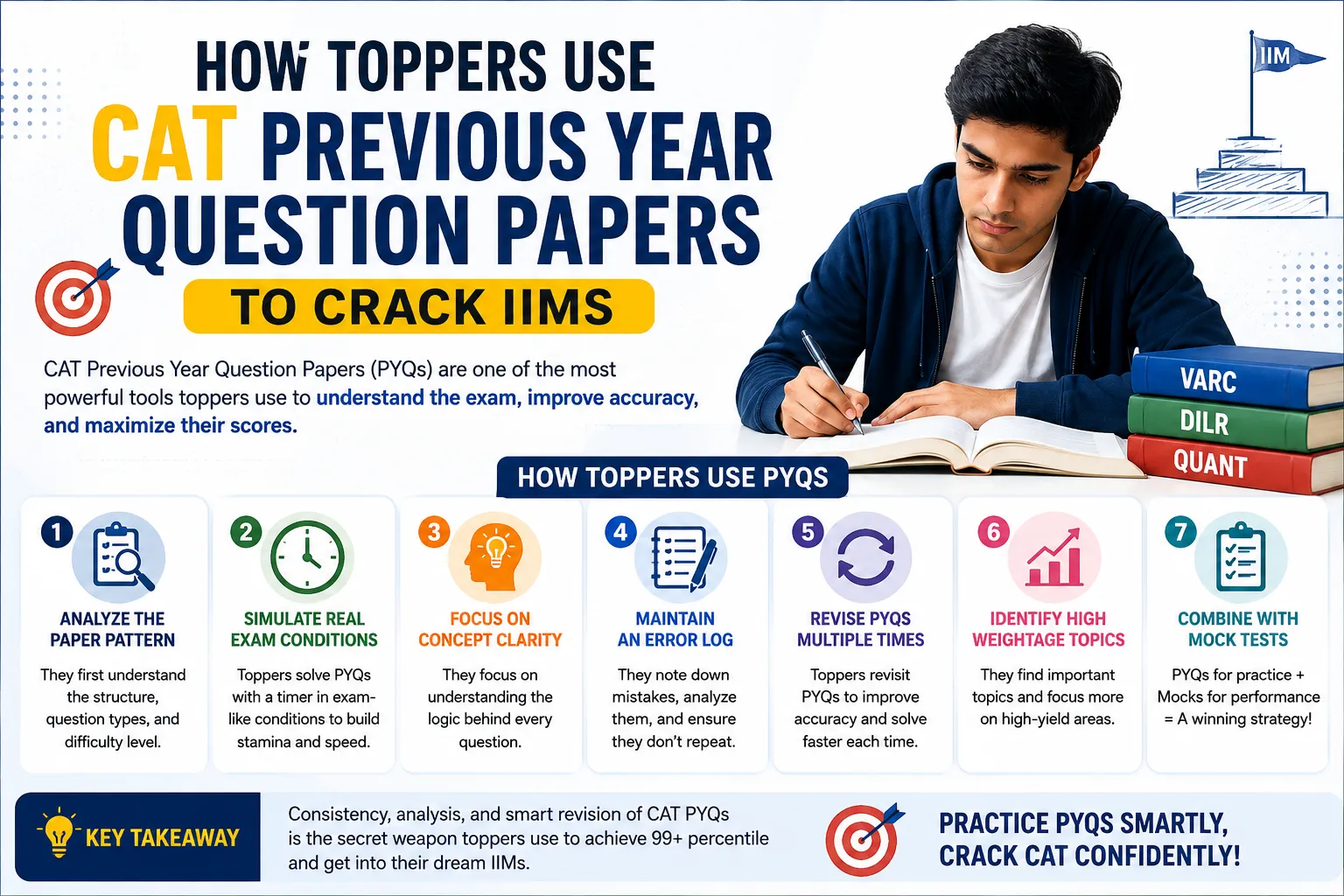

Preparing for the Common Admission Test (CAT) is not just about completing the syllabus. To perform well, aspirants need to understand how questions are framed, practise different difficulty levels, improve time management, and develop an effective question-selection strategy. This is where CAT Previous Year Question Papers become extremely valuable.
CAT PYQs give you an opportunity to practise questions from earlier examinations and understand how concepts have been tested over the years. When combined with concept revision, sectional practice, and mock tests, previous year papers can make your preparation more focused and structured.
For CAT 2026 aspirants, solving PYQs should be an important part of the preparation journey.
What Are CAT Previous Year Question Papers?
CAT Previous Year Question Papers (PYQs) are questions from previous CAT examinations and reliable previous-year question sets.
CAT preparation broadly covers three sections:
- Verbal Ability & Reading Comprehension (VARC)
- Data Interpretation & Logical Reasoning (DILR)
- Quantitative Ability (QA)
The exact CAT 2026 pattern, number of questions, duration, and marking scheme should always be checked against the official CAT notification when released.
Why Are CAT Previous Year Papers Important?
1. Understand the Nature of CAT Questions
Reading the CAT syllabus tells you what topics you need to study, but PYQs show you how those topics are actually tested.
By solving previous year questions, you can understand:
- Question formats
- Difficulty variations
- Concept application
- Logical reasoning requirements
- Reading comprehension styles
- Calculation requirements
- Question-selection challenges
This makes your preparation more practical.
2. Identify Your Strengths and Weaknesses
CAT PYQs can act as a diagnostic tool.
After solving questions from different topics, you can identify areas where you perform well and topics that require additional preparation.
For example:
QA
- Arithmetic – Strong
- Algebra – Moderate
- Geometry – Needs improvement
VARC
- Reading Comprehension – Strong
- Para-based questions – Moderate
DILR
- Tables – Strong
- Complex arrangements – Needs practice
This information helps you allocate your study time more effectively.
3. Improve Your Problem-Solving Skills
CAT questions often require candidates to think beyond basic formulas and definitions.
While solving PYQs, don't simply search for the correct answer. Try to understand the most efficient method.
Ask yourself:
- Is there a shortcut?
- Can I eliminate options?
- Can I estimate the answer?
- Is there another approach?
- How much time should I spend on this question?
Developing this mindset can improve your problem-solving efficiency.
4. Develop Better Time Management
Time management is an important part of CAT preparation.
Initially, solve PYQs without worrying too much about speed. Once your concepts become stronger, start using a timer.
A useful progression is:
Understand → Practise → Time Yourself → Analyse → Improve
Timed PYQ practice helps you understand which questions consume too much time and which ones can be solved quickly.
5. Learn Question Selection
CAT preparation isn't about attempting every question.
You need to make decisions about:
- Which question to attempt?
- Which question to skip?
- Which question can be solved quickly?
- Which question may consume too much time?
- When should you move to another question?
Previous year questions provide valuable practice for developing this judgment.
CAT PYQs for VARC Preparation
The VARC section requires strong reading and comprehension skills.
While solving previous year questions, focus on:
Reading Comprehension
- Main idea
- Author's viewpoint
- Inference
- Tone
- Supporting arguments
- Elimination of incorrect options
Verbal Ability
Practise relevant question types and focus on understanding the logic behind the correct answer.
Don't just check whether your answer is correct. Understand why the correct option is supported and why the other options are not.
Also check: CAT mock test Exam

























Sign in to leave a comment.