
Making Sense of Birth Certificate Translation for Your UK Application
Life has a funny way of throwing paperwork at you just when you’re planning your biggest adventures. Whether you’re finally applying for that UK visa, getting ready to marry the love of your life abroad, or sorting out a passport application for your little one, you’ve probably hit a wall called "official documentation." You have your original birth certificate, but if it’s not in English or Welsh, it’s basically a decorative piece of paper to the British authorities. They need to know exactly what it says, and more importantly, they need to know they can trust the person who translated it.
Navigating the world of government requirements is enough to give anyone a headache. You’ve likely seen terms like "certified," "notarised," or "apostilled" being thrown around, and honestly, it’s hard to know which one applies to you. This is why most people in this situation reach out to a professional birth certificate translation service UK to make sure they don’t get a rejection letter three months down the line. It isn't just about knowing two languages; it’s about providing a document that the Home Office or the Passport Office will actually accept without a second glance. When the stakes are this high, you really don't want to leave things to chance or use a basic online translator.
The Problem with "Good Enough"
I’ve spoken to so many people who thought they could save a few pounds by doing it themselves. They’re fluent in both languages, so they figured, "Why not?" Well, the UK authorities are quite picky. They don’t just want to know what the document says; they want a "Certificate of Accuracy." This is a signed statement from a professional translator or agency that confirms the work is a true and accurate reflection of the original. Without this specific bit of paper, your translation carries zero legal weight.
It’s incredibly frustrating to wait weeks for an appointment only to be told in the first five minutes that your paperwork is invalid. I’ve seen people lose their application fees and their minds over a missing signature or a translator who didn't include their credentials. The system isn't trying to be mean; it’s just designed to prevent fraud. They need a trail of accountability, and a professional service provides exactly that.
Certified vs. Notarised: What’s the Big Deal?
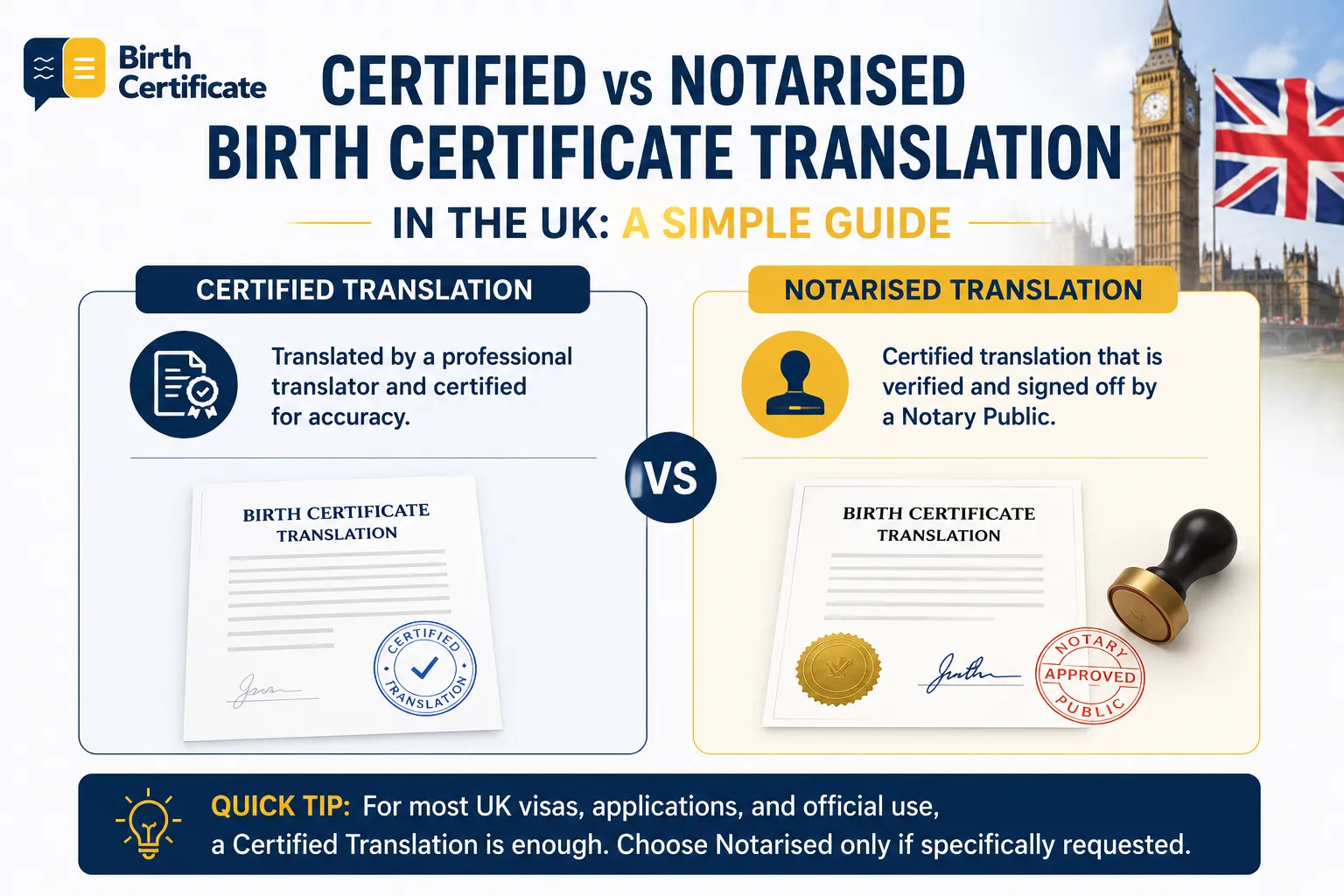
This is where most people get tripped up. For about 90% of UK-based applications—like standard visas or residency—a standard "certified" translation is all you need. This is a translation accompanied by a letter from the translator stating their qualifications and confirming the accuracy. It’s straightforward, relatively fast, and does the trick for the Home Office.
However, sometimes a caseworker or a foreign embassy will ask for something a bit more heavy-duty. This is usually where you might need a notarised birth certificate translation UK for your application. Notarisation adds an extra layer of "officialness." A Notary Public (a specialized lawyer) watches the translator sign the certificate of accuracy and then adds their own official seal. This doesn't necessarily mean the translation is "better," but it proves that the person signing it is definitely who they say they are. It’s often required for court proceedings, some high-level civil service jobs, or if you’re using the document in a country that is very traditional about its legal processes.
Why Human Touch Beats a Machine Every Time
We live in an age where you can point your phone at a menu in a foreign country and get a translation instantly. It’s amazing for ordering dinner, but it’s a disaster for a birth certificate. Official documents are full of "legalese," old-fashioned stamps, and sometimes even messy handwriting from a registrar forty years ago. A computer can't "read" the context of a faded stamp in the corner of a page, but a human can.
A professional translator doesn't just swap words. They look at the layout, they decipher the handwritten notes, and they ensure that names are spelled correctly so they match your passport. If your passport says "Mohammad" but your translated certificate says "Muhammed," the Home Office might think you’re two different people. A human catches these little details that a machine misses. That attention to detail is what gives you peace of mind when you finally hit that "submit" button on your application.
Understanding the Emotional Weight
I know we’re talking about dry legal documents, but your birth certificate is actually quite an emotional thing. It’s the record of your beginning. It has your parents' names, the place where you first entered the world, and the official marks of your home country. Seeing it translated into English is a big step in your journey to a new life in the UK.
When you choose a translation partner, you want someone who treats your story with respect. You aren't just a file number; you’re someone trying to build a future. Having a responsive person you can talk to—someone who explains the process and answers your "silly" questions—makes the whole experience feel a lot less like a cold, bureaucratic hurdle and more like a helpful hand along the way.
Common Pitfalls to Watch Out For
One of the biggest mistakes I see is people leaving the translation to the very last minute. While most services offer a 24 or 48-hour turnaround, you don't want to be sweating over an email at midnight before your interview. Another issue is providing a blurry photo of the document. If the translator can't see the text clearly, they can't certify it. Always try to provide a high-quality scan.
Also, be careful with the "sworn translator" trap. In many European countries, you have to use a "sworn" translator who is registered with a local court. The UK doesn't have a "sworn" system in the same way. Here, we use "certified" translations. If you spend a fortune on a sworn translator in another country, you might find that the UK Home Office still asks for a UK-based certification. It’s always best to use a service that understands the specific rules of the country where you’re actually submitting the papers.
The Final Step: The Apostille
Just when you think you’re done, someone might mention an "Apostille." This is a government sticker that proves the original birth certificate is genuine. In most cases, you should get the Apostille on the original document before you get it translated. That way, the translator can include the text of the Apostille in the English version. It’s like the final seal of approval on your paperwork, and it makes your document globally recognized.
Conclusion: Trusting the Process
At the end of the day, getting your birth certificate translated shouldn't be the thing that keeps you awake at night. Yes, the rules are specific, and yes, the authorities are picky, but thousands of people successfully navigate this every single month. By choosing a certified human professional, you’re taking a huge weight off your shoulders.
You’re investing in your own peace of mind. When you hand over that folder of neatly translated, certified, and perhaps notarised documents, you can do it with total confidence. You’ve done your homework, followed the rules, and respected the process. Now, you can get back to the exciting stuff—planning your move, starting your job, or finally celebrating that big family milestone. You’ve got this, and before you know it, the paperwork will be a distant memory. Good luck with your application!
























Sign in to leave a comment.