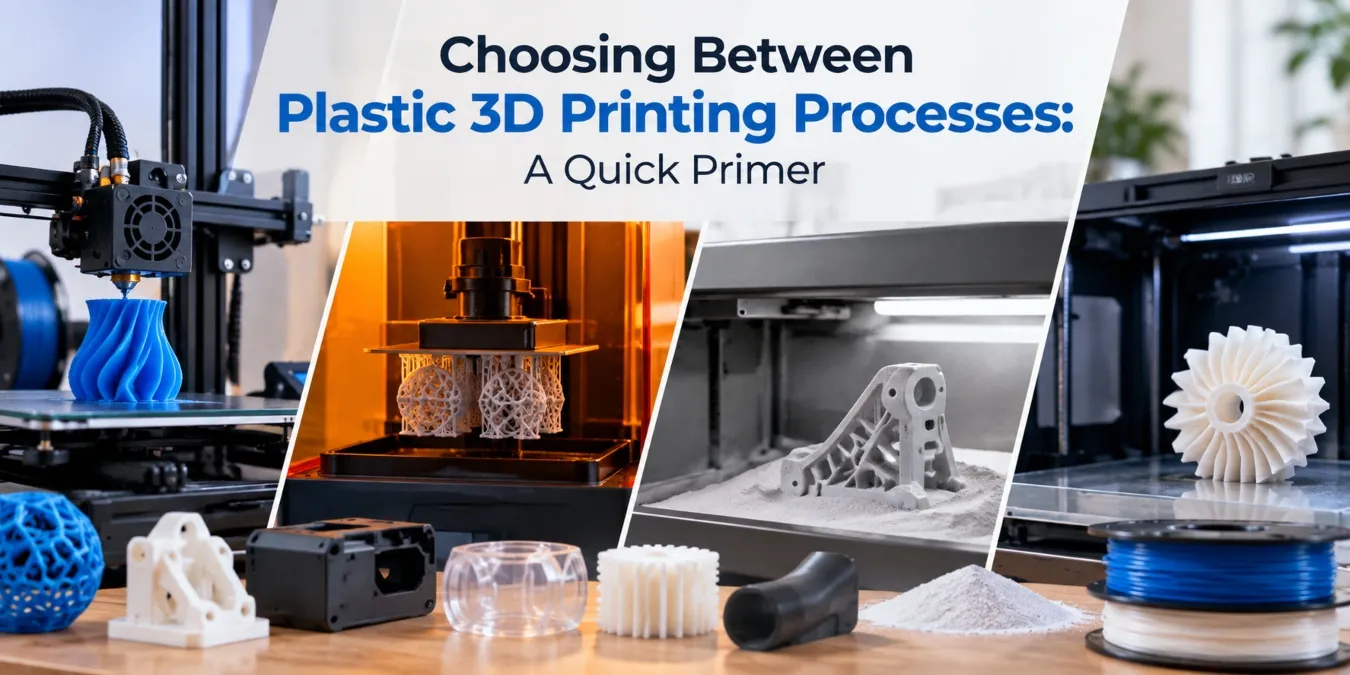

Choosing a plastic 3D printing process comes down to three questions: what the part has to do, how it needs to look, and how soon you need it. FDM suits fast, durable functional parts. SLA gives the smoothest finish and finest detail. SLS and MJF produce tough nylon parts with complex geometry, and PolyJet handles multi-colour and multi-material models.
This primer compares the five side by side, using the published capabilities of Quantix 3D Printing, an Australian industrial additive manufacturing service, rather than overseas averages.
Key takeaways
- FDM: the fastest option, with dispatch within 24 hours and single parts up to 914 × 609 × 914mm.
- SLA: the smoothest surface, detail down to 0.2mm and single parts up to 1700 × 800 × 800mm.
- SLS: tough nylon parts printed without support structures.
- MJF: consistent properties from part to part, suited to production runs.
- PolyJet: multiple colours and materials in a single build.
How Additive Manufacturing Builds a Plastic Part
Plastic 3D printing builds a part layer by layer from a CAD file, using a thermoplastic, a liquid resin or a polymer powder in place of a mould or a cutting tool. The five common processes fall into four families, and the family explains most of the trade-offs:
- Material extrusion (FDM): a heated nozzle lays down melted thermoplastic filament. Parts are strongest along the printed layers.
- Vat photopolymerisation (SLA): a UV laser cures liquid resin, producing a near-moulded surface.
- Powder bed fusion (SLS and MJF): heat fuses nylon powder, and the loose powder supports the part as it builds.
- Material jetting (PolyJet): print heads jet photopolymer droplets that UV light cures, allowing several materials in one part.

The Five Processes at a Glance
| Process | Best known for | Finest detail | Largest single part | Typical dispatch |
| FDM | Durable functional parts, jigs, fixtures | 1.0mm | 914 × 609 × 914mm | Within 24 hours |
| SLA | Smooth finish, fine detail, large one-piece models | 0.2mm | 1700 × 800 × 800mm | 5 to 6 working days |
| SLS | Tough nylon parts, complex geometry, no supports | 0.3mm | 675 × 545 × 366mm | 5 to 6 working days |
| MJF | Repeatable nylon parts for production runs | 0.1 to 0.2mm | 380 × 284 × 380mm | 5 to 6 working days |
| PolyJet | Multi-colour and multi-material models | 0.2 to 0.7mm | 490 × 390 × 200mm | 5 to 6 working days |
Tolerance is ±0.1mm per 100mm for SLA, SLS, MJF and PolyJet, and ±0.15mm per 100mm for FDM. Actual accuracy on plastic 3D printed parts depends on geometry, orientation and material, so treat these as starting points rather than guarantees.
Four Questions That Narrow the Choice
1. Does the part carry load?
If it holds a fastener, flexes or takes knocks, start with SLS or MJF nylon, which behave consistently in every direction. Engineering FDM materials such as polycarbonate, carbon-fibre-filled Nylon 12 and ULTEM also suit structural work when the load runs along the layers. For outdoor parts, FDM in ASA resists the UV yellowing standard ABS suffers in strong Australian sun.
2. Will anyone look closely at it?
For a presentation model or master pattern, SLA gives the smoothest surface and needs the least sanding before painting, while PolyJet adds colour and soft-touch areas. SLS and MJF give a uniform matte finish, and FDM shows layer lines that are fine on a shop-floor fixture.
3. How big is it?
Size often decides for you. SLA produces single pieces up to 1700mm long, avoiding glued seams on large covers. FDM reaches 914mm, while the powder processes have smaller build volumes but nest many parts per build.
4. How many do you need, and how soon?
FDM is the quickest route from file to part, ideal for design iteration. For batches of identical parts, MJF holds tight consistency, and SLS nesting spreads build cost across every part in the chamber.
Where Industrial Plastic 3D Printing Fits
Beyond prototypes, printed polymers do real work on factory floors and in the field: assembly-line jigs and fixtures, replacement parts for unsupported legacy equipment, snap-fit enclosures, short runs before tooling is justified, and flame-retardant ULTEM 9085 components. Manufacturing, automotive, mining and robotics teams use industrial plastic 3D printing wherever waiting weeks for a machined or moulded part would hold up a project.
Common Mistakes When Picking a Process
- Choosing by machine, not by part: a provider with only one process will tend to recommend it. Ask for a comparison.
- Forgetting escape holes: hollow SLA parts can trap resin, and hollow SLS parts can trap powder.
- Designing zero-clearance fits: mating parts printed with no gap often won't assemble.
- Using one process for every stage: many teams check fit in FDM, appearance in SLA, then prove function in SLS or MJF.
Frequently Asked Questions
Q1. Which plastic 3D printing process is strongest?
Ans - For most functional parts, SLS and MJF nylon are the strongest all-rounders because their strength is consistent in every direction. Engineering FDM materials can match them when load runs along the layers.
Q2. Which process gives the best surface finish?
Ans - SLA produces the smoothest as-built surface and holds detail down to 0.2mm. PolyJet is the choice when the part also needs colour or multiple materials.
Q3. What is the fastest plastic 3D printing process?
Ans - FDM. Standard FDM jobs can be dispatched within 24 hours, while the other processes typically take 5 to 6 working days.
Q4. Can plastic 3D printed parts be used as end-use parts?
Ans - Yes. Nylon parts from SLS and MJF, and FDM parts in engineering materials, are regularly used as jigs, fixtures, housings and production components.
Q5. What should I look for in a 3D printing service in Australia?
Ans - Look for a provider that runs several processes, publishes real specifications, reviews your file before printing, keeps designs confidential and ships Australia-wide.
Getting the Choice Right
No single process wins on every count, so start with the part: what it must survive, how it must look, its size and quantity. Then share that brief with a provider that can compare processes honestly.
Quantix 3D Printing runs all five plastic processes, reviews every file before printing and ships nationally. For a recommendation on your next part, their plastic 3D printing service in Australia includes one with every free quote.
About Quantix 3D Printing
Quantix 3D Printing is an industrial 3D printing service in Australia, based in Chadstone, Victoria. It runs 7 additive manufacturing processes (FDM, SLA, SLS, MJF, PolyJet, SLM and DMLS) across 45+ engineering materials, with confidential handling and Australia-wide delivery.





















Sign in to leave a comment.