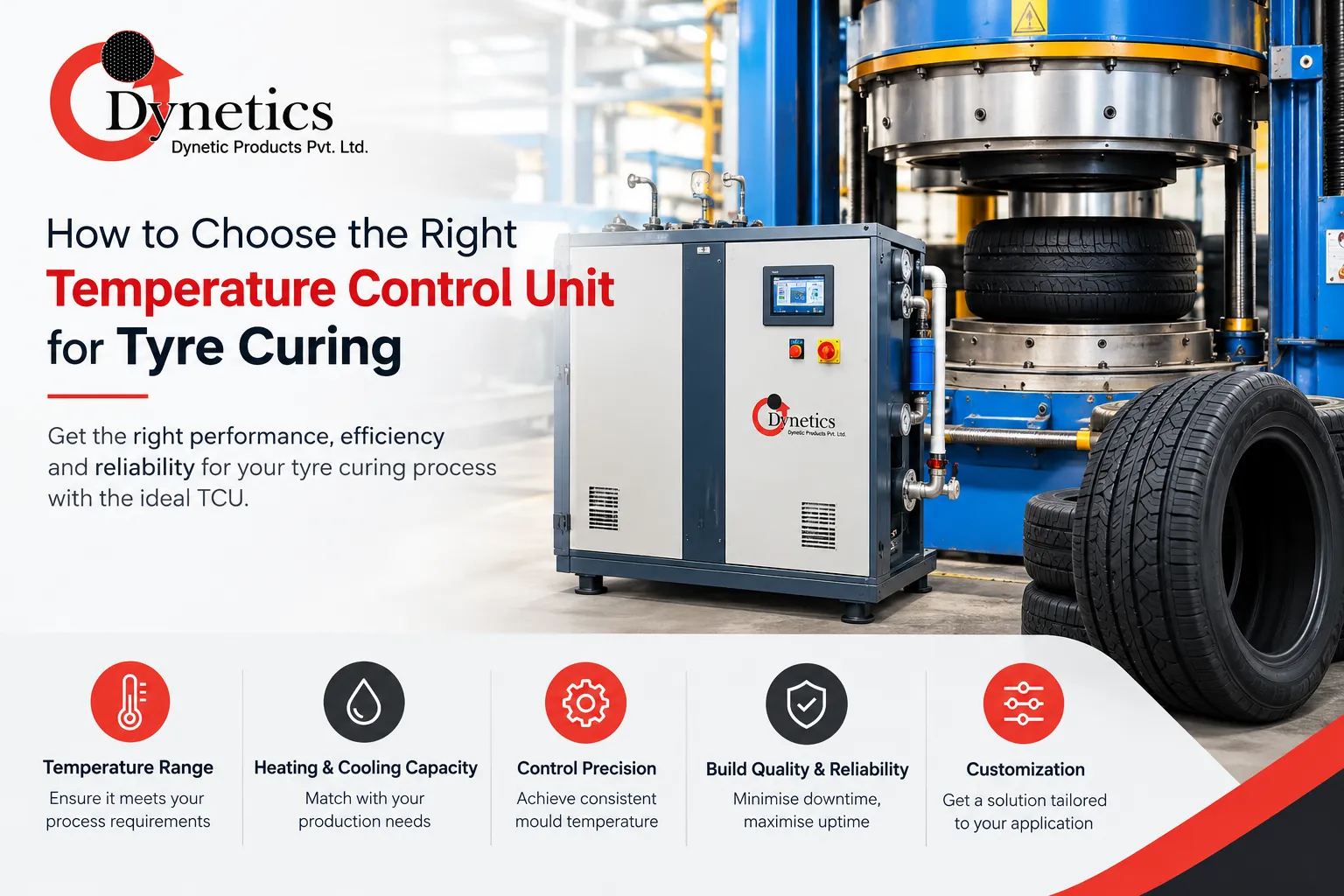

Why Temperature Control Matters in Tyre Curing
Curing is the stage where a tyre stops being a shaped rubber assembly and becomes a finished product with the mechanical properties it needs to perform on the road. It happens inside a heated mould under pressure, and the chemistry that takes place during those minutes — vulcanisation — is extremely sensitive to heat. A mould that runs a few degrees hotter or cooler than intended, or one whose temperature drifts across the cure cycle, can change tensile strength, adhesion between compound layers, and the tyre's long-term durability.
This is why the temperature control unit (TCU) feeding a curing press deserves the same engineering attention as the press itself. A well-selected TCU keeps mould temperature within a tight band, cycle after cycle, shift after shift. A poorly matched one becomes a hidden source of scrap, rework, and unplanned downtime. Choosing a temperature control unit for tyre curing is therefore not a purely mechanical purchasing decision — it is a process decision that affects quality, throughput, and energy cost for years after installation.
This article walks through what a TCU does, how it influences the curing process, and the practical factors a plant engineer or production manager should weigh before selecting one.
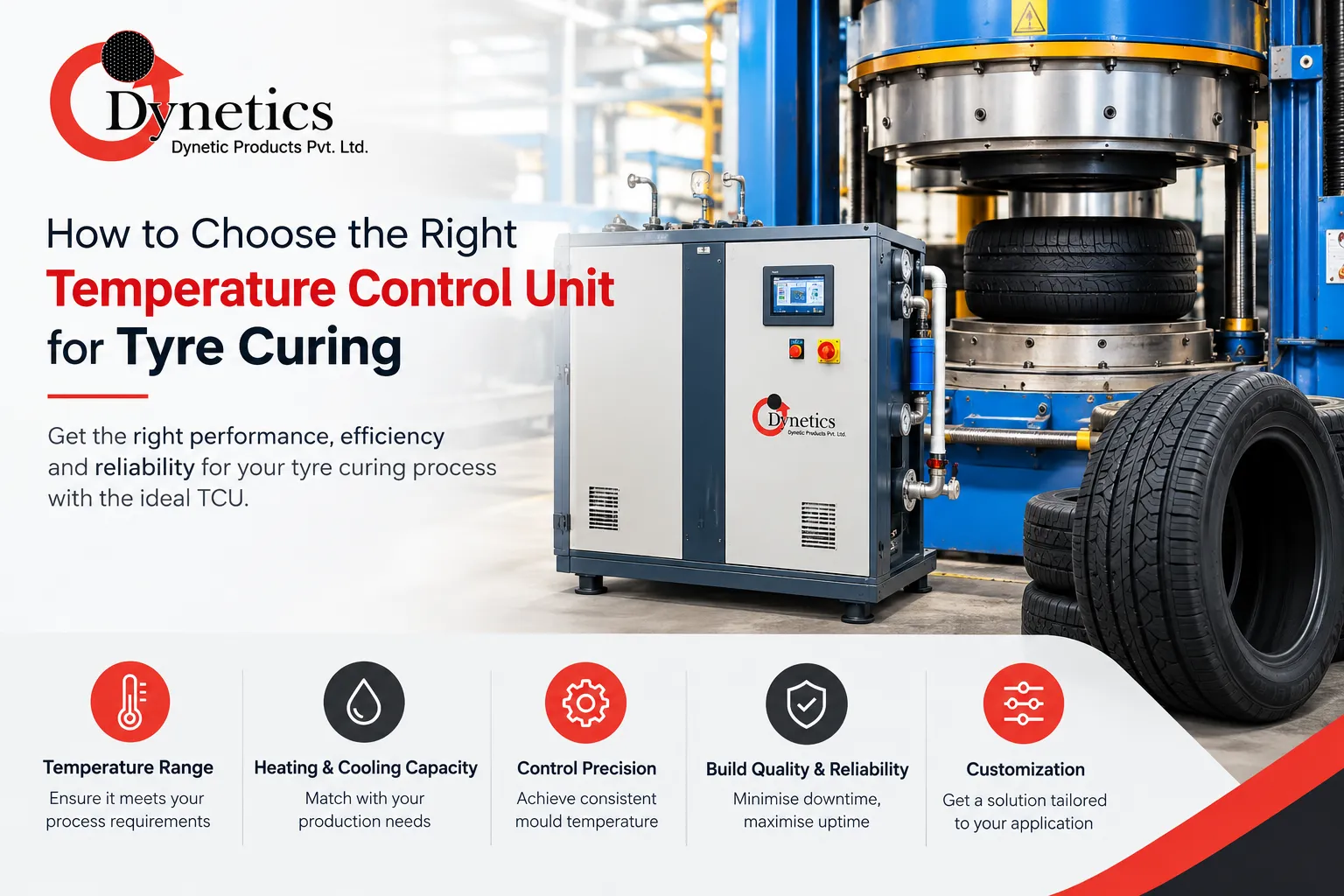
What Is a Temperature Control Unit (TCU)?
A temperature control unit is a closed-loop system that circulates a heat-transfer medium — usually water, pressurised hot water, or thermal oil — through the mould or platen at a set temperature. Instead of applying heat or cooling directly to the mould with an open steam line or a raw water feed, the TCU regulates the fluid's temperature externally and pumps it through the mould's internal channels, holding the surface as close as possible to the target set point.
A typical TCU includes:
- A heating source (electric heaters, steam heat exchanger, or a combination)
- A cooling circuit, often connected to a plant chilled-water or cooling-tower loop
- A circulation pump sized for the required flow rate
- Temperature sensors and a controller (PID or PLC-based) that manages heating and cooling output
- Piping, valves, and instrumentation for pressure and flow monitoring
In tyre manufacturing, TCUs are used well beyond the curing press — they also support internal mixing, extrusion, and calendaring — but curing is usually the most temperature-critical of these stages, because it is where the compound's final mechanical properties are locked in.
How Temperature Control Affects the Tyre Curing Process
Vulcanisation is a time-and-temperature-dependent reaction. Sulphur or peroxide cross-links form between rubber polymer chains, and the rate at which this happens depends directly on how much heat reaches the compound and how evenly it is distributed through the tyre's cross-section.
The relationship engineers work with, in simple terms, is:
Mould temperature stability → uniform heat transfer through the compound → consistent cure state → predictable tyre properties → repeatable production quality.
A few practical consequences follow from this chain:
- Under-cure (mould running cold, or losing temperature mid-cycle) leaves cross-link density incomplete, reducing strength, abrasion resistance, and dimensional stability.
- Over-cure (mould running hot, or holding too long at temperature) can degrade the polymer network, reducing elasticity and fatigue resistance, particularly in thicker tyre sections.
- Uneven mould temperature across zones or across the tyre's circumference produces inconsistent cure between the tread, sidewall, and bead areas of the same tyre.
- Cycle-to-cycle drift, even within a supposedly tight tolerance, shows up statistically as variation in test results and occasional rejects that are hard to trace back to a single cause.
Because these effects are cumulative and often only show up in later testing, temperature control is one of the few curing variables where a small deviation can have a proportionally large downstream cost.
Key Factors to Consider When Selecting a TCU for Tyre Curing
Selecting the right unit means matching its engineering specification to your press, your compound, and your production schedule. Below are the parameters worth evaluating carefully.
Required Temperature Range
Tyre curing typically runs in the range of roughly 140°C to 180°C, depending on compound formulation, tyre construction, and whether the process uses steam, hot water, or thermal oil as the heating medium. Confirm the exact range your compounds and press design require, since this determines whether a water-based or oil-based system is appropriate, and what pressure rating the circuit needs to carry.
Heating Capacity
The TCU's heater bank must be able to bring the mould up to temperature within your target heat-up time and then replace the heat lost to the compound, the mould mass, and ambient radiation during steady-state operation. Undersized heating capacity shows up as slow mould recovery between cycles and longer-than-necessary cure times.
Cooling Capacity
Cooling matters for two reasons: controlling overshoot during heat-up, and — in some press designs — actively cooling the mould at the end of the cure cycle to assist demoulding. Cooling capacity should be sized against your worst-case ambient conditions and the largest heat load the press will present.
Flow Rate
Flow rate determines how quickly heat is carried to and from the mould, and how even the temperature is across multiple heating/cooling channels. Too low a flow rate creates temperature gradients within the mould; oversizing the pump wastes energy and adds unnecessary pressure drop. Flow rate should be calculated against the mould's channel geometry, not just the press tonnage.
Pressure Requirements
Circuits running pressurised hot water above 100°C need a pump and piping system rated for the working pressure that keeps the fluid liquid at that temperature, with margin for transients. Check the TCU's design line pressure against your mould's channel rating and your plant's piping standards.
Heat-Transfer Medium
Whether the system uses water, pressurised hot water, or thermal oil affects the achievable temperature range, response speed, and maintenance profile. This is significant enough that it's covered separately below.
Temperature Accuracy and Stability
Ask for the controller's achievable accuracy at the mould, not just at the TCU outlet — the two can differ once you account for line losses and sensor placement. Stability under load (i.e., how much the temperature moves when the mould opens, closes, or draws a sudden heat load) is often more important than static accuracy specified on a data sheet.
Response Time
A fast-responding TCU recovers to set point quickly after each mould opening, which shortens the portion of the cycle spent waiting for thermal stability rather than curing. Response time depends on heater wattage, pump sizing, and control-loop tuning together — not any single component.
Pump and Circulation Requirements
Confirm pump duty (continuous, multi-shift operation), seal type suited to the fluid and temperature, and whether a standby pump is included to avoid a single point of failure on a line that may run three shifts a day.
Energy Efficiency
Insulation quality, heater staging (rather than simple on/off control), and controller tuning all affect running cost. Over a multi-year service life, energy consumption is often a larger cost factor than the unit's purchase price.
Control System and Automation
A PLC-based controller with PID temperature loops, data logging, and the ability to interface with the press or a central SCADA system gives you traceability — useful both for quality assurance and for diagnosing the root cause when a batch falls outside specification.
Safety Features
Look for high-limit thermostats, low-flow and dry-run protection for the pump, pressure relief provisions, and proper interlocks between the heating circuit and the circulation pump so heaters cannot energise without flow.
Maintenance Requirements
Evaluate how accessible the heater elements, filters, and pump are for routine service, and how much downtime a typical maintenance task requires. A unit that is difficult to service tends to get neglected, which eventually shows up as temperature instability.
Space and Installation Requirements
Skid-mounted and modular configurations have different footprints and different implications for how many press zones a single unit can serve. This is worth planning against your actual floor layout rather than fitting the layout to a standard unit.
Water-Based vs. Oil-Based Temperature Control Systems
Both fluid types are used in tyre curing, and the right choice depends on your temperature range, existing utilities, and safety requirements.
| Aspect | Water / Pressurised Hot Water | Thermal Oil |
|---|---|---|
| Typical temperature range | Effective up to roughly 180–200°C when pressurised | Can reach higher temperatures at lower system pressure |
| System pressure | Requires pressure-rated piping and pumps as temperature rises | Generally operates at lower pressure for a given temperature |
| Heat capacity | High specific heat, efficient heat transfer per unit flow | Lower specific heat than water, generally needs higher flow |
| Fire risk | Non-flammable | Requires attention to leak detection and fire safety, since oils are combustible |
| Maintenance | Scale and water quality management; corrosion control | Oil degradation over time requires periodic quality checks and eventual replacement |
| Common use case | Widely used across curing press circuits where pressurised hot water systems are already standard | Used where higher temperatures or specific mould designs favour oil circuits |
Many tyre plants standardise on pressurised hot water for curing because it aligns well with the temperature range most compounds require and integrates cleanly with steam-based utility infrastructure already present on the shop floor. Oil-based systems remain relevant for specific press designs or higher-temperature requirements. Either way, the heat-transfer medium should be selected as part of the overall system design, not treated as an afterthought once the TCU is already specified.
How to Match TCU Capacity to Your Tyre Curing Application
Sizing a TCU correctly starts with the press, not the catalogue. The information a manufacturer needs to size a unit properly includes:
- Number of curing press zones or stations to be served
- Mould mass and material, which determines thermal inertia
- Target heat-up time and cure cycle duration
- Ambient temperature range on the shop floor
- Required temperature uniformity across the mould
- Whether the unit needs to serve a single press or a multi-zone, centralised loop
Undersizing a TCU is the more common mistake, because it is tempting to select based on press tonnage alone rather than actual thermal load. Oversizing, on the other hand, adds capital cost and can make fine temperature control harder, since larger heating and cooling elements are more difficult to modulate precisely at low loads. The right answer is usually a unit sized against calculated heat-up and steady-state loads, with a reasonable safety margin rather than a large one.
Skid-mounted units, which centralise control across multiple press zones through unified headers, work well for large, closed-loop production lines. Modular units, sized and zoned around individual machines, offer more flexibility where press layouts vary or where lines are added incrementally over time.
Common Mistakes When Selecting a Temperature Control Unit
- Sizing on press tonnage instead of thermal load. Tonnage tells you about clamping force, not heat-up time or mould heat loss.
- Ignoring flow rate at the mould. A powerful heater is wasted if the flow rate through the mould channels can't move that heat where it's needed.
- Underestimating pressure requirements when specifying pressurised hot water above 100°C, leading to undersized pumps or piping that can't hold design pressure reliably.
- Choosing the heat-transfer medium based on habit rather than requirement. Water and oil each have a legitimate place; the decision should follow from temperature range and safety needs.
- Overlooking control system quality. A well-built heating and cooling circuit paired with a poorly tuned or basic controller will still produce inconsistent mould temperature.
- Treating the TCU as a standalone purchase rather than as part of the wider utility loop, including cooling water supply, steam availability, and electrical capacity.
- Skipping a proper site and process discussion with the manufacturer, and instead requesting a quote against a generic specification sheet.
TCU Features That Can Help Improve Process Consistency
A handful of design features tend to make a measurable difference to real-world consistency, beyond the headline temperature range:
- Multi-zone control for presses where different mould sections need slightly different set points.
- PLC-based automation with data logging, so temperature trends are recorded and can be reviewed when investigating a quality issue.
- Fast-acting control valves that respond to load changes — such as a mould opening — without significant overshoot.
- Standby pump configuration, so a pump fault doesn't translate directly into a stopped press.
- Proper insulation and heat-loss management, which supports both temperature stability and energy efficiency.
These features are especially relevant in continuous, multi-shift tyre production, where the cumulative effect of small inconsistencies across thousands of cycles is what ultimately shows up in batch quality data.
Maintenance and Reliability Considerations
A TCU's performance on day one is only part of the picture — reliability over years of multi-shift operation matters just as much. Practical considerations include:
- Water or oil quality management. Scale build-up in water circuits or degradation in oil circuits both reduce heat-transfer efficiency over time and can eventually affect temperature accuracy.
- Filter and strainer maintenance, particularly important for water systems where dissolved solids can affect pump seals and heater surfaces.
- Pump seal inspection, since seal wear under continuous multi-shift duty is one of the more common causes of unplanned stoppages.
- Calibration checks on temperature sensors and controllers, to catch drift before it affects cure quality.
- A structured maintenance schedule, whether handled in-house or through a supplier's annual maintenance contract, rather than a purely reactive approach.
Planning maintenance access into the original installation — space around the pump, accessible heater elements, isolation valves where they're needed — pays off every time the unit needs servicing rather than just at commissioning.
Questions to Ask a TCU Manufacturer Before Purchase
Before finalising a purchase, it helps to have clear answers to:
- What temperature range and accuracy can the unit reliably hold at the mould, not just at the TCU outlet?
- What flow rate and pressure will be delivered to each press zone, and has this been calculated against our mould design?
- What heating and cooling capacity is provided, and against what heat-load assumptions was it sized?
- Is the unit designed for water, pressurised hot water, or oil, and does that match our existing utility infrastructure?
- What control system is used, and does it support data logging or integration with our existing press controls?
- What safety interlocks are built in for dry-run, over-temperature, and pump failure conditions?
- What is the expected maintenance schedule, and how accessible are the wear components?
- What is the manufacturer's experience with tyre and rubber industry installations specifically, and can they reference comparable projects?
- What compliance standards (ISO, CE, IBR, or others relevant to your region) does the unit meet?
- What support is available for installation, commissioning, and after-sales service?
A manufacturer who can answer these with specifics — rather than generic marketing claims — is generally a safer long-term partner for a piece of equipment your production schedule will depend on daily.
How Dynetic Products Supports Temperature Control Applications in the Tyre & Rubber Industry
Dynetic Products has been engineering thermal systems for process industries for more than three decades, with dedicated experience in temperature control for tyre and rubber industry applications across mixing, extrusion, calendaring, and curing. The company designs both skid-mounted and modular temperature control units, including configurations built around oil-based circuits for tyre lines operating at elevated process zones, and offers modular systems zoned specifically for extruders and mills or for mixers and calenders.
For curing presses, Dynetic's engineered hot water systems, built around modular vertical direct-calorifier technology, are designed to replace less predictable direct-steam setups with stable, modulated heating for a single trench of curing presses, with standard tank capacities and pump ratings sized to match press-line demand. Alongside curing-side heating, Dynetic's process cooling systems support the mixing and utility cooling loads that run in parallel with curing operations.
All systems are engineered with ISO 9001:2015 quality management and CE and IBR compliance, and the company works through the full project lifecycle — design, manufacturing, installation, commissioning, and ongoing maintenance support — rather than supplying equipment in isolation. If you're evaluating a TCU for a curing line, reaching out to Dynetic's engineering team with your press specifications and production goals is a practical starting point for a properly sized recommendation.
Conclusion
Selecting a temperature control unit for tyre curing is ultimately about matching engineering specifics — temperature range, flow rate, heating and cooling capacity, control quality, and heat-transfer medium — to the real thermal load your presses present, rather than choosing off a generic spec sheet. Getting this right pays off in consistent cure quality, fewer rejects, and a production schedule you can plan around with confidence. Getting it wrong tends to show up gradually, as small quality variations that are difficult to trace back to their source.
Treat the TCU selection process as a conversation about your specific mould design, compound requirements, and production schedule, and ask the manufacturer detailed technical questions before committing. A properly specified and well-maintained TCU is one of the more reliable ways to keep curing consistency — and tyre quality — under control, cycle after cycle.
















Sign in to leave a comment.