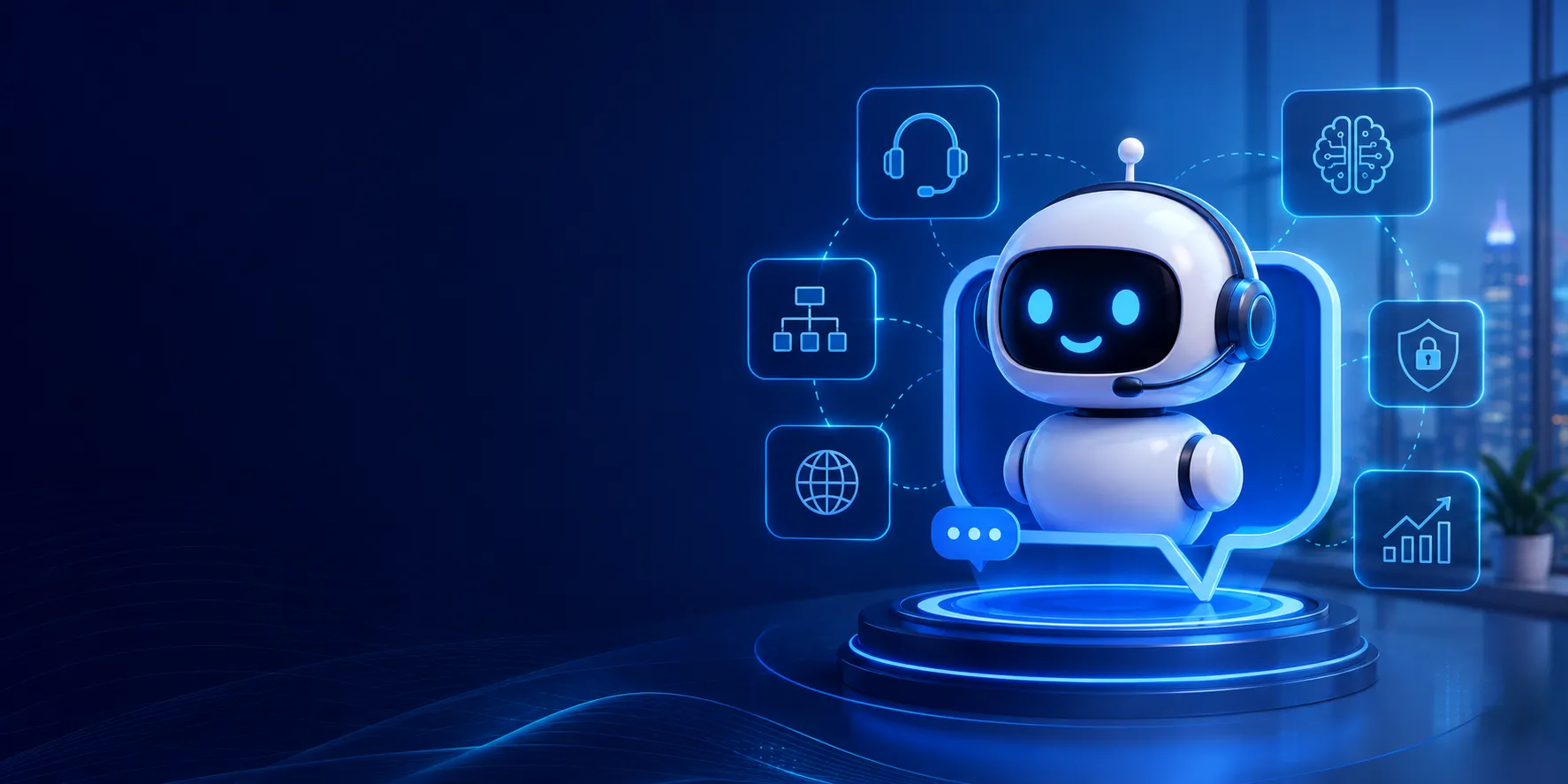

Every vendor in this space claims to have the best enterprise AI chatbot solution on the market. Scroll through any comparison page and you'll see the same promises repeated in slightly different fonts: "24/7 support," "seamless integration," "human-like conversations." After a while, it all starts to sound the same — which is exactly the problem. Picking the wrong solution doesn't just waste budget; it can actively frustrate the customers you were trying to serve better.
So instead of another feature checklist, let's talk about how to actually evaluate an enterprise chatbot solution the way a business leader should — by asking what problem it solves, not what buzzwords it uses.
Start With the Problem, Not the Product
The mistake a lot of companies make is shopping for a chatbot before defining what they need it to do. "We want AI" isn't a strategy. Some businesses need a solution that resolves support tickets. Others need one that qualifies sales leads before a rep ever gets involved. Others need an internal tool that helps employees find answers buried across a dozen different systems.
An enterprise ai chatbot solution built for customer support looks nothing like one built for internal knowledge management, even though both might run on similar underlying technology. Before comparing vendors, get specific about the outcome you're chasing — faster response times, lower support costs, better lead qualification, fewer repetitive employee questions to HR and IT.
The Three Types of Chatbot Solutions on the Market
Off-the-shelf platforms. These are the fastest to launch and the cheapest upfront. They work reasonably well for simple, high-volume, low-stakes questions. The tradeoff is flexibility — you're working within someone else's framework, and customization is often shallow.
Mid-tier configurable tools. These let you plug in your own data and workflows to a degree, offering more control than a pure off-the-shelf product. They're a reasonable middle ground for companies with moderate complexity but limited engineering resources.
Custom-built enterprise chatbot solutions. These are designed from the ground up around a specific business — its systems, its data, its compliance needs, and its customer base. They take longer to build and cost more upfront, but they tend to outperform generic tools significantly once deployed, because they're not fighting against a one-size-fits-all template.
Which category makes sense depends entirely on your scale and complexity. A five-person startup answering basic questions probably doesn't need a custom build. A company processing thousands of daily interactions across multiple departments almost certainly does.
Why Off-the-Shelf Tools Often Hit a Ceiling
Generic AI chatbot solutions are trained to handle broad, common scenarios well. Where they struggle is nuance — the specific product terminology your customers use, the internal exceptions to your official policy, the edge cases that make up a surprising share of real customer interactions. When a generic bot hits one of these, it either gives a wrong answer or loops the customer in frustrating circles.
This is the exact gap that custom development closes. A company like Xpiderz, a custom AI development company, approaches chatbot solutions differently — building around a business's actual data, workflows, and customer language instead of adapting a generic template after the fact. The chatbot ends up understanding not just language in general, but your language: your product names, your policies, your customer's typical phrasing.
Questions Worth Asking Before You Commit
Whether you're evaluating a vendor or scoping an internal build, a solid enterprise chatbot solution should be able to answer yes to most of these:
- Does it integrate directly with your CRM, helpdesk, or internal databases, rather than operating as a disconnected add-on?
- Can it be retrained or fine-tuned as your business changes, or does it require a full rebuild?
- Does it hand off to a human cleanly, with full context, when a conversation exceeds its scope?
- Is there clarity on data ownership, security, and compliance — especially if you operate in a regulated industry?
- Will it scale if your conversation volume triples next year?
If a vendor can't answer these clearly, that's worth noting before you sign anything.
Measuring Whether It's Actually Working
A chatbot solution is only as good as the outcomes it produces. Track resolution rate — how many conversations the bot closes without human intervention. Track customer satisfaction on bot-handled interactions specifically, not just overall. Track how often it escalates unnecessarily, which usually signals gaps in its training data or scope.
The numbers will tell you quickly whether the solution you picked matches the problem you were trying to solve.
The Bottom Line
There's no universal best enterprise ai chatbot solution — only the one that fits your business's actual complexity, data, and goals. Off-the-shelf tools work for simple, predictable needs. Custom-built solutions earn their higher cost when the stakes, scale, or complexity are high enough to demand it. The companies that get the most value aren't necessarily the ones who moved fastest — they're the ones who matched the solution to the actual problem in front of them.























Sign in to leave a comment.