
Introduction
Industrial automation is no longer limited to large, highly complex production lines. Manufacturers of different sizes are adopting robotics to automate repetitive handling, assembly, inspection, packaging, sorting, and positioning tasks.
However, choosing a robot is not simply a matter of selecting the model with the highest payload or fastest movement.
The robot architecture has a major influence on how effectively an automation system can perform a particular task. A gantry robot, SCARA robot, articulated robot, or surface gantry can each provide very different movement characteristics, installation requirements, and operating advantages.
igus® develops low-cost automation and motion solutions covering several robotic architectures, including linear robots, SCARA robots, articulated arm robots, delta robots, and modular automation systems.
The right choice depends on the application—not simply on the robot category.
Understanding Different Robot Architectures
Industrial robots are designed around different movement geometries.
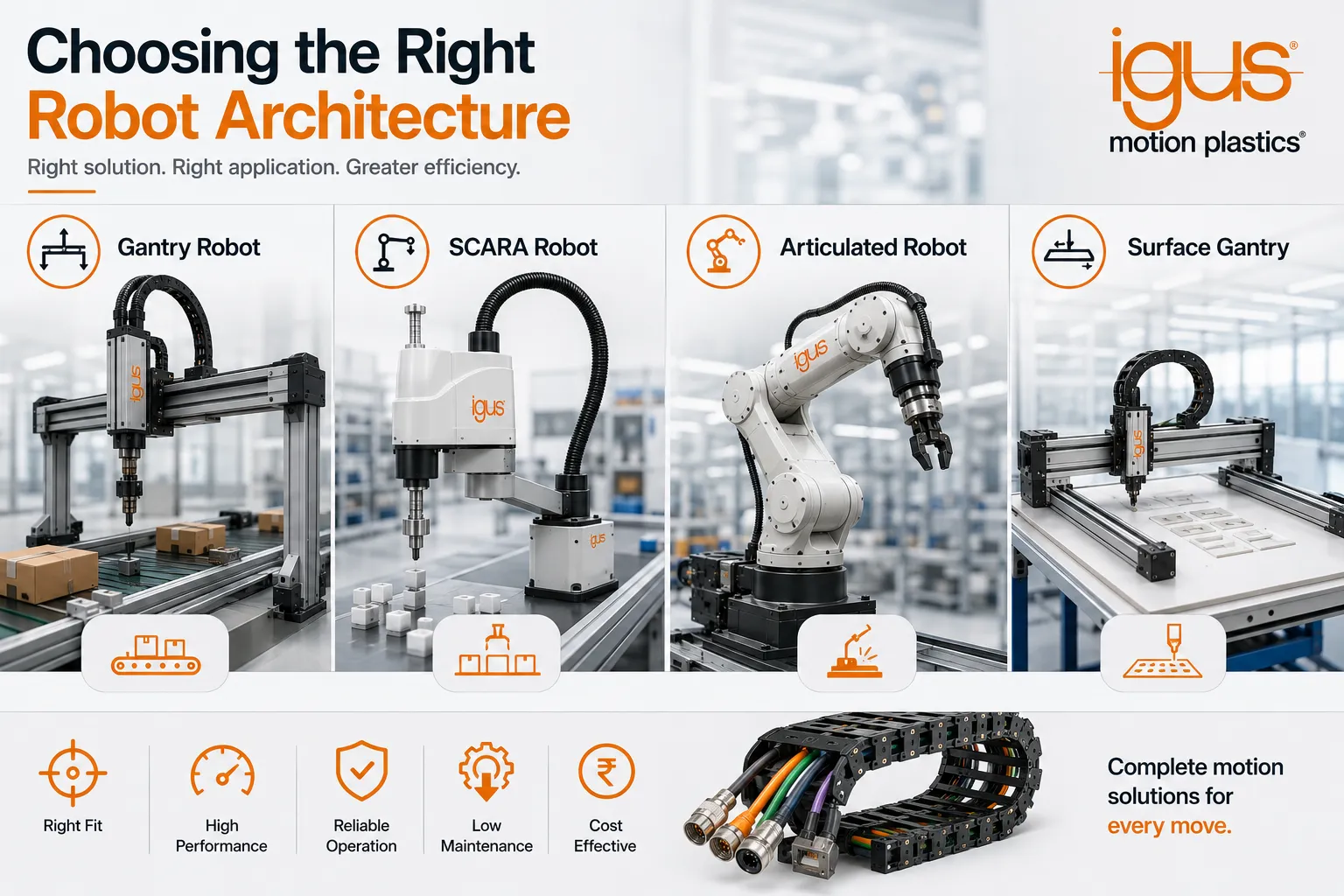
A gantry robot generally moves along linear axes. A SCARA robot uses articulated joints to provide fast horizontal movement with a comparatively compact footprint. An articulated robot uses multiple rotary joints and can provide a greater range of movement. A surface gantry provides movement over a defined planar workspace.
Each architecture has strengths and limitations.
Understanding those differences before selecting equipment can help manufacturers avoid overengineering a system or choosing a robot that is poorly suited to the required task.
Gantry Robots for Structured Linear Movement
A gantry robot is built around linear axes and typically moves a tool or gripper across a defined workspace.
This architecture can be particularly effective when the application requires predictable X, Y, and Z movement.
Typical applications include:
- Pick-and-place operations
- Conveyor handling
- Sorting
- Packaging
- Palletising
- Inspection
- Automated dispensing
- Laboratory automation
One of the advantages of a gantry system is its relatively straightforward movement geometry. Engineers can define the required working area by selecting appropriate axis lengths.
igus® offers line, surface, and room gantry configurations. Its product information describes room gantries as suitable for pick-and-place, conveyor picking, and stacking applications in three-dimensional space.
For applications involving large rectangular workspaces, a gantry can therefore be an efficient alternative to a conventional articulated robot.
Surface Gantry Applications
A surface gantry is designed for movement across a defined two-dimensional workspace.
This makes it useful for applications where the robot needs to move across a flat area rather than reach around obstacles from multiple angles.
Potential applications include:
- Sorting products
- Loading and unloading
- Conveyor handling
- Pick-and-place
- Inspection
- Positioning
- Dispensing
igus® offers flat gantry robots based on preconfigured drylin® linear modules and linear axes.
Its current flat linear robot product information lists configurations with a working area of 300 × 300 mm, a payload of up to 8 kg, speeds of up to 0.5 m/s, and repeatability of ±0.5 mm. (igus.in)
The appropriate specifications naturally depend on the selected configuration and application.
SCARA Robots for Fast Pick-and-Place
A SCARA robot is designed differently from a gantry.
SCARA stands for Selective Compliance Assembly Robot Arm, and the architecture is particularly suited to fast horizontal movement and repetitive pick-and-place operations.
igus® currently offers 3- and 4-axis SCARA robots. Its India product information states that the SCARA range can provide up to 2 kg payload, up to 560 × 500 mm reach, four degrees of freedom, speeds of up to 25 picks per minute, and repeatability of ±0.5 mm, depending on the configuration. (igus.in)
Typical applications include:
- Pick-and-place
- Conveyor loading
- Laboratory automation
- Small-part handling
- Assembly
- Sorting
SCARA robots can be attractive where speed and repeatability are more important than the ability to navigate a complex three-dimensional workspace.
Articulated Robots for More Complex Movement
An articulated robot uses multiple rotary joints to create a movement pattern similar to a human arm.
This architecture can provide significantly more flexibility than a simple linear system.
Articulated robots can be used for applications such as:
- Assembly
- Machine tending
- Material handling
- Welding
- Inspection
- Packaging
- Screwdriving
- Surface treatment
The additional degrees of freedom allow the robot to approach a component from different angles.
However, increased flexibility can also introduce additional engineering considerations. Cable routing, torsional movement, workspace planning, collision avoidance, and robot programming all become important parts of the system design.
Cable Management Is Part of Robot Design
One area that is sometimes overlooked when selecting a robot is cable management.
A robot does not only need mechanical movement. It also needs power, control signals, feedback, data, and sometimes pneumatic or other media connections.
These cables and hoses must follow the robot's movement without excessive bending, twisting, or interference.
For linear gantries, cable movement may be relatively predictable because the cable follows a defined axis.
Articulated robots are different.
The cable may need to accommodate several simultaneous rotary movements. This can create torsional stresses that require specialised cable-management solutions.
SCARA robots also have specific cable-routing requirements because of their rotational axes.
igus® provides a dedicated SCARA cable solution that is designed to help route and manage cables on SCARA robots. The solution includes configuration and planning tools intended to simplify cable-management design.
This illustrates an important principle:
Robot selection and cable management should be considered together.
The Importance of a Shaft Guide
A shaft guide can also become important in linear and gantry systems.
When a mechanical system requires supported movement along a shaft, the guide needs to maintain controlled movement while handling the expected load and environmental conditions.
The choice of guide material can influence friction, wear, maintenance, and operating life.
For applications where external lubrication is undesirable, engineers may consider dry-running linear systems based on tribologically optimised polymers.
igus® drylin® linear systems use sliding elements rather than recirculating balls. The company highlights their suitability for applications involving dirt, moisture, liquids, vibration, and impacts. (igus.in)
This type of architecture can be particularly useful where contamination resistance and low maintenance are important considerations.
How Should Engineers Choose Between Robot Types?
There is no universally superior robot architecture.
The best choice depends on the application.
A simple way to begin the evaluation is to consider five questions.
1. What Is the Required Workspace?
If the application requires movement across a large rectangular area, a gantry may be appropriate.
If the robot needs to reach around objects or approach components from multiple angles, an articulated robot may provide greater flexibility.
2. How Fast Does the Process Need to Be?
SCARA robots can be well suited to repetitive pick-and-place applications where rapid movement is important.
3. How Many Axes Are Actually Necessary?
Adding more degrees of freedom can increase flexibility, but it can also increase system complexity.
If the application only requires two or three linear movements, a gantry may be more practical than a multi-axis articulated system.
4. What Payload Is Required?
The gripper, tooling, workpiece, and associated equipment all contribute to the required payload.
Selecting a robot with insufficient capacity can compromise performance, while significantly oversizing the system can increase cost unnecessarily.
5. What Maintenance Conditions Exist?
The operating environment should be considered from the beginning.
Dust, moisture, chemicals, temperature, continuous operation, and access for maintenance can all influence the selection of robot and motion components.
Automation Does Not Have to Mean Maximum Complexity
A common mistake in automation projects is assuming that the most sophisticated robot is automatically the best solution.
In many cases, a simpler architecture can deliver the required performance at lower cost and with easier commissioning.
For example, if a component only needs to move between predefined X, Y, and Z positions, a gantry may be sufficient.
If the application requires rapid horizontal pick-and-place, a SCARA robot may be more appropriate.
If the task requires flexible positioning and multiple approach angles, an articulated robot may provide the necessary freedom.
The goal should therefore be application-appropriate automation, rather than maximum technological complexity.
Low-Cost Automation and Smaller Manufacturers
The increasing availability of modular robotic systems is also changing the accessibility of automation.
Smaller manufacturers may not have the resources to develop fully customised robotic cells from the ground up.
Modular systems can provide a more accessible route into automation by combining standard mechanical components, motors, controllers, software, and robot modules.
igus®' Low Cost Automation approach includes different robot architectures and control solutions designed to simplify the implementation of automation projects.
Its robot portfolio includes gantry systems, SCARA robots, delta robots, articulated arm robots, cobots, and modular robotic systems.
This allows manufacturers to evaluate different architectures according to their actual production requirements.
Software Is Becoming an Important Part of Robot Selection
Hardware is only one part of a modern automation system.
Programming and commissioning can have a significant influence on the overall project timeline.
igus® provides Robot Control software designed to support programming of several robot types, including delta, linear, SCARA, and articulated arm robots. The company states that the software allows users to test robot applications digitally before purchasing and provides sample programs and interfaces for integration.
Simulation and offline programming can potentially reduce commissioning time and allow engineers to identify issues before installing the physical system.
The Future of Modular Robotics
The future of industrial robotics is likely to involve greater modularity.
Instead of treating every automation project as a completely unique machine, manufacturers can increasingly combine standardised components to create application-specific systems.
This approach can provide several potential benefits:
- Faster system development
- Easier component replacement
- More flexible machine configurations
- Simplified expansion
- Reduced engineering effort
- Greater accessibility for smaller manufacturers
Gantry robots, SCARA robots, articulated robots, linear axes, cable-management systems, and modular control systems can all become building blocks within this approach.
Conclusion
Choosing a robot is ultimately an engineering decision, not simply a purchasing decision.
A gantry robot can provide structured linear movement across a large workspace. A surface gantry can efficiently handle planar applications. A SCARA robot can provide fast and repeatable pick-and-place movement. An articulated robot can offer greater flexibility for complex multi-axis tasks.
The most effective automation system is the one that matches the robot architecture to the actual application.
Cable routing, shaft guides, drive systems, payload, workspace, speed, accuracy, environmental conditions, maintenance, and programming requirements should all be considered together.
As manufacturers continue to automate more processes, the ability to select the right level of robotic complexity will become increasingly important. The future of automation is not necessarily about using more sophisticated robots everywhere.
It is about using the right robot, the right motion technology, and the right supporting components for the job.























Sign in to leave a comment.