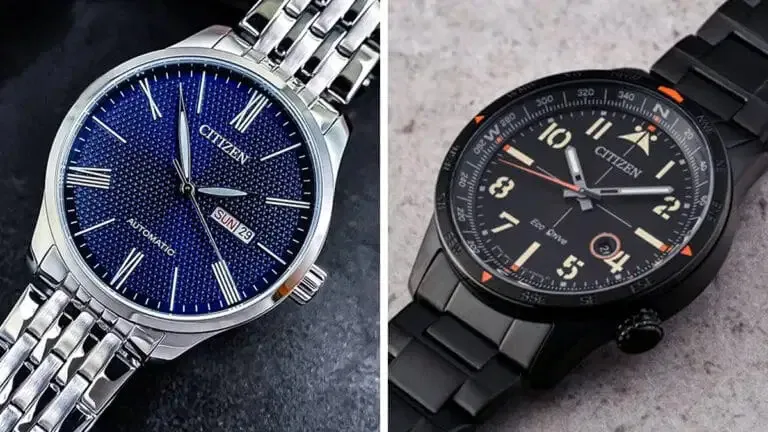

Few watch-buying decisions cause more genuine debate than choosing between solar and mechanical when shopping for Citizen watches. Eco-Drive solar promises a watch that never needs a battery and rarely needs setting; automatic offers the romance of mechanical engineering and the satisfaction of a self-winding movement on your wrist. Both have legitimate followings, and the right answer depends entirely on what you actually want from a watch.
Quick Answer
Eco-Drive wins on practicality: no battery changes for the watch's lifetime, accuracy of +/-15 seconds per month, and almost zero maintenance for 10-20 years. Automatic wins on character: a self-winding mechanical movement, traditional watchmaking heritage, and the visceral appeal of a watch that runs on motion rather than light. For most buyers, Eco-Drive is the smarter daily choice; automatic is the right choice if mechanical watchmaking itself is part of the appeal.
How Eco-Drive Actually Works
Eco-Drive is a solar-powered quartz movement, but the system is more sophisticated than the term 'solar watch' suggests. A photovoltaic cell sits behind the dial — invisible from the front — and converts any light into electrical energy. That energy charges a lithium-ion secondary cell (essentially a small rechargeable battery) that drives a standard quartz movement.
The key advantage: the rechargeable cell typically lasts 10-20 years before needing replacement. Compare that to a standard quartz battery's 2-3 year lifespan, and the cost-of-ownership math becomes obvious. Citizen launched Eco-Drive in 1976 and has refined the technology through dozens of caliber generations. Most current models retain a full charge for 6 months in total darkness.
How Citizen Automatic Works
Citizen automatic watches use mechanical movements with a self-winding rotor — the same principle as Seiko, Hamilton, or Omega automatics. The wearer's wrist motion winds a mainspring, which releases tension at a controlled rate through an escapement to drive the hands.
Citizen's mechanical division focuses on the Miyota family of movements (the brand owns Miyota), with the Series 8 collection and Promaster automatics representing the brand's mechanical capability. Movements like the 9015 and 9051 deliver 42-hour power reserves and accuracy in the -10/+30 seconds per day range.
Head-to-Head Comparison
When Eco-Drive Wins
Eco-Drive is the right choice when you want a watch that genuinely disappears from your maintenance list. You're not going to forget to wind it, you're not going to wake up to a stopped watch on Monday morning, you're not going to pay €300 for service every five years. Specific scenarios where Eco-Drive dominates:
- Travel watch — never needs setting if you've kept it on your wrist
- Office daily wear — accuracy and reliability beat mechanical character in business settings
- Sport and outdoor — Promaster Eco-Drive divers and pilots are tougher than equivalent mechanicals
- Gift watches — recipient doesn't need to learn winding habits
- First serious watch — the lowest maintenance entry point into proper watchmaking
When Automatic Wins
A Citizen automatic is the right choice when the mechanical watchmaking itself is part of why you're buying. Scenarios where automatic dominates:
- You want a display caseback showing the rotor in motion
- You collect mechanical watches and want Citizen's take on the form
- You appreciate the smooth sweep of a mechanical second hand vs quartz tick
- You're building toward Swiss or Japanese luxury mechanicals and want Citizen as a stepping stone
- You prefer the character of a watch that runs on motion rather than light
The Top Models Worth Knowing
Eco-Drive standouts: Promaster BN0150 (€200-€280, classic diver), Attesa AT8181 (radio-controlled, €700+), Series 8 NA1004 (Eco-Drive in luxury chassis, €400-€600)
Automatic standouts: Tsuyosa NJ0150 series (€350-€450, in-house Miyota 9051), Series 8 mechanical NB6011 (€1,200+, premium finishing), Promaster Mechanical NB6004 (titanium diver, €900+)
Service and Long-Term Cost
Across a 20-year ownership period, the math favors Eco-Drive heavily. An Eco-Drive needs one cell replacement (~€80) and possibly one gasket service (~€100). Total: ~€180. A comparable Citizen automatic needs service every 5-7 years at €250-€400 per service. Total over 20 years: ~€800-€1,200. That gap is real, and worth factoring in if total cost of ownership matters to you.
FAQ
Does an Eco-Drive watch need direct sunlight?
No. Any light source works — fluorescent office lighting, ambient daylight through a window. Direct sun charges fastest, but normal indoor light maintains the charge.
How long do Eco-Drive cells last?
10-20 years before replacement is needed. Some models from the 1990s are still running on their original cells.
Can Citizen automatic watches be wound by hand?
Most models with the Miyota 9015 or 9051 movement support hand-winding. Older calibers may not.
Are Citizen automatics as good as Seiko automatics?
Similar quality tier, different design philosophy. Seiko has stronger diver heritage; Citizen is stronger in radio-controlled and titanium pieces.
What happens if Eco-Drive cell dies?
It gets replaced at service — €60-€100 typical cost. The watch isn't disposable.
Verdict
For the majority of buyers, the smart pick from the Citizen range is Eco-Drive. It's more accurate, more reliable, dramatically cheaper to own long-term, and removes all the small daily friction of mechanical ownership. Choose automatic only when the mechanical character itself is what you're buying — when you specifically want a watch that runs on motion and shows it through a display caseback. Both are legitimately good. Neither is wrong. But be honest about which need you're actually solving.




























Sign in to leave a comment.