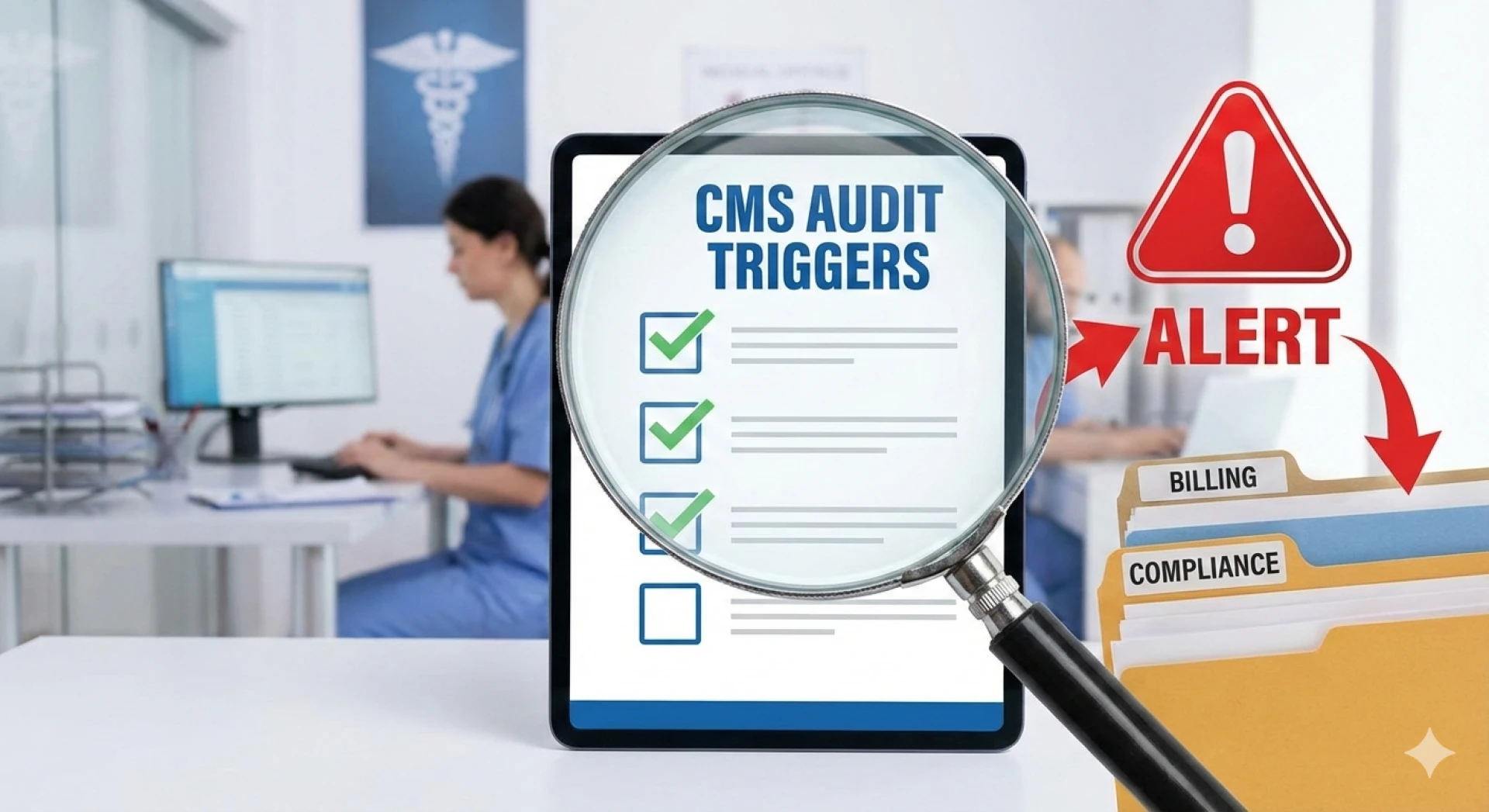

Most doctors do not find out they are being audited until it is already happening.
The letter arrives without warning. The deadline is short. The pressure is immediate.
CMS audits rarely happen by chance.
They are almost always triggered by data patterns that look unusual when compared to those of other doctors.
Many U.S. physicians believe that audits target only bad actors. That belief is costly.
Solo practices and small groups are audited every year for routine billing habits they did not realize were risky.
This article explains the real CMS audit triggers every medical practice should know.
These are not theories. They are recurring patterns in U.S. medical billing operations.
The goal is to help you recognize risk early and reduce exposure before CMS starts asking questions.
What a CMS Audit Really Is
A CMS audit is a review of your Medicare claims to confirm that services were billed correctly and supported by documentation.
CMS does not manually review claims at random.
It relies on automated data analysis to compare your billing behavior to other physicians in your specialty and region.
When your numbers fall outside expected ranges, CMS flags the practice for review.
By the time an audit notice arrives, the concern already exists.
How CMS Chooses Practices for Audits
CMS analyzes claims submitted through the CMS-1500 form.
That data is reviewed by CMS and several oversight contractors.
Medicare Administrative Contractors, Recovery Audit Contractors, and Unified Program Integrity Contractors each look for different risks, but they use the same core method. They compare your billing patterns against peers, regional trends, and national benchmarks.
If your practice looks different without a clear explanation, it attracts attention.
CMS Audit Trigger 1: Billing Outliers Compared to Peers
This is the most common audit trigger.
CMS tracks how often you bill specific CPT codes and compares that data to physicians in the same specialty. When usage is significantly higher or lower than expected, CMS assumes there may be a problem.
A common example involves evaluation and management coding.
An internal medicine physician bills CPT 99214 for the majority of visits. Other physicians in the same region bill that level far less often.
Even when care is appropriate, CMS may request records to verify medical necessity. If documentation does not fully support the level billed, repayments may follow.
CMS Audit Trigger 2: Excessive Use of Modifier 25
Modifier 25 is legitimate but heavily scrutinized.
It tells Medicare that a significant and separate evaluation and management service occurred on the same day as a procedure. CMS monitors how often it is used, which procedures it is attached to, and whether documentation supports it.
Many practices rely on EHR templates that automatically apply modifier 25. This creates risk when notes do not clearly show a separate visit.
When documentation fails to justify modifier use, CMS may deny or recoup payments.
CMS Audit Trigger 3: Weak or Incomplete Documentation
Good care does not protect you during an audit.
Only documentation does.
CMS frequently finds notes that are copied forward, vague, or missing clear medical decision-making. Short assessments and generic plans often fail to justify higher-level services.
A common audit scenario involves high-level visits supported by minimal documentation. CMS may conclude that the service level was not medically necessary and demand repayment.
CMS Audit Trigger 4: High Frequency of Certain CPT or HCPCS Codes
CMS closely monitors codes known to be high-risk.
These include injections, diagnostic testing, durable medical equipment, and prolonged services. High volume alone is not wrong, but high volume without strong documentation raises concerns.
Local Medicare Administrative Contractors often pay special attention to codes that are overused in their region. Practices unaware of local patterns are more likely to be flagged.
CMS Audit Trigger 5: Diagnosis and Procedure Mismatch
ICD-10-CM diagnosis codes must clearly support the CPT or HCPCS service billed.
Problems arise when practices rely on vague diagnoses, outdated problem lists, or copied diagnosis templates. CMS expects the diagnosis to explain why the service was medically necessary.
For example, advanced imaging billed with nonspecific pain diagnoses may be denied if coverage rules require greater detail. LCDs and NCDs define these requirements, and ignoring them increases audit risk.
CMS Audit Trigger 6: Sudden Changes in Billing Patterns
CMS tracks trends over time.
A sudden increase in high-level visits, new procedures, or Medicare revenue can trigger review. These changes often occur after EHR updates, staff turnover, or billing workflow changes.
Even legitimate shifts require clear documentation and consistent coding behavior to avoid scrutiny.
CMS Audit Trigger 7: High Medicare Patient Volume
Practices with a large Medicare population face greater audit exposure simply due to claim volume.
More claims create more data. More data makes unusual patterns easier to detect. This is especially true for practices managing chronic conditions with frequent follow-up visits.
High Medicare volume does not cause audits. Poor visibility into billing behavior does.
CMS Audit Trigger 8: Ignoring LCDs and NCDs
Local and National Coverage Determinations define when Medicare will pay for specific services.
Many practices are unaware of frequency limits, diagnosis restrictions, or documentation requirements set by their MAC. Billing services outside these rules often leads to post-payment audits and recoupments.
Providing appropriate care does not override coverage rules.
CMS Audit Trigger 9: Time-Based Coding Errors
Time-based billing is increasingly audited.
CMS expects precise time documentation and a clear description of activities performed. Rounded times, repeated language, or inconsistent time reporting across visits often trigger review.
Time must be documented carefully and honestly for every encounter.
CMS Audit Trigger 10: Place of Service Errors
Incorrect place of service coding affects payment accuracy.
Mistakes often occur after telehealth expansion, workflow changes, or confusion between office and outpatient hospital settings. CMS tracks these inconsistencies and may audit when patterns emerge.
How CMS Uses Data to Identify Risk
CMS relies on claims data generated by EHR systems and clearinghouses.
Small daily habits become long-term patterns.
Those patterns are compared against national and regional benchmarks.
When numbers stand out, CMS investigates.
How Medical Billing Services Help Reduce Audit Risk
Many audit triggers originate in billing workflows rather than clinical care.
Medical billing services help practices monitor coding behavior, modifier usage, documentation trends, and compliance with LCDs and NCDs. This added oversight reduces blind spots that often lead to audits.
Preventive Steps Every Practice Should Take
Internal reviews should focus on patterns, not individual claims. Practices should regularly review their most commonly billed codes, modifier usage, and documentation quality.
Documentation improvement starts with reducing copy-paste behavior and clearly explaining medical decision-making. Diagnoses should always match the service billed.
These steps are simple but powerful when done consistently.
What to Do If You Receive a CMS Audit Letter
Stay calm and move deliberately.
Read the request carefully. Note deadlines. Submit only the records requested. Review documentation before submission and seek billing or compliance support if anything is unclear.
Rushed responses often cause more harm than the audit itself.
Key Takeaways for Physicians
CMS audits are data-driven, not personal.
Most triggers come from routine habits that go unchecked.
Understanding how CMS sees your data gives you control over audit risk.




























Sign in to leave a comment.