
When homeowners choose new countertops, most of the focus goes toward material selection, color, and edge profiles. However, one critical detail often overlooked is seam placement. Where seams are located—and how well they’re executed—has a significant impact on both appearance and performance.
At Stone Concepts, we educate homeowners on how kitchen layout directly influences seam placement, especially in projects involving Quartz countertops Hudson homeowners prefer for clean, modern kitchens. Understanding these layout considerations helps set realistic expectations and prevents costly mistakes—especially for those considering shortcuts like trying to install new countertop over old surfaces.
Why Seam Placement Matters
Seams are the joints where two pieces of countertop meet. While many homeowners hope for a completely seamless surface, seams are unavoidable in most kitchens due to slab size limits, layout complexity, and structural considerations.
Proper seam placement:
- Minimizes visibility
- Preserves structural integrity
- Aligns patterns naturally
- Reduces long-term stress on the stone
Poorly placed seams can disrupt the design and become weak points over time.
Straight Kitchens (Single-Wall Layouts)
Single-wall kitchens appear simple, but they can still require seams depending on length.
How seam placement is handled:
- Short runs may use a single slab with no seam
- Longer runs require seams placed away from high-visibility areas
- Seams are often positioned near sinks or cooktops where breaks already occur
For quartz surfaces, consistency makes seam precision especially important. Poor seam execution is more visible on quartz than on natural stone.
Galley Kitchens
Galley kitchens feature two parallel countertop runs, often with limited space.
Seam considerations:
- Seams are placed to mirror each side for visual balance
- Sink locations often dictate seam placement
- Long runs may require one or more seams per side
Careful planning ensures symmetry and avoids awkward seam alignment in narrow walkways.
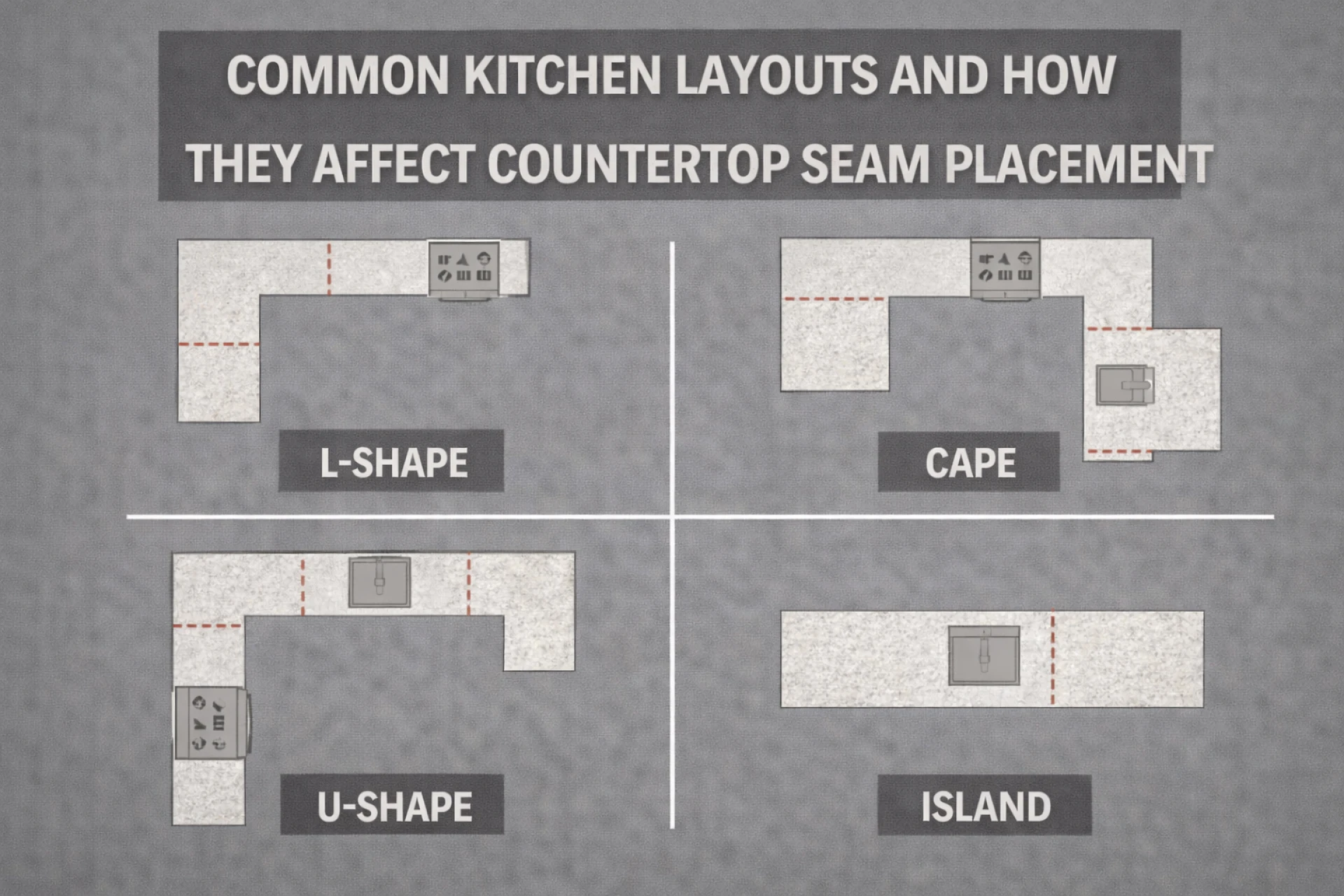
L-Shaped Kitchens
L-shaped kitchens are very common and naturally introduce seam challenges.
Typical seam placement:
- Seams near corner joints
- Seams positioned close to sinks or dishwashers
- Corner seams reinforced for strength
Corners are natural breaking points, making them ideal for seams when fabricated correctly.
U-Shaped Kitchens
U-shaped layouts often involve multiple seams due to the number of connecting sections.
Seam strategies include:
- Using corners as natural seam locations
- Balancing seam visibility across all runs
- Minimizing seams on focal wall sections
This layout requires careful measurement and planning to prevent excessive seams.
Kitchens with Islands
Islands are often the focal point of the kitchen, making seam placement especially critical.
Island seam planning:
- Larger islands may require one or more seams
- Seams should be aligned symmetrically
- Pattern matching is essential for quartz surfaces
Whenever possible, seams are placed away from seating areas or main sight lines. For Quartz countertops Hudson homeowners choose for modern islands, clean seam work is essential to maintaining a polished appearance.
Peninsula Layouts
Peninsulas function similarly to islands but connect to cabinets or walls.
Seam considerations:
- Seams placed near attachment points
- Reinforcement under overhangs
- Alignment with cabinetry for visual continuity
Proper support is crucial here to avoid stress near seam locations.
Impact of Material Choice on Seam Placement
Material type influences how seams are placed and perceived.
Quartz Seams
Quartz’s uniform appearance makes seam alignment more noticeable. Precision in fabrication and installation ensures seams blend naturally.
Granite Seams
Granite’s natural veining can disguise seams more easily, but pattern alignment is still critical.
Regardless of material, poor seam planning cannot be corrected after installation.
Why Installing Over Old Countertops Creates Seam Problems
Some homeowners ask whether they can install new countertop over old ones to save time. This approach often creates serious seam and leveling issues.
Problems include:
- Uneven surfaces causing visible seams
- Stress points that lead to cracking
- Inaccurate seam alignment due to hidden variations
Removing old countertops allows for proper leveling, accurate measurement, and clean seam execution.
Seams and Long-Term Performance
Beyond aesthetics, seam placement affects durability.
Poor seam placement can lead to:
- Cracking over time
- Water infiltration
- Weak structural points
- Movement or separation
Professional installation ensures seams are reinforced, leveled, and sealed correctly.
How Stone Concepts Approaches Seam Planning
At Stone Concepts, seam placement is treated as a design and engineering decision—not an afterthought.
Our process includes:
- Evaluating layout and sightlines
- Identifying natural break points
- Minimizing seams in focal areas
- Aligning seams for balance
- Reinforcing stress points
This approach ensures seams are both discreet and durable.
Setting the Right Expectations
Homeowners should understand that seams are normal and necessary in most kitchens. The goal is not to eliminate seams, but to place them intelligently.
Clear communication between homeowner and installer ensures alignment on:
- Number of seams
- Their general locations
- How they’ll appear once finished
Stone Concepts provides upfront guidance so homeowners know what to expect before fabrication begins.
Final Thoughts
Kitchen layout plays a major role in countertop seam placement, affecting both appearance and performance. From straight kitchens to complex island designs, proper planning ensures seams enhance rather than detract from the final result.
For homeowners investing in Quartz countertops Hudson or planning a replacement without risky shortcuts like trying to install new countertop over old surfaces, working with experienced professionals makes all the difference.
At Stone Concepts, thoughtful seam placement is part of our commitment to quality craftsmanship—ensuring countertops that look right, perform well, and stand the test of time.
Sign in to leave a comment.