

Enterprises are confronted with a significant challenge regarding the selection of business intelligence tools since a wrong choice equals wasted money without any revelation. The right one is determined by matching the capabilities to the data size, the requirements of the users, and the integration necessities to get the full power of the decision-making process.
Key Factors in BI Tool Selection
First and foremost, conduct an audit of the whole data ecosystem. The data characteristics to be measured are volume, variety, and velocity. Once the characteristics are clearly defined, it will be much easier to select the right tools. Real-time tools are suitable for high-velocity streaming data, whereas huge historical datasets require extensive storage.
Take the user base into consideration: Top management prefers dashboards that are easy to create and use by means of drag-and-drop, while data analysts prefer to use SQL queries and scripts to access the data.
Scalability is the most important criterion — tools should be capable of supporting a user increase from 100 to 10,000 without any performance deterioration.
Popular Enterprise BI Tools Compared
The market for data visualization tools is still being controlled by the heavyweights: Tableau, Power BI, Looker, Qlik Sense, and Sisense. Each one of them has its own strengths and weaknesses, and the choice for one or the other might depend on the specific use cases.
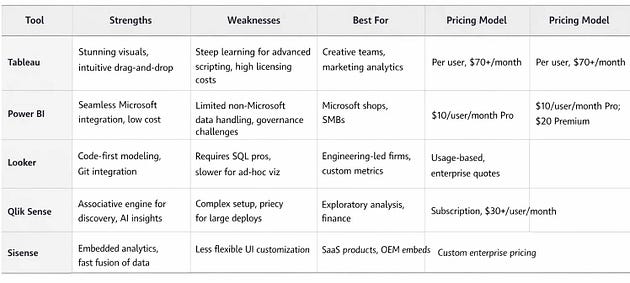
Deployment and Integration Realities
Cloud and on-premises are the two main types of business intelligence services in a very clear-cut manner. Cloud solutions are ridiculously easy to scale, but they are also problematic because of data sovereignty in regulated sectors.
How well the integration operates is the critical point — having native connectors for Salesforce, SAP, or Snowflake will guarantee no outdated process nightmares that would otherwise increase setup time by 20–30%.
The different security measures, like role-based access, audit logging, and compliance with GDPR or SOC2, will remain essential for the big companies.
Cost Breakdown and Hidden Expenses
The licensing that you have to pay upfront is the one that gets most attention, but the total cost of ownership is the one that really matters in the case of business intelligence services. Basic setups for mid-sized companies are in the range of $30K-$100K; the enterprise portion can go beyond $1M.
Let us analyze it:
- Licenses and Subscriptions: $10-$70/user/month; be careful with concurrency limits.
- Infrastructure: Cloud pay-as-you-go or on-prem hardware that is refreshed every 3 years.
- Implementation: 3–6 months of labor at $150-$250/hour, plus data migration.
- Training: $5K-$20K to achieve 80% adoption rates.
- Maintenance: Annual charges of 15–20% for updates and support.
The hidden dangers include the growth of shadow IT and vendor lock-in. The use of flexible licensing reduces the TCO for users whose numbers fluctuate.
Measuring ROI Before Commitment
ROI calculation, as such, can take many forms, but using a simple ROI calculator is often the best starting point:
(Net Benefits / Total Costs) x 100. The net benefits are the sum of the time savings, the increase in revenue, and the reduction in costs due to business intelligence services.
Phased rollouts, on the other hand, are the key to expecting first-year returns of anywhere from 200% to 340%, but not every company gets the latter, as 70% to 80% of them end up failing due to poor governance. The main indicators:
- Time-to-insight: Cut down report preparation from several days to only a few hours.
- Decision speed: Self-service technology reduces time needed for decision-making by 30%.
- Cost savings: Free up the analysts by eliminating tedious manual efforts through Excel automation.
- Revenue impact: Early identification of customer loss risks resulting in a 10–15% increase in retention.
Pilot with PoCs: Implement small dashboards on actual data, observe and document usage after one month. Long-term, every BI dollar will generate a return of more than $13+.
Scalability and Future-Proofing
Businesses may exceed the limitations of their intelligence service tools; data engineering services, together with AI/ML natives, provide strong foundations for future expansion. Predictive autosuggest features, on the other hand, investment-proof the future; moreover, data engineering services take the burden off data pipelines.
Vendor roadmap scrutiny: Yearly increments introduce GenAI agents. Don’t use tools that lack vector search for unstructured data, and rely on data engineering services for uninterrupted scalability. Open standards exit strategies that diminish locking-in risks.
| Also read: Top 7 Business Intelligence Consulting Companies
Conclusion
Navigating through the services of business intelligence necessitated heavy weight on the fit, costs, and long-term value, and thus, choosing the right tools alongside the data engineering services turned the raw data into strategic gold. The companies that moved along with pilots, pursued real ROI metrics, and made adoption their priority, avoided the 70% failure trap and thus, built robust analytics engines that produced large wins year after year. Savvy leaders not only invest in software but also in the development of the whole ecosystem, which can grow with ambition, offering insights that are very useful in the competition, especially in a world of data where everyone has access.


























Sign in to leave a comment.