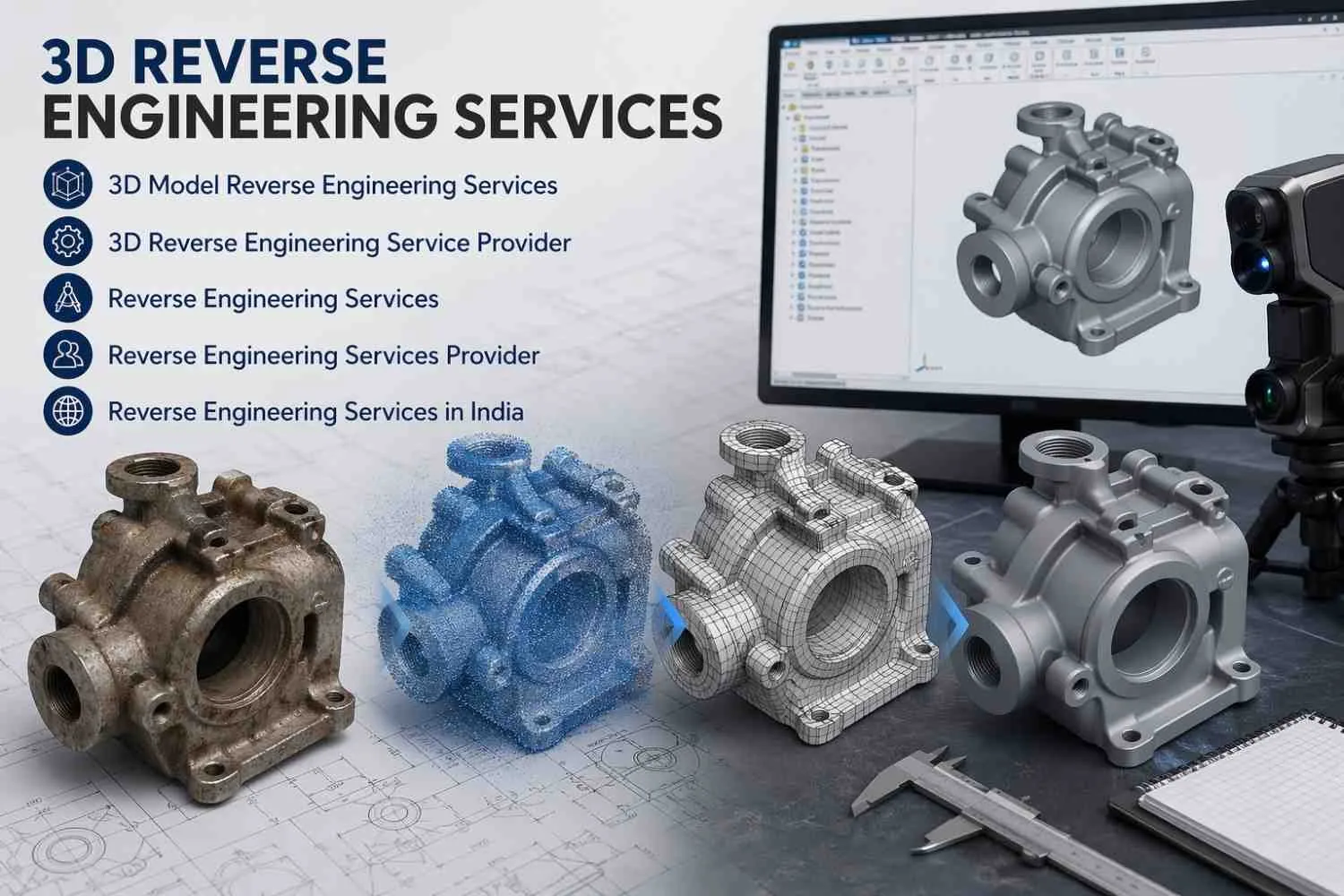

A casting cracks in the field, the OEM no longer supports the part, and production is losing ₹2.7 lakh per hour — that’s usually when companies start looking for Reverse Engineering Services. Not earlier. Not during planning. And by then, the margin for error is already gone.
Most buyers assume reverse engineering is just scanning a part and getting a CAD file. It’s not. The gap between a scanned model and a manufacturable, tolerance-ready component is where projects either succeed quietly or fail expensively.
Specifications That Actually Matter in Reverse Engineering Services
Data Capture Methods Decide Accuracy, Not Just Speed
Laser scanning, structured light scanning, and CMM probing all serve different use cases. Structured light can hit ±10–20 microns in controlled setups, but throw in reflective surfaces or worn edges, and accuracy drops. Which means your 3d Reverse Engineering Services provider must adapt methods — not just use one machine for everything.
CAD Reconstruction Isn’t Automatic
Here’s what most buyers miss: point cloud data is not CAD. Converting millions of points into parametric models takes manual engineering judgment. That’s where experienced 3D Model Reverse Engineering Services teams separate themselves — especially when dealing with legacy parts with no design intent.
Material & Functional Analysis
Reverse engineering without understanding material composition is guesswork. A supplier who skips spectrometry or hardness testing is gambling with your production line.
Tolerance Mapping — The Overlooked Detail
And yet, this is where many projects fail. Capturing geometry is one thing. Rebuilding tolerances based on wear patterns and intended function is harder than buyers expect — especially in rotating or load-bearing parts.
What a Serious Buyer Checks Before Choosing a Reverse Engineering Services Provider
- How do they validate accuracy?
Good answer: Reports with deviation analysis and inspection overlays.
Bad answer: “We match the scan perfectly.” That’s not validation. That’s a claim. - What’s their process for damaged or worn parts?
Good answer: They reconstruct nominal geometry using engineering assumptions.
Bad answer: “We scan what we get.” That’s how defects get duplicated. - Do they handle manufacturing feasibility?
Good answer: Design adjustments for tooling, machining, or casting constraints.
Bad answer: “We only deliver CAD files.” Then you’ll fix it later — at your cost. - Turnaround time clarity
Good answer: Stage-wise timeline (scan, modeling, validation).
Bad answer: One vague delivery date. Usually missed. - Ownership and IP security
Good answer: NDA-backed, documented policies.
Bad answer: “We don’t share data.” That’s not a policy.
A supplier who avoids specifics here will avoid accountability later.
Where Reverse Engineering Services Protect Your Margins
Downtime reduction
Recreating a failed part in 5–8 days instead of waiting 6 weeks for OEM supply can save lakhs in production loss.
Legacy system continuity
Many Indian plants still run machines installed before 2005. Spare parts aren’t available. Reverse engineering keeps them alive.
Cost control vs OEM pricing
OEM replacements can be 2.3× higher due to low-volume production. Reverse-engineered parts often bring that down significantly.
Supplier independence
Relying on one OEM is risky. A capable Reverse Engineering Services Provider gives you control.
Design improvement opportunities
Not every reverse-engineered part has to be identical. Some can be improved for durability or manufacturability.
Faster prototyping cycles
Especially relevant for automotive and tooling sectors, where design iteration speed matters more than perfection in the first pass.
Reverse Engineering Services in India: Availability and Supply Chain Reality
India has quietly become a strong base for Reverse Engineering Services in India, especially across Pune, Chennai, and NCR clusters. Which means shorter lead times and easier coordination if you’re sourcing locally.
Most buyers focus only on price. That’s a mistake. Location affects logistics, communication speed, and even inspection visits. A supplier sitting 40 km from your plant can fix issues in hours. One sitting 1,800 km away can’t — no matter how competitive the quote looks.
And here’s the part nobody says openly: some low-cost providers skip validation entirely to win price wars. The CAD file looks fine. The part fails in operation.
About Integrated Solutions
We’ve been working on reverse engineering projects since 2013, mostly for clients who come to us after a failed attempt elsewhere. That pattern tells you something about this industry.
We don’t treat scanning as the final output. Our team rebuilds design intent — especially for parts that have seen years of wear. In 2021, we stopped accepting scan-only jobs after three clients reported downstream machining issues from incomplete data models. We changed our process. That’s what real project feedback looks like.
If you’re evaluating 3D Reverse Engineering Service Provider options, send us:
- Part images (clear, multiple angles)
- Approx dimensions or weight
- Application details (load, environment, usage)
- Required quantity (MOQ starts at 1 for critical parts)
We usually respond within 24 hours. For urgent breakdown cases, same-day assessment is possible.
Reach out to Integrated Solutions with actual data, not just “need reverse engineering.” The more specific you are, the faster we can give you a workable plan.
Conclusion
Most failures in Reverse Engineering Services don’t happen in scanning — they happen in assumptions. Choose a provider who questions the part, not just copies it. Because the goal isn’t replication. It’s reliability.
FAQs
1. How do I choose a reliable Reverse Engineering Services Provider?
Look at how they handle worn or damaged parts. A proper Reverse Engineering Services Provider explains reconstruction logic, not just scanning capability. If they can’t explain tolerances clearly, walk away.
2. Are 3D Model Reverse Engineering Services accurate enough for production?
Yes, but only if validation is done properly. A 3D Model Reverse Engineering Services provider must include deviation reports. Without that, accuracy is just assumed.
3. How long do Reverse Engineering Services in India usually take?
Simple parts can take 3–5 days. Complex assemblies may take 2–3 weeks. Some Reverse Engineering Services in India providers promise faster delivery but skip validation — that’s risky.
4. Can reverse engineering improve part performance?
It can. A good 3D Reverse Engineering Service Provider may suggest material or design changes. But not every part should be modified — sometimes replication is safer.
5. What file formats are delivered in 3D Model Reverse Engineering Services?
Typically STEP, IGES, or native CAD formats. Some 3D Model Reverse Engineering Services providers also include 2D drawings with tolerances, which helps manufacturing teams.
6. Is reverse engineering legal in India?
Generally yes, but depends on IP and patent status. Most Reverse Engineering Services in India providers will ask you to confirm ownership or usage rights before starting.

























Sign in to leave a comment.