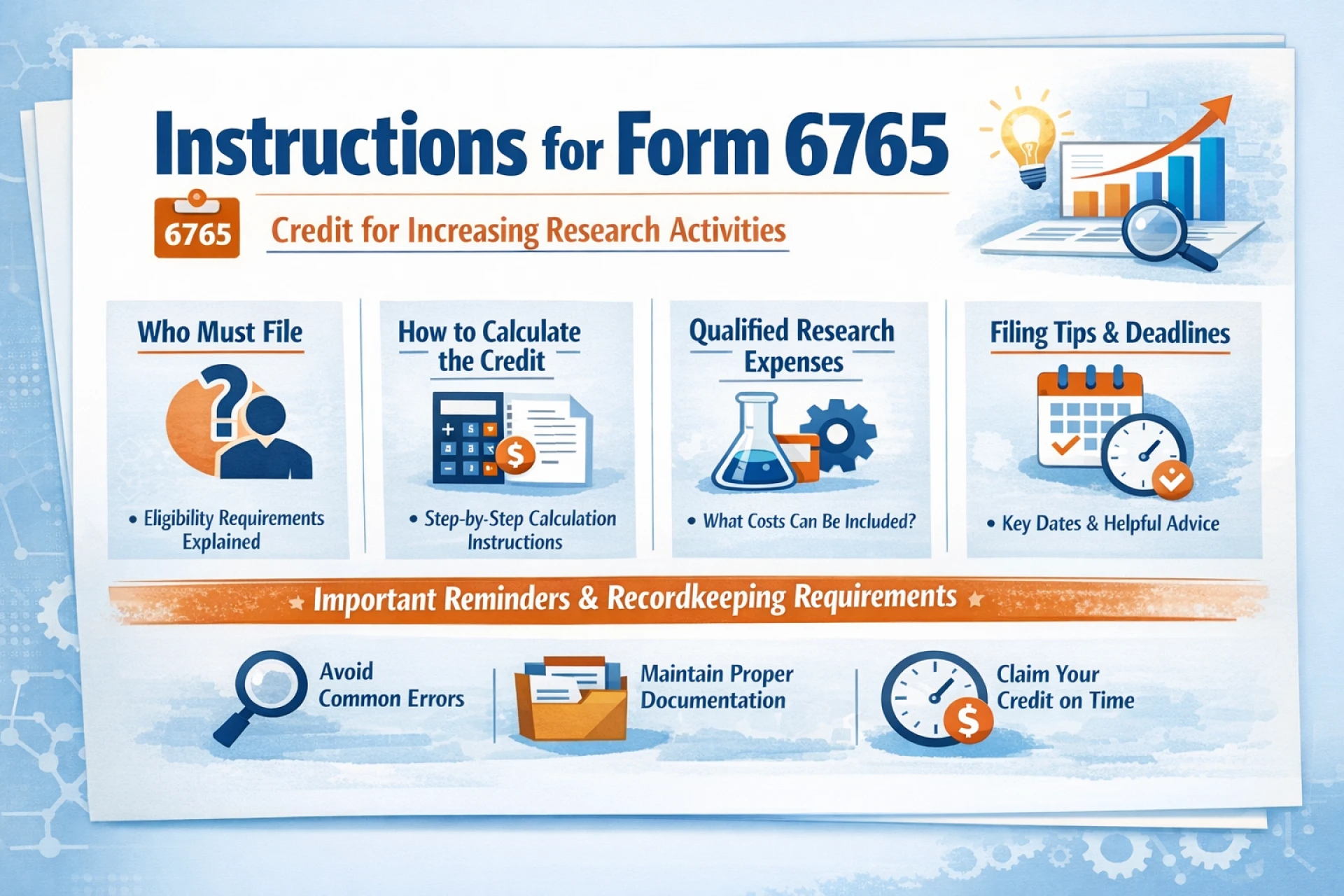

Form 6765 instructions explain how businesses claim the IRS Research and Development tax credit, calculate qualified expenses, choose the right method, and file correctly to reduce federal tax liability.
Table of Contents
- Introduction to Form 6765
- What Is Form 6765 Used For?
- Who Qualifies for the R&D Tax Credit?
- Understanding Qualified Research Expenses (QREs)
- Instructions for Form 6765 Step by Step
- ASC vs Regular Credit Method Explained
- Required Documents and Recordkeeping
- Payroll Tax Offset for Startups
- What Changed in Form 6765 Instructions 2025
- Common Filing Mistakes to Avoid
- How BooksMerge Supports Accurate Filing
- Trusted Sources and Compliance Standards
- Conclusion
- Frequently Asked Questions
Introduction to Form 6765
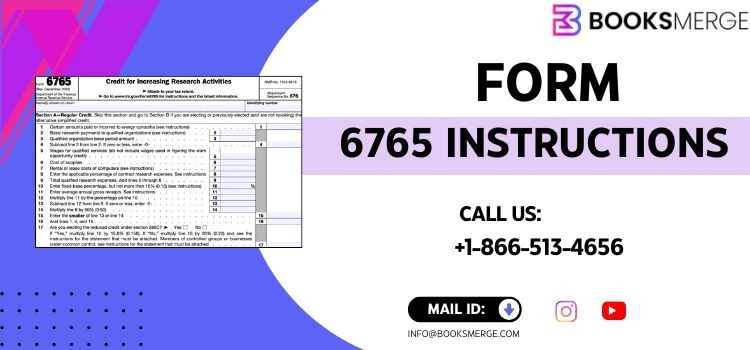
IRS Form 6765 allows eligible businesses to claim the federal Research and Development tax credit. The credit rewards companies that invest in innovation, technical improvement, and product development. Despite its value, many businesses avoid it because the instructions feel complex. That complexity fades with the right guidance and real data.
These IRS Form 6765 instructions focus on accuracy, documentation, and logic. When businesses follow them carefully, they unlock significant tax savings while staying fully compliant.
What Is Form 6765 Used For?
Form 6765 calculates and claims the federal R&D tax credit under Internal Revenue Code Section 41. Businesses attach the form to their federal income tax return.
Companies use this form to:
- Identify qualified research activities
- Calculate eligible expenses
- Choose between credit calculation methods
- Apply credits against income tax or payroll tax
The IRS designed this form to encourage innovation, not confusion. Still, clear interpretation matters.
Who Qualifies for the R&D Tax Credit?
Eligibility depends on activities, not company size. Startups, small businesses, and large corporations can all qualify.
A business qualifies when its activities meet the IRS four-part test:
- Permitted purpose such as improving performance, function, reliability, or quality
- Technological in nature relying on engineering, computer science, or physical sciences
- Elimination of uncertainty during development
- Process of experimentation including testing and iteration
Software firms, manufacturers, construction companies, and even food producers often qualify. Many overlook eligibility because they assume R&D only means lab coats and test tubes. The IRS disagrees.
Understanding Qualified Research Expenses (QREs)
QREs form the foundation of Form 6765 calculations. The IRS recognizes three main categories.
Qualified wages
- Employee salaries for direct R&D work
- Supervisory and support roles tied to research
Supplies
- Materials consumed during experimentation
- Excludes capital assets and general office supplies
Contract research
- Payments to third parties for qualified research
- Limited to 65 percent of the cost
Clear expense tracking improves accuracy and audit readiness. According to IRS guidance, businesses must link each expense directly to qualifying research activities.
Instructions for Form 6765 Step by Step
The Instructions for Form 6765 divide into four main sections.
Section A: Regular Credit
Used by companies with consistent historical data. It compares current research spending against a base amount.
Section B: Alternative Simplified Credit (ASC)
Preferred by many businesses due to simpler calculations and reduced documentation burden.
Section C: Current Year Credit
Summarizes the credit amount claimed for the tax year.
Section D: Payroll Tax Election
Allows qualified startups to apply credits against employer payroll taxes.
Each section builds logically. Accuracy in earlier sections ensures smoother completion later.
ASC vs Regular Credit Method Explained
Choosing between methods affects credit size and complexity.
Regular Credit Method
- Requires historical gross receipts data
- Uses a fixed base percentage
- Can yield higher credits for established firms
Alternative Simplified Credit
- Equals 14 percent of current QREs exceeding 50 percent of the prior three-year average
- Offers simpler calculations
- Reduces audit risk
Most small and mid-sized businesses choose ASC for clarity. The IRS Form 6765 instructions allow businesses to select the method annually.
Required Documents and Recordkeeping
Documentation builds trust with the IRS and protects your claim.
Required records include:
- Payroll reports tied to R&D roles
- Project descriptions and timelines
- Technical design documents
- Expense ledgers
- Contractor agreements
The IRS emphasizes contemporaneous documentation. Businesses that maintain organized records reduce audit stress and processing delays. For better financial habits, reviewing small business financial literacy insights can help. A helpful resource appears here: Financial Literacy Statistics
Payroll Tax Offset for Startups
Startups often ask, Can startups use payroll offset? The answer is yes.
Qualified small businesses can apply up to $500,000 of R&D credits annually against employer payroll taxes. To qualify, a business must:
- Have less than $5 million in gross receipts
- Earn gross receipts for no more than five years
This option helps early-stage companies preserve cash flow. Many startups see this benefit as a financial lifeline.
What Changed in Form 6765 Instructions 2025
The Form 6765 instructions 2025 reflect tighter documentation standards and clearer disclosure expectations.
Key updates include:
- Enhanced reporting of research activities
- Stronger alignment with capitalization rules under Section 174
- Increased emphasis on substantiation
The IRS aims to improve transparency, not discourage claims. Businesses that adapt early face fewer surprises.
Common Filing Mistakes to Avoid
Even strong claims fail due to simple errors.
Common mistakes include:
- Overstating wages without role allocation
- Including non-qualifying expenses
- Weak project descriptions
- Inconsistent calculation methods
A careful review before filing saves time and prevents penalties. Humor helps here. Think of Form 6765 like assembling furniture. Skip the instructions and something always ends up crooked.
Quick Tip: The IRS form list helps you quickly find the right tax forms, instructions, and schedules so you can file accurately, avoid errors, and stay fully compliant with IRS requirements.
How BooksMerge Supports Accurate Filing
BooksMerge provides professional accounting, bookkeeping, payroll, and tax credit support. The team understands IRS Form 6765 instructions and applies them with precision.
BooksMerge helps businesses:
- Identify qualifying activities
- Calculate QREs accurately
- Prepare audit-ready documentation
- File compliant claims with confidence
For direct support, call +1-866-513-4656. Expert guidance turns complexity into clarity.
Trusted Sources and Compliance Standards
This article relies on authoritative sources, including:
- Internal Revenue Code Section 41
- IRS Instructions for Form 6765
- IRS Chief Counsel Memoranda
- Treasury Regulations on R&D credits
Using genuine sources builds credibility and long-term trust with search engines and users alike.
Conclusion
Form 6765 offers real tax savings for businesses that innovate. The key lies in understanding eligibility, documenting expenses, and following IRS instructions carefully. With the right approach, the R&D tax credit becomes a strategic advantage, not a paperwork headache. BooksMerge stands ready to guide businesses through every step with accuracy and professionalism.
Frequently Asked Questions
What is Form 6765 used for?
Form 6765 calculates and claims the federal R&D tax credit, allowing businesses to reduce income or payroll tax by documenting qualified research activities and expenses.
Who qualifies for R&D tax credit?
Any business performing qualified research activities that meet the IRS four-part test can qualify, regardless of size or industry.
What are QREs?
QREs include qualified wages, supplies used in research, and a portion of contract research costs directly tied to eligible R&D activities.
How to calculate ASC vs regular method?
ASC uses a simplified comparison to prior three-year averages, while the regular method relies on historical base percentages and gross receipts.
What documents are required?
Businesses need payroll records, project documentation, expense ledgers, and technical reports that connect costs to qualifying research.
Can startups use payroll offset?
Yes. Qualified startups can apply up to $500,000 of R&D credits annually against employer payroll taxes.
What changed in 2025?
The 2025 instructions emphasize stronger documentation, clearer disclosures, and alignment with updated capitalization rules.
Read Also: Form 6765 Instructions
Sign in to leave a comment.