
Form 6765 instructions explain how businesses claim the IRS Research and Development tax credit by reporting qualified research expenses, choosing a calculation method, and filing accurately with their tax return.
Claiming the R&D tax credit can feel like solving a puzzle with missing pieces. The good news is that Form 6765 instructions provide a structured way to unlock valuable tax savings if your business invests in innovation. This guide breaks everything down in plain English, with logic, light humor, and facts you can trust.
At BooksMerge, we work daily with business owners who want clarity, not confusion. This article follows IRS guidance, trusted sources, and real-world practices to help you file confidently.
Table of Contents
- What Is IRS Form 6765?
- What Is Form 6765 Used For?
- Who Qualifies for the R&D Tax Credit?
- Understanding Qualified Research Expenses (QREs)
- Regular Credit vs ASC Method Explained
- Step-by-Step IRS Form 6765 Instructions
- Documents Required to Support Form 6765
- Payroll Tax Offset for Startups
- What Changed in Form 6765 Instructions 2025?
- Common Mistakes to Avoid
- How BooksMerge Helps You Get It Right?
- Conclusion
- FAQs
What Is IRS Form 6765?

IRS Form 6765 is the official form used to claim the federal Research and Development tax credit, and the Form 6765 instructions explain how to report and calculate eligible research expenses correctly. The IRS introduced this credit to reward businesses that invest time and money in improving products, processes, software, or technologies.
If your business experiments, tests, designs, or improves something, the IRS wants to hear from you. Yes, even if the experiment did not work. Innovation does not always succeed, and the IRS understands that.
What Is Form 6765 Used For?
So, what is Form 6765 used for in real terms?
Form 6765 allows eligible businesses to:
- Calculate their R&D tax credit accurately
- Choose between the regular credit and the ASC method
- Claim an income tax reduction or a payroll tax offset
- Attach the completed credit to their federal tax return
Think of it as the bridge between your innovation efforts and real, measurable tax savings.
Who Qualifies for R&D Tax Credit?
One of the most common questions we hear is, who qualifies for R&D tax credit?
You may qualify if your business activities meet the IRS four-part test:
- Permitted purpose such as improving function, performance, reliability, or quality
- Elimination of uncertainty related to design or capability
- Process of experimentation like trial and error or simulation
- Technological in nature relying on engineering, computer science, or hard sciences
This applies to many industries, including software, manufacturing, architecture, engineering, and even some service businesses.
Understanding Qualified Research Expenses (QREs)
Let us talk money. Specifically, what are QREs?
Qualified Research Expenses generally include:
- Wages paid to employees involved in R&D
- Supplies used during experimentation
- Contract research costs, usually 65 percent of payments
Office rent, marketing, and general admin costs do not count. Coffee for late-night coding sessions also does not count, sadly.
Regular Credit vs ASC Method Explained
Many taxpayers struggle with how to calculate ASC vs regular method. You are not alone.
Regular Credit Method
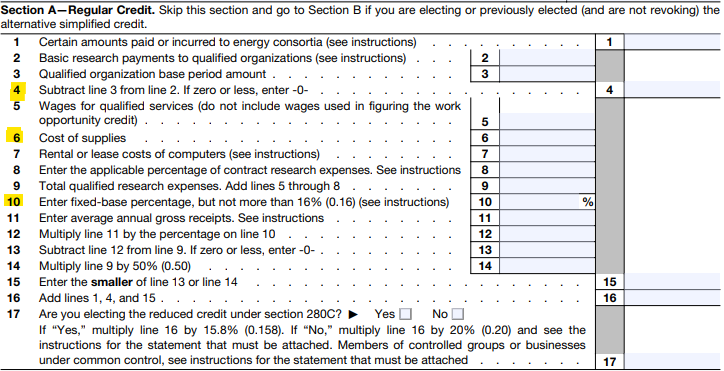
- Based on historical research spending
- Offers higher credit potential
- Requires detailed records from prior years
Alternative Simplified Credit (ASC)
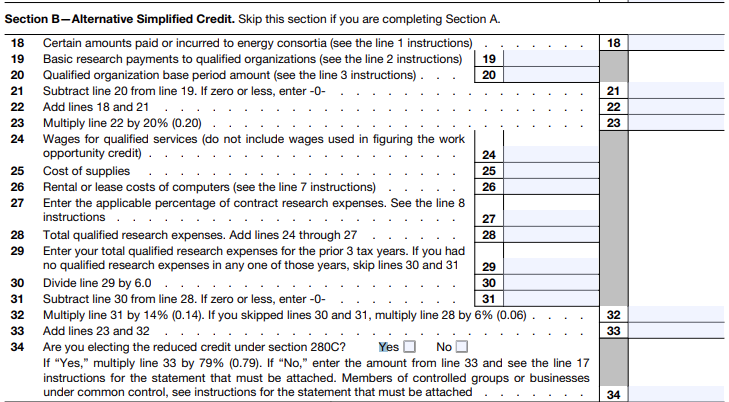
- Uses a simpler formula
- Compares current QREs to the prior three years
- Easier for newer or growing businesses
Most companies choose ASC because it reduces risk and paperwork. The IRS confirms this trend in its published guidance.
Step-by-Step IRS Form 6765 Instructions
Here is a simplified walkthrough of instructions Form 6765:
- Complete Section A if using the regular credit
- Complete Section B if using the ASC method
- Report QRE totals accurately
- Calculate the credit using IRS formulas
- Complete Section D for payroll tax offset, if applicable
- Attach Form 6765 to your income tax return
Accuracy matters more than speed here. A rushed form invites IRS questions, and nobody enjoys those letters.
Documents Required to Support Form 6765
Many business owners ask, what documents are required?
The IRS expects reasonable documentation, not perfection. Common records include:
- Payroll reports showing R&D wages
- Project descriptions and timelines
- Technical design documents or code repositories
- Expense reports for supplies
Strong documentation builds audit defense and trust. It also shows Google and users that your financial practices are solid, which aligns with broader financial literacy principles discussed in this helpful resource: Financial Literacy Statistics
Payroll Tax Offset for Startups
Yes, startups can benefit too. Can startups use payroll offset? Absolutely.
Qualified small businesses can apply up to $500,000 of R&D credit against employer payroll taxes. This helps startups with little or no income tax liability.
Eligibility basics:
- Gross receipts under $5 million
- No gross receipts before five years ago
This option appears in Section D of IRS Form 6765 instructions and has helped many early-stage companies breathe easier.
What Changed in Form 6765 Instructions 2025?
Naturally, people ask, what changed in 2025?
Key updates include:
- Increased scrutiny on project descriptions
- Alignment with Section 174 capitalization rules
- More emphasis on documentation quality
The IRS now expects clearer explanations of research activities. This change aims to reduce abuse and improve compliance, not to punish honest businesses.
Staying updated with form 6765 instructions 2025 is essential for safe filing.
Quick Tip: A W-2 form is a tax document employers provide to employees showing annual wages earned and taxes withheld, which employees use to accurately file their federal and state income tax returns.
Common Mistakes to Avoid
Even smart businesses slip up. Common errors include:
- Claiming non-qualifying expenses
- Using estimates instead of records
- Mixing R&D with routine operations
- Forgetting to attach Form 6765
Avoid these mistakes and you reduce audit risk significantly. Think of it as defensive driving, but for taxes.
How BooksMerge Helps You Get It Right?
At BooksMerge, we blend accounting expertise with real-world business logic. Our team helps you:
- Identify eligible R&D activities
- Calculate credits correctly
- Prepare IRS Form 6765 instructions with confidence
- Maintain audit-ready documentation
If you want professional guidance without the jargon overload, call us at +1-866-513-4656. We believe smart tax planning should feel empowering, not intimidating.
Conclusion
Form 6765 does not have to feel like a maze. With the right understanding, proper records, and expert support, the R&D tax credit becomes a practical reward for innovation. Follow IRS guidelines, stay honest with your data, and use professional help when needed. Your future self will thank you.
FAQs
What is Form 6765 used for?
Form 6765 is used to claim the federal Research and Development tax credit by reporting qualified research expenses and selecting the appropriate calculation method.
Who qualifies for R&D tax credit?
Businesses that conduct technological experimentation to improve products or processes and meet the IRS four-part test may qualify.
What are QREs?
QREs include wages, supplies, and certain contract research costs directly tied to qualified research activities.
How to calculate ASC vs regular method?
The regular method uses historical data, while the ASC compares current expenses to the prior three-year average, offering simplicity for most businesses.
What documents are required?
Payroll records, project documentation, technical notes, and expense reports help support Form 6765 claims.
Can startups use payroll offset?
Yes, eligible startups can apply R&D credits against payroll taxes instead of income tax.
What changed in 2025?
The IRS increased documentation expectations and reinforced compliance with Section 174 rules in the latest Form 6765 instructions.
Read Also: How to fill out a 1040 form
Sign in to leave a comment.