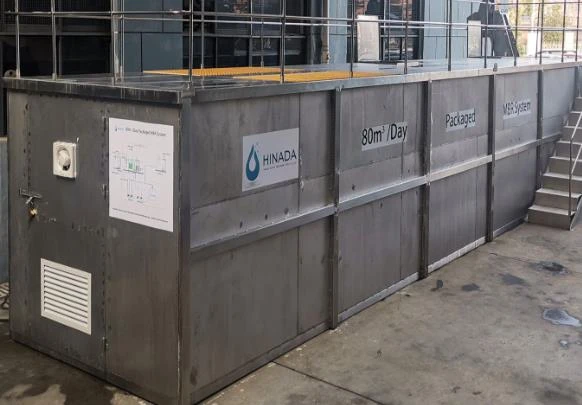

In situations where space on-site is very limited and adherence to standards is a must, a factory-constructed and containerized system may be a game-changer.
At Hinada we blend practical engineering with straightforward operation, using mbr technology to give predictable effluent and low on-site assembly. It is an introduction that dwells on practical advantages, as opposed to buzzwords, and contains a single specific keyword to place the discussion in the mind of the project owners who may be considering membrane-based wastewater solutions.
Ultrafiltration Overview and Application
Ultrafiltration Membrane (NM-UF-250)
Application: Suitable for projects treating above 30 m³/hour of river or city water.
Permeate quality highlights:
• Suspended matter >2 µm: 100% removal
• Organics removal: 99.99%
• Turbidity ≤ 0.2 NTU
• SDI ≤ 2.5
NM-UF-250 Descriptions and Specs
• Membrane material: PVC or PVDF
• Hollow fiber diameters: PVC 0.9/1.96 mm; PVDF 0.6/1.2 mm
• Module size: ø250 × 1715 mm; area: 48 m² (PVC) or 78 m² (PVDF)
• Design flux: PVC 3500–4500 L/H; PVDF 3500–5500 L/H
• MWCO: 100,000 Daltons; temperature range: 5–45°C
• Max inlet turbidity ≤50 NTU; pH 2–13; tolerable chlorine up to 200 PPM
• Backwash interval: 15–60 min; CIP: every 30–90 days using NaClO and NaOH
Product Variants
• NM-UF-250 (PVC): 48 m², economical for input turbidity <15 NTU.
• NM-UF-250 (PVDF): 78 m², better anti-pollution tolerance and flow for inputs up to 50 NTU.
System Design Summary
The solution incorporates biological tanks, membranes, and controls within a container in which it can be deployed to plug and run. The common type of process line is Anaerobic Tank - Aerobic Tank (MBBR) - MBR Technology Tank (membrane separation) - Control Room. This packaged MBR System is optimized for continuous 24-hour operation with capacities commonly under 200 m3/day.
Performance and Efficiency Metrics
Membranes of the right type normally yield steady permeate turbidity of less than 0.2 NTU when installed in the field. Leveraging mbr technology reduces chemical dosing and improves overall plant energy profile when compared with conventional tertiary filtration. When UF is before membranes, operators experience a higher SDI and have longer RO life. A Packaged MBR System can be fitted with UF pretreatment to protect downstream membranes.
Operational Notes and Membrane Care
• Input data: provide flow, BOD/COD, TSS, turbidity for accurate sizing.
• Maintenance: periodic backwash, scheduled CIP, and spare parts planning.
• Output: configured to meet land-release standards; not sized for direct discharge to water bodies.
• Incorporating an mbr reactor between aerobic treatment and membrane tank can stabilize biomass under variable loads.
Operational Training and Lifecycle Planning
Why Membranes and Biology Pair Well
Training in membrane handling and CIP preserves membrane integrity. Mbr technology in automation reduces operator time and clarifies maintenance intervals.
The suspended solids and organics are removed drastically by membrane filtration and protect further components downstream. Applying mbr technology compresses biological treatment and filtration into a compact footprint while improving effluent consistency. Adding an mbr reactor enhances nitrification and solids retention, particularly when influent composition fluctuates.
Retrofit and Pretreatment Benefits
Pairing UF modules with a Packaged MBR System improves pretreatment, reduces membrane fouling risk and extends service intervals. In retrofit projects an mbr reactor can be installed ahead of membranes to increase hydraulic retention and biological contact.
Customization and Modular Upgrades
These modular systems allow membrane upgrades, added UF modules or a dedicated mbr reactor for biological polishing without major civil work. This modularity helps in the phased investment and benefits the small and mid-sized projects in terms of commissioning.
Installation, Commissioning and Service
Factory fabrication shortens site works: the Packaged MBR System arrives largely outfitted, reducing site assembly. Engineering scope covers membrane selection control integration commissioning training and the integration of mbr technology.
To shorten the time needed to commission the sites, we develop and test every unit prior to shipment. The services that can be offered after the installation are performance tests and regular check-ups to ensure the quality of the output over time.
FAQs
Q: What website information should be provided to do accurate sizing?
A: Peak flow, average flow, BOD/COD, TSS, turbidity and other industrial contaminants.
Q: How many times do the membrane cleanings need to be done?
A: Maintenance, Cleaning cycles are based on the quality of feed, CIP is generally every 30-90 days and regular 15-60 minutes backwash every operation.
Q: Is it possible to monitor such systems remotely?
A: Yes, remote monitoring and integration of alarms can be controlled packages.
Final Summary
To obtain a technical review to customize specifications and obtain a GET PRICING, use the Hinada contact page. Provide influential data and capacity needs and our engineers will suggest the right Packaged MBR System and membrane modules for your project.
Containerized treatment with a membrane focus provides small projects with predictable performance, maintainability and predictable results. Contact Hinada and have a dedicated feasibility assessment and recommendations.























Sign in to leave a comment.