
Creating an app like Ask AI involves various factors that influence the overall cost. From development and design to AI integration and maintenance, each component contributes to the final budget. While some businesses opt for a basic chatbot, others require advanced AI capabilities, making the pricing highly variable.
This article breaks down the cost factors involved in developing an AI-powered app similar to Ask AI.
Key Factors That Affect the Cost
1. Type of AI Model Used
The complexity of the AI model directly impacts the development cost. Some AI models rely on pre-trained datasets, while others require continuous training with real-time data.
- Rule-Based AI – A simpler option that operates on predefined commands, costing less to develop.
- Machine Learning-Based AI – Requires training data and adaptation, leading to higher costs.
- Generative AI – More advanced, capable of natural language responses but expensive due to high computational requirements.
2. Development Platform and Compatibility
Building an app for a single platform, such as iOS or Android, is generally cheaper than creating a cross-platform solution. However, companies targeting a larger audience often invest in hybrid or native app development, increasing costs.
- iOS Only – Costs less but limits the user base.
- Android Only – Slightly more expensive due to device fragmentation.
- Cross-Platform – Higher initial cost but broader reach.
3. Backend Infrastructure and Cloud Hosting
An AI-driven app requires a strong backend with cloud storage and processing capabilities. The cost depends on:
- Database Management – Structured vs. unstructured data storage.
- Cloud Providers – AWS, Google Cloud, or Azure offer different pricing models.
- Data Processing Power – AI applications demand higher processing power, increasing expenses.
4. User Interface and Experience Design
Even though AI functionality is the core feature, a well-designed interface keeps users engaged. Custom UI/UX design adds to the development budget, especially if interactive elements, animations, or voice commands are integrated.
5. AI Training and Data Processing
AI applications need continuous learning from user interactions. Training models with extensive datasets require substantial computing power, leading to additional costs in:
- Data acquisition and processing.
- Model fine-tuning for accuracy.
- Real-time response optimization.
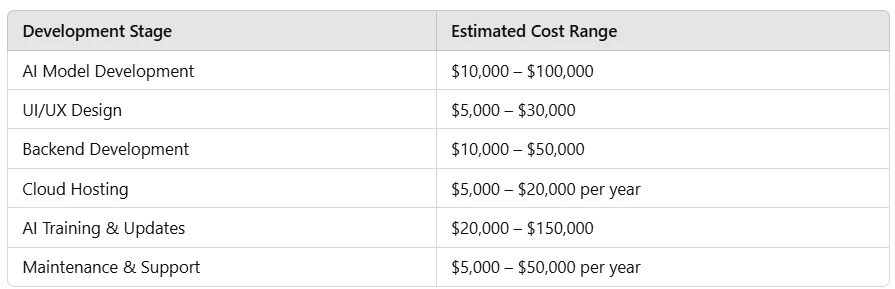
Estimated Cost Breakdown
1. Voice Recognition and Speech AI
If the app includes voice-based AI interactions, development costs increase due to speech-to-text and text-to-speech processing.
2. Integration with Third-Party APIs
APIs for real-time translation, sentiment analysis, or payment gateways add extra charges, especially when using paid services.
3. Multi-Language Support
AI chatbots with multiple language capabilities require additional training data and processing power, making them more expensive to develop.
4. Personalized AI Responses
Customization in AI responses based on user behavior demands sophisticated machine learning models, increasing development costs.
Cost-Saving Strategies for AI App Development
1. Using Pre-Trained AI Models
Rather than building a chatbot from scratch, businesses can integrate existing AI models like OpenAI’s GPT or Google’s Bard. This significantly reduces costs while maintaining high-quality AI responses.
2. Developing a Minimum Viable Product (MVP)
Instead of launching a fully-featured app initially, companies can build an MVP with essential functions and scale over time. This approach helps control initial expenses.
3. Opting for Cloud-Based AI Solutions
Hosting AI models on cloud services like AWS reduces infrastructure costs while maintaining scalability.
Hidden Costs That Businesses Often Overlook
1. AI Model Updates and Maintenance
AI-driven apps require frequent updates to stay accurate and relevant. These updates demand additional budget allocation.
2. User Data Security and Compliance
Compliance with data protection laws like GDPR or CCPA involves legal and technical costs.
3. Scalability and Performance Optimization
As the user base grows, the app needs infrastructure expansion to prevent slow response times, adding to operational expenses.
Industry Use Cases for AI-Powered Chat Apps
AI-driven chat applications are not limited to general Q&A platforms. Many industries utilize them for customer support, automation, and user engagement.
1. Customer Support Automation
Many companies integrate AI chatbots to handle common customer queries, reducing human intervention and operational costs.
2. AI in Healthcare
Medical AI assistants provide preliminary diagnoses, appointment scheduling, and symptom analysis, improving patient experience.
3. AI in the Adult Industry
Some businesses incorporate AI-powered features for personalized interactions. For instance, ai sexting services simulate human-like conversations using advanced natural language processing, increasing engagement.
4. AI for Website Assistance
Many businesses use AI chatbots to assist users in navigating their websites. In sectors like Escort web design, AI-driven virtual assistants help clients find relevant services effortlessly.
Future Trends in AI Chat Applications
1. AI with Emotional Intelligence
Future AI chatbots will likely analyze emotions and respond accordingly, making interactions feel more natural.
2. Hyper-Personalization with AI
With advancements in AI, personalized recommendations will become even more precise, enhancing user experience.
3. AI in Voice and Video Communication
Many applications are integrating AI with voice and video support to provide real-time assistance.
4. AI for Business Automation
Companies are increasingly using AI chatbots for marketing automation, sales support, and lead generation. Platforms like Ai Chatbot 18+ demonstrate how businesses leverage AI for user engagement across different niches.
Conclusion
Developing an AI-powered app like Ask AI requires careful budgeting and planning. The cost varies depending on AI model complexity, platform compatibility, cloud hosting, and additional features. While businesses can reduce costs by using pre-trained models or developing an MVP, they should also account for hidden expenses like maintenance and compliance.
As AI continues to evolve, applications incorporating voice recognition, multilingual support, and emotional intelligence will become more common. Companies investing in AI-powered apps today are positioning themselves for future growth in an increasingly AI-driven world










Sign in to leave a comment.