
We live immersed in a technological society because it seems that all the philosophical, political, economic, and social thought that developed strongly from the eighteenth century has lost validity today in the face of the power of science and technology. It is also true that there is no evolution of thought without a leap in science since social progress, as a result of technological change, imposes the need to adopt standards and procedures. This ranges from the way we do our daily tasks to the way we use basic necessities or what programs we watch on television. Absolutely everything is conditioned by technological innovation.
Today, homo economicus has been replaced by a technological homo. Although it has the same brain physiology and intelligence, its evolution does not. Why? Because the differences in the way in which a man or a woman of 2022 perceives reality and acts on it, with respect to that same man or woman of only five years ago, are very important.
Technological evolution moves up the industry curves and also our intellectual quotient, not in terms of expanding intelligence, but in terms of making it more efficient and rational in the use of the resources of our mental activity. Something like knowing how to better balance our abilities against the “grey matter” that we are all supposed to have.
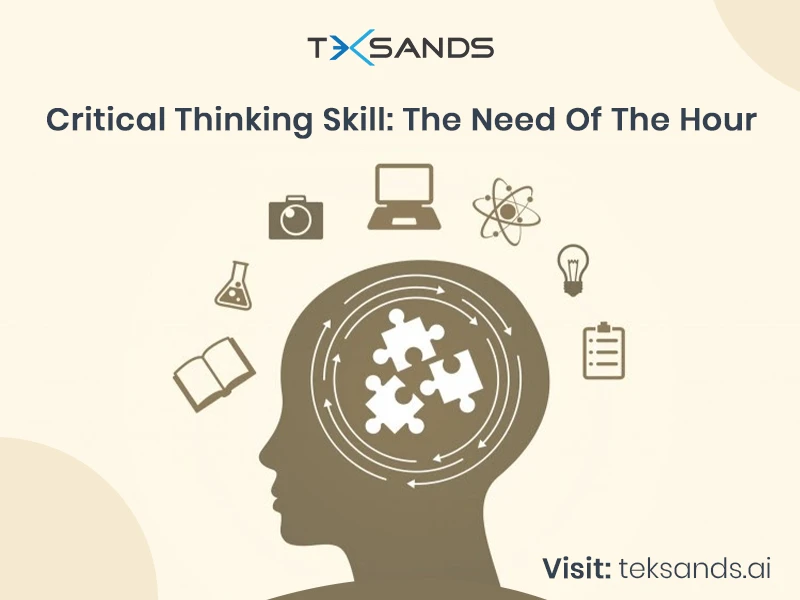
This is why we like to talk about Employee Training and Development and critical thinking, following as usual in our style, the doctrinal currents that make us notice these necessary changes to reflect on the importance that they will have in the current leadership and in the medium term of organisations, which is our main task. It implies the examination of thought structures that are part of our reasoning, which makes us stop to study what our objective is, the problem we face, the questions we ask ourselves, the assumptions that cause doubts in our minds, as well as the perception we have of one or more things, concepts, or the way we decide, etc.
It is evident that critical thought is not an island but rather forms part of a family of modes of human thought, such as scientific thought, or also mathematical and historical thought, going through anthropological, economic, or philosophical thought. Its intangible and non-morphological structure is what places us in critical thinking at two speeds: the skills that generate and process information and beliefs, which end up shaping our principles and values, and the habit (our behaviour) based on the intellectual ability to make use of all our resources (skills) to guide our behaviour. In the field of leadership, for example, we can find different situations that show the best or worst use of critical thinking, which would automatically qualify these leaders as more or less effective.
Abilities Of A Critical Thinker
One consideration to keep in mind is that there is no leader, no matter how outstanding, whose critical thinking is universal because it depends on the degree and dependence of many elements and factors. This is where experience in certain skills in the field of business and organisations plays a predominant role. No one can master the wide range of critical thinking, but due to its characteristics (personality typology) and personal circumstances that have led them to that position, they can delve into a certain type of thinking that makes it easier for them to answer questions or face problems.
Nobody is a critical thinker from beginning to end, but only to a certain degree, with strong and weak points, with certain tendencies to think and/or act in a certain way. The question is not whether you have it to a certain degree. The effectiveness of a leader is seen by how he applies it and what critical thinking he submits to in different situations. Being similar, they are not contextualised in the same way. For this reason, developing critical thinking skills and dispositions is a lifelong endeavour
Much of our thinking, by itself, is distorted, arbitrary, uninformed, or biased. However, the quality of our life and of what we produce, build, or do depends, precisely, on the quality of our thinking. This is why it is important to have critical thinking, as it helps us make better decisions in our daily lives.
A critical thinker has the ability to:
Evaluate the knowledge acquired.Question information, conclusions, and points of view.Identify and reject valid or failed ideas.Perceive the question that must be reformulated to have a better answer.Delve with logic and impartiality.As we can see, it does not sound easy to be a critical thinker. However, we have many advantages of being one, so we can work on developing such thinking day by day and little by little. For that, we have to start with the basic skills of thinking, which are:
WatchCompareRelateSort outDescribeOn the contrary, these skills may seem very easy and logical, but the objective is that we become aware of them when we perform these skills. An example is when we observe without paying attention to the details.
How Can Teksands’ Lift-Off Program Help You?
It cannot be disputed that all companies throughout the different industries worldwide need talents that possesses critical thinking skills. All organisations require professionals with critical thinking abilities so that they can act proactively in the face of challenges and use their critical thinking skills to solve problems as and when they occur. This is precisely where the Lift-Off program comes into the picture. With this program in your corner, you can hire skilled personnel with critical thinking abilities so that they can communicate better and come up with some out-of-the-box ideas to aid in the growth of an organisation. The Bootcamp program targets specific skills and hence, you can handpick skilled resources from their Coding Bootcamp that can prove to be an asset to your organisation.
With Teksands’ Lift-Off Program, recruitment becomes a cakewalk as you can hire professionals directly from the Bootcamp. Teksands make Java Full Stack Development recruitment easy!

























Sign in to leave a comment.