

A CRM system can become the central platform for managing customer relationships, sales activity, service operations, and business data. However, simply purchasing CRM software does not guarantee better results. Businesses need the right strategy, configuration, data structure, integrations, automation, and user adoption to turn a CRM into a valuable business system.
This is where CRM implementation services become important.
For UK businesses looking to improve customer visibility, streamline processes, and support sustainable growth, a well-planned CRM implementation can create a connected environment where sales, service, marketing, and operations teams work from reliable customer information.
What Are CRM Implementation Services?
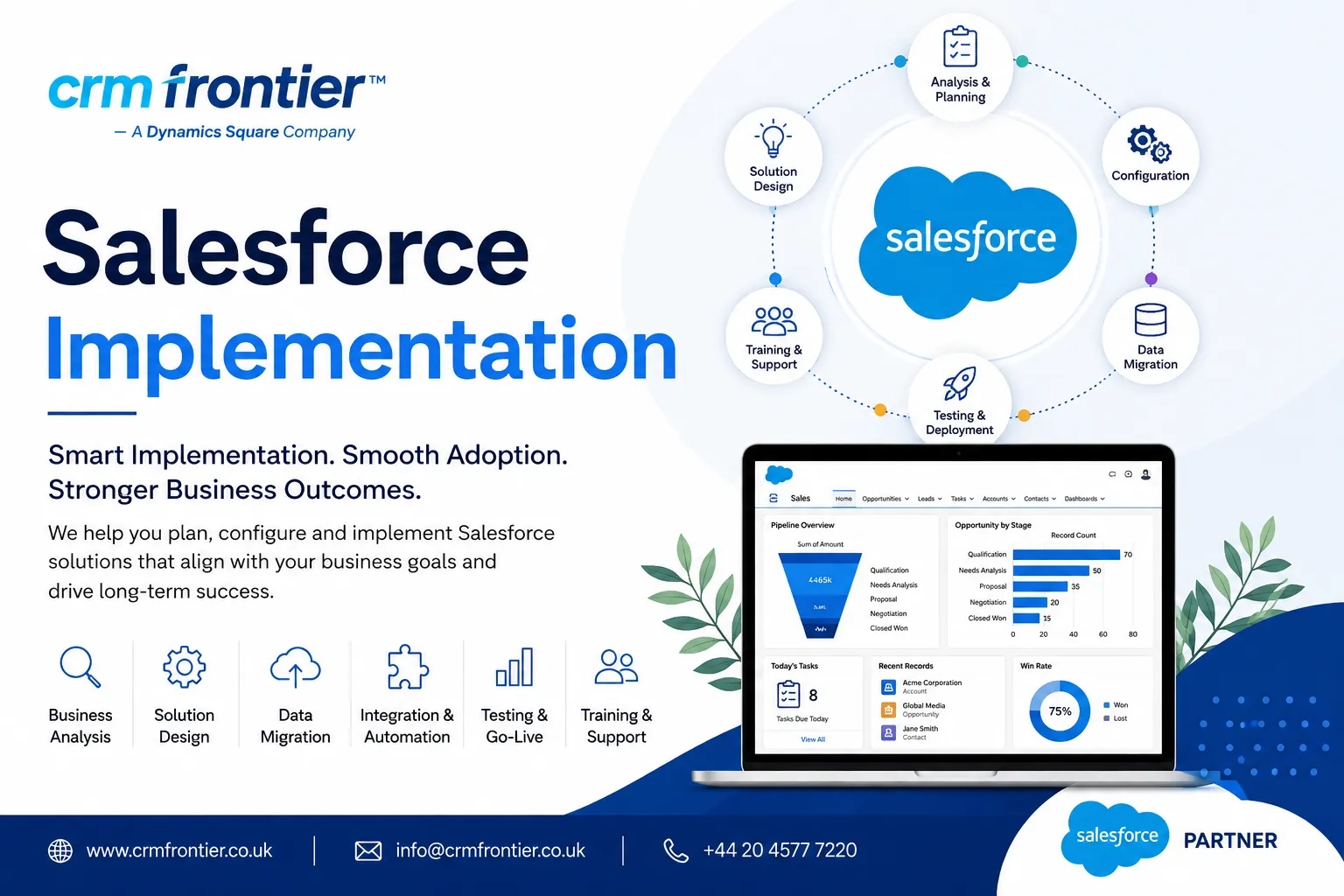
CRM implementation services cover the planning, configuration, deployment, data migration, integration, testing, training, and launch of a customer relationship management platform.
The objective is not simply to install CRM software. Instead, the CRM should be designed around the organisation's processes, customers, teams, and business goals.
A typical CRM implementation may include:
- Business and process analysis
- CRM strategy and planning
- Solution design and architecture
- CRM configuration and customisation
- Data migration and cleansing
- Third-party system integration
- Workflow and process automation
- Reports and dashboards
- User testing and training
- Go-live planning
- Post-launch support and optimisation
A structured approach helps businesses avoid unnecessary complexity while creating a CRM environment that employees can actually use.
Why Do Businesses Need CRM Implementation Services?
Many organisations already use spreadsheets, disconnected applications, email systems, and legacy databases to manage customer information. As a company grows, these systems can make it difficult to maintain accurate customer data and understand the complete customer journey.
A professional CRM implementation can help address common challenges such as:
1. Disconnected Customer Data
Customer information may be stored across different systems. A CRM can bring relevant information together and provide teams with a more complete view of customer interactions.
2. Manual Processes
Sales and service teams often spend time updating spreadsheets, sending internal emails, or performing repetitive administrative tasks. CRM automation can reduce unnecessary manual work.
3. Limited Sales Visibility
Without centralised opportunity and pipeline data, sales managers may struggle to understand current performance, forecasts, and potential revenue.
4. Poor Reporting
A properly configured CRM can provide dashboards and reports that help management monitor sales, service activity, customer engagement, and operational performance.
5. Low User Adoption
A CRM that is difficult to use can quickly become another system employees work around. Implementation should therefore focus on usability and adoption rather than adding unnecessary features.
Salesforce as a CRM Implementation Platform
Salesforce is widely used by organisations that want a scalable CRM platform capable of supporting sales, customer service, marketing, and other business processes.
However, Salesforce implementation requires more than basic configuration. Businesses need to determine how Salesforce should support their existing workflows, customer journeys, data requirements, reporting needs, and future growth.
A Salesforce implementation can include solutions such as Sales Cloud, Service Cloud, Marketing Cloud, and other Salesforce capabilities depending on the organisation's requirements.
For UK businesses considering Salesforce, working with an experienced Salesforce implementation partner can help reduce implementation risks and create a stronger foundation for long-term CRM adoption.
Key Stages of a Successful CRM Implementation
1. Discovery and Business Analysis
The implementation should begin with understanding the business.
This includes reviewing current processes, identifying challenges, speaking with stakeholders, and defining what the organisation expects from its CRM.
The goal is to understand the business before deciding how the CRM should be configured.
2. Solution Design
Once requirements are established, the implementation team can design the CRM environment.
This may include defining:
- Customer and account structures
- Sales processes
- Service processes
- User roles and permissions
- Data requirements
- Automation opportunities
- Reporting requirements
- Integration requirements
3. CRM Configuration
The CRM is then configured around the agreed business requirements.
Depending on the project, configuration may include objects, fields, workflows, automation, permissions, dashboards, reports, and other functionality.
The focus should be on creating a system that supports business processes without unnecessary complexity.
4. Data Migration
Data migration is one of the most important parts of CRM implementation.
Existing customer information may need to be extracted, cleaned, mapped, validated, and migrated into the new CRM.
Poor-quality data can reduce the value of the CRM, so organisations should address duplicate, incomplete, outdated, or inconsistent information before and during migration.
5. Integration
Businesses rarely operate with only one software platform.
A CRM may need to connect with marketing platforms, accounting systems, websites, communication tools, ERP systems, or other business applications.
CRM integration can help reduce duplicate data entry and create smoother information flow between systems.
6. Testing and User Training
Before launch, the CRM should be tested against real business scenarios.
User acceptance testing can help identify issues before the system goes live.
Training is equally important. Employees should understand not only how to use the CRM but also how it fits into their daily responsibilities.
7. Go-Live and Continuous Improvement
Go-live is not the end of CRM implementation.
After launch, businesses should monitor adoption, user feedback, reporting quality, system performance, and changing business requirements.
Ongoing CRM optimisation and support can help the platform continue to deliver value as the organisation grows.
Benefits of Professional CRM Implementation Services
A well-planned CRM implementation can provide several business benefits:
Better customer visibility: Teams can access important customer and interaction information from a central system.
Improved productivity: Automation can reduce repetitive administrative tasks.
Stronger sales management: Sales teams can manage leads, opportunities, pipelines, and forecasts more effectively.
Better reporting: Centralised data can support more consistent reporting and decision-making.
Improved collaboration: Sales, service, marketing, and operations teams can work from shared customer information.
Scalability: A properly designed CRM can evolve as business requirements change.
Higher user adoption: A CRM designed around real workflows is more likely to be used consistently.
Why Choose CRM Frontier for CRM Implementation?
CRM Frontier helps UK businesses implement, integrate, customise, optimise, and support Salesforce.
Its approach starts with understanding how teams work, where information comes from, and what business challenges need to be solved. The implementation process follows a structured journey covering Discover, Design, Build, Launch, and Improve.
CRM Frontier focuses on creating Salesforce environments that are practical, scalable, and designed for user adoption rather than unnecessary complexity.
For organisations starting a new Salesforce project or looking to improve an existing CRM environment, professional implementation support can provide a clearer path from planning to long-term CRM value.
Final Thoughts
Investing in CRM software is only the beginning. The real value comes from implementing the platform around the needs of the business.
The right CRM implementation services can help organisations build reliable customer data foundations, automate processes, improve reporting, connect business systems, and encourage stronger user adoption.
For UK businesses considering Salesforce, choosing an experienced implementation partner such as CRM Frontier UK can help turn Salesforce from another business application into a practical platform for sales, service, customer relationships, and long-term growth.


























Sign in to leave a comment.