Introduction
Choosing between CRM and ERP often feels like standing at a crossroads with too many signposts and not enough clarity. Both systems promise growth, efficiency, and control—yet they solve very different problems. Businesses chasing long-term sustainability usually discover this distinction a little too late, often after workflows begin to crack under pressure. Years of watching fast-growing teams wrestle with the “wrong” system reveal a common pattern: technology decisions made for today rarely survive tomorrow’s scale. So, before committing budget and bandwidth, it’s worth slowing down and understanding what each platform truly brings to the table—and what it quietly demands in return.
What a CRM Really Does (Beyond Sales Pipelines)
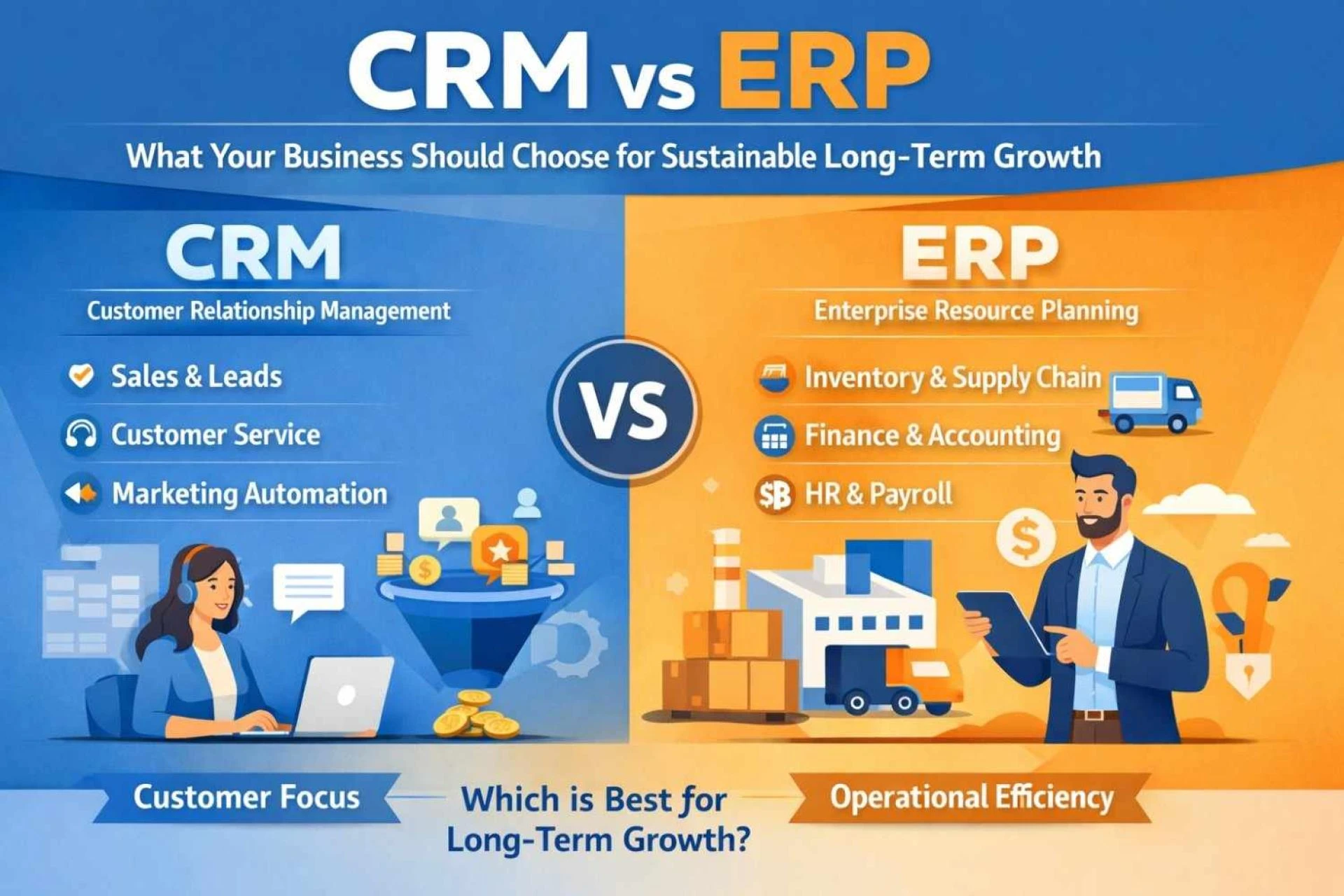
A CRM is often described as a sales tool, but that label barely scratches the surface. At its core, a CRM system organizes relationships—leads, prospects, customers, and the history attached to them. Marketing automation, customer support tracking, and analytics are usually aligned with sales pipelines. Problems emerge when growth accelerates, and off-the-shelf tools start feeling rigid. That’s where Custom CRM Software Development enters the conversation, allowing businesses to shape workflows around real customer journeys instead of forcing teams to adapt to generic processes. Used correctly, CRM becomes a revenue enabler, not just a digital contact list.
What an ERP Actually Manages (And Why It’s Heavier)
ERP systems operate behind the scenes, quietly running the operational engine of a business. Finance, procurement, inventory, manufacturing, HR, and compliance often live under one umbrella. This breadth explains why ERP implementations feel heavier and slower than CRM rollouts. ERP Software Development focuses less on quick wins and more on stability, accuracy, and long-term control. The payoff arrives when leadership gains a single source of truth for operations. The downside? Complexity, cost, and change management challenges that can overwhelm organizations not operationally ready for such a comprehensive system.
CRM vs ERP — The Strategic Differences That Matter
The real difference between CRM and ERP isn’t functionality—it’s perspective. CRM looks outward, focusing on customers, interactions, and revenue opportunities. ERP looks inward, prioritizing efficiency, cost control, and operational discipline. CRM thrives in fast-moving, growth-focused environments, while ERP shines where predictability and scale matter most. Confusion arises when one system is expected to replace the other. Experience shows that frustration follows quickly. Each platform solves a distinct strategic problem, and treating them as interchangeable tools often leads to underutilization, wasted spend, and internal resistance.
Growth Stages — Which System Fits When?
Early-stage businesses typically benefit more from CRM systems, where visibility into leads and customers directly fuels revenue growth. As operations become more complex—multiple departments, higher transaction volumes, stricter compliance ERP becomes increasingly attractive. Scaling companies often find themselves stuck in the middle, juggling spreadsheets and disconnected tools. That’s usually the signal that operational maturity is catching up with ambition. The right system depends less on company size and more on process complexity. Growth doesn’t demand more software—it demands the right software at the right time.
The Cost Myth (Upfront vs Long-Term Reality)
Sticker price rarely tells the full story. CRM tools may appear affordable initially, but customization, integrations, and user adoption costs add up over time. ERP systems demand higher upfront investment, yet often deliver stronger long-term ROI by reducing errors and inefficiencies. The real cost driver is misalignment—buying a system before processes are ready or delaying one after complexity explodes. Long-term growth favors technology that evolves with the business, not platforms chosen solely for short-term budget comfort or impressive feature lists.
Why “Either/Or” Is Often the Wrong Question
Framing CRM versus ERP as a binary choice oversimplifies reality. Many successful businesses eventually run both, connected through integrations that allow data to flow cleanly. CRM captures demand; ERP fulfills it. Problems only surface when systems operate in silos or compete for ownership of the same data. Observations across industries suggest that integration strategy matters more than platform selection. When systems talk to each other, teams collaborate better, decisions happen faster, and leadership sees the whole picture instead of fragmented snapshots.
Custom vs Off-the-Shelf — A Long-Term Lens
Off-the-shelf solutions work well for standardized processes, but growth often introduces nuance. Custom CRM Software Development allows organizations to reflect unique sales cycles, customer segmentation, and reporting needs without excessive workarounds. Similarly, tailored ERP Software Development supports industry-specific compliance and operational flows. Customization isn’t about building everything from scratch—it’s about flexibility. The risk lies in over-engineering. The sweet spot balances proven frameworks with targeted customization, ensuring systems remain scalable, maintainable, and aligned with long-term strategy rather than short-term convenience.
Decision Framework (Practical Checklist)
Choosing between CRM and ERP becomes easier with a structured lens. Consider current pain points: revenue visibility or operational inefficiency. Evaluate growth plans over the next three to five years. Assess internal readiness for change, including training capacity and leadership alignment. Budget matters, but governance matters more. Systems amplify existing habits—good or bad. A thoughtful decision framework prevents reactive purchases and encourages intentional growth. Technology should support strategy, not dictate it.
Conclusion
Sustainable growth isn’t driven by software—it’s driven by clarity. CRM and ERP serve different purposes, solve different problems, and mature at different stages of a business journey. The smartest organizations resist rushing the decision and instead align technology with strategy, timing, and operational readiness. Growth rewards patience and foresight far more than impulse purchases. When systems are chosen deliberately, they stop feeling like constraints and start acting like quiet partners—supporting expansion without stealing focus from what actually matters: building a resilient, scalable business.
FAQs
Is CRM or ERP better for small businesses?
CRM is usually better early on, as it supports sales and customer relationships without heavy operational overhead.
Can a business start with CRM and add ERP later?
Yes. Many businesses follow this path as complexity increases.
How long does ERP implementation usually take?
ERP projects often take several months to over a year, depending on scope and customization.
Does a CRM replace accounting software?
No. CRM handles customer data, while accounting remains an ERP or finance system function.
What’s the biggest mistake when choosing between CRM and ERP?
Buying based on features instead of long-term business maturity.
Sign in to leave a comment.