
Connected TV (CTV) advertising has become an increasingly important channel for brands that want the reach and impact of television combined with the targeting capabilities of digital advertising. However, one of the first questions advertisers ask is: How much does CTV advertising cost?
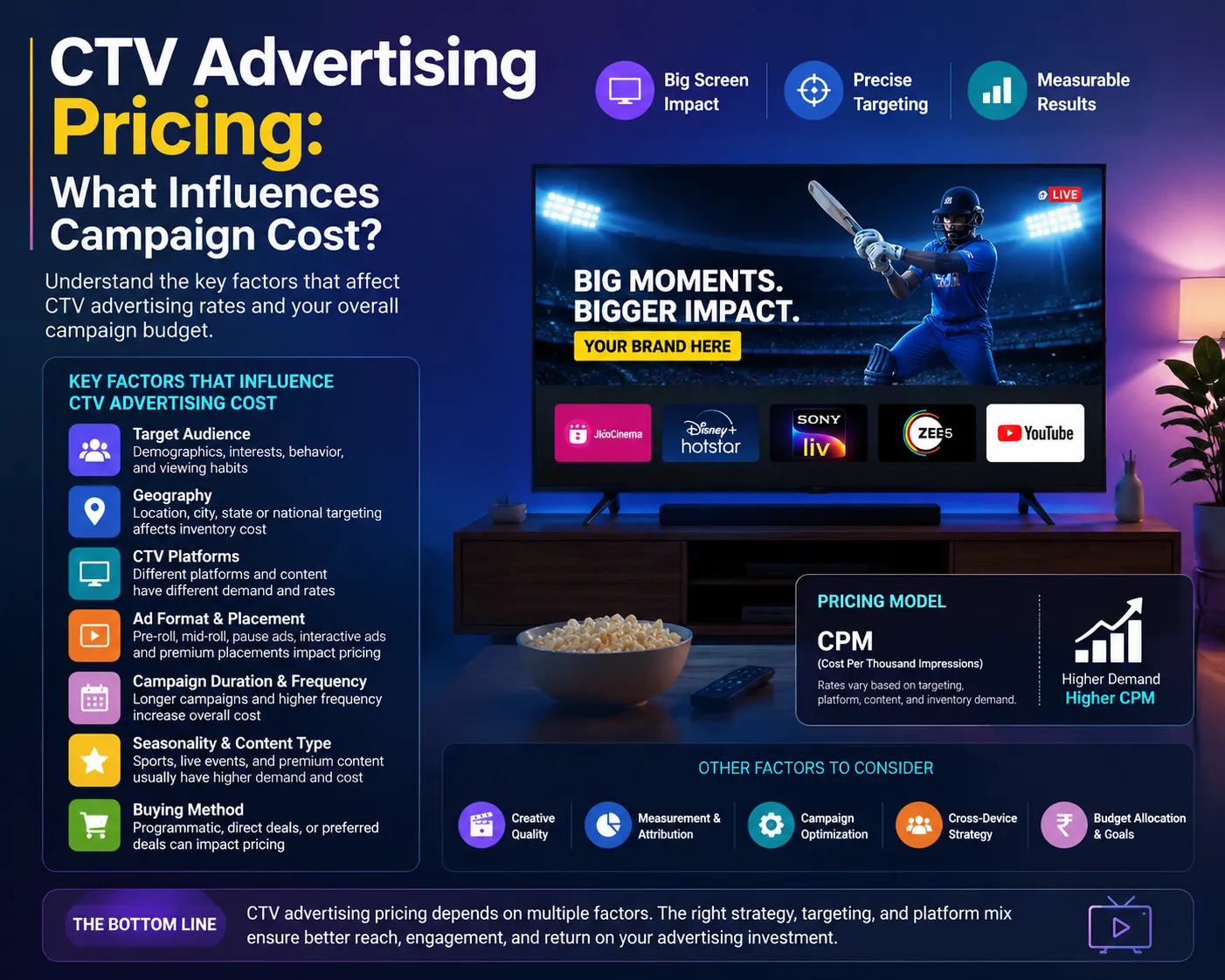
There is no single fixed price for a CTV campaign. CTV advertising pricing depends on several factors, including the audience being targeted, geography, platform, content category, campaign duration, ad format, inventory availability, and buying method. Understanding these factors can help brands plan their budgets more effectively and choose the right CTV advertising solutions.
What Determines CTV Advertising Cost?
The cost of Connected TV advertising can vary significantly depending on campaign requirements. Some of the most important factors include:
1. Target Audience
Audience targeting is one of the biggest factors influencing CTV advertising pricing. Advertisers can target viewers based on demographics, interests, location, household characteristics, device type, and viewing behaviour.
A highly specific audience may cost more than broad targeting because premium audience segments and limited inventory can command higher rates.
2. Geography
The location where you want to show your CTV ads also affects campaign cost.
A campaign targeting a single city may require a smaller budget than a nationwide campaign. Advertisers can also focus on specific states, regions, or urban and Tier-2 markets depending on their objectives.
This makes CTV advertising in India particularly useful for brands that want to combine large-screen advertising with geographic targeting.
3. CTV Platforms
The platform where an advertisement appears can influence pricing. Advertisers may choose from different CTV platforms and Connected TV environments based on their target audience and content preferences.
Sports, premium entertainment, regional content, movies, and live events may have different inventory costs because audience demand and availability vary.
Choosing the right Connected TV platforms is therefore an important part of CTV campaign planning.
4. Ad Format
The type of advertisement can also affect the campaign budget. Common CTV ad formats include:
- Pre-roll video ads
- Mid-roll video ads
- Post-roll ads
- Pause ads
- Interactive CTV ads
- Sponsored content
- Premium video placements
- Event and sports advertising
Premium placements or high-demand formats may have higher rates than standard inventory.
5. Campaign Duration and Frequency
A campaign running for several weeks or months will naturally require a larger overall investment than a short campaign.
Advertisers also need to consider frequency—how often the same household sees an advertisement. Increasing frequency can improve brand recall, but it can also increase total campaign cost.
6. Seasonality and Premium Content
CTV advertising rates can increase when demand for inventory rises. Major sporting events, festivals, movie launches, and popular entertainment programs can attract significant advertiser interest.
For example, campaigns around cricket tournaments or major Indian sporting events may have higher demand than regular programming.
7. Buying Method
The way inventory is purchased also influences pricing. Advertisers can use direct deals, programmatic buying, or managed media buying depending on campaign requirements.
CTV media buying can help advertisers identify suitable inventory, audience segments, platforms, and geographic markets while managing campaign budgets more efficiently.
How Are CTV Advertising Rates Usually Calculated?
One commonly used pricing metric is CPM (Cost Per Thousand Impressions). Instead of paying a fixed amount simply for being present on a particular television channel, advertisers can evaluate CTV inventory based on the number of impressions delivered.
For example, if a campaign delivers 100,000 impressions at a CPM of ₹300, the media cost would be approximately ₹30,000.
However, the actual CTV CPM rates can vary depending on targeting, platform, content, geography, inventory quality, campaign scale, and other factors. Therefore, advertisers should avoid treating one CPM as a universal CTV advertising price.
CTV Advertising Pricing vs Traditional TV Advertising
CTV and traditional TV both offer large-screen video advertising, but their pricing and planning models can differ.
| CTV Advertising | Traditional TV Advertising |
| Audience-based targeting | Channel/program-based targeting |
| Digital campaign measurement | Traditional TV measurement |
| Flexible geographic targeting | Often broader geographic reach |
| Programmatic buying available | Primarily scheduled inventory |
| Impression-based buying options | Often spot-based buying |
| Cross-device measurement opportunities | More limited digital attribution |
For brands that want television-style visibility with greater audience control, CTV advertising can provide an attractive addition to a traditional TV strategy.
How to Reduce Your CTV Advertising Cost
A larger budget does not necessarily mean a better campaign. Effective CTV campaign planning can help brands use their budgets more efficiently.
Some practical approaches include:
Start with a defined audience: Avoid paying for impressions outside your target market.
Focus on relevant geographies: If your business operates only in selected cities, consider limiting the campaign geographically.
Choose platforms based on audience fit: The most expensive platform is not necessarily the most effective platform for every campaign.
Test before scaling: Start with a controlled campaign, evaluate performance, and increase investment based on results.
Manage frequency: Avoid excessive exposure to the same household while maintaining sufficient frequency for brand recall.
Use campaign optimization: Monitor delivery and performance throughout the campaign and adjust targeting or inventory where appropriate.
What Should Be Included in a CTV Advertising Budget?
When calculating the cost to advertise on Connected TV, brands should consider more than just media spend. A campaign budget may include:
- Media buying cost
- CTV inventory cost
- Audience targeting
- Creative production
- Premium placements
- Campaign management
- Measurement and reporting
- Optimization
- Cross-device or retargeting requirements
Understanding the complete cost structure makes it easier to compare different CTV advertising solutions and plan an appropriate campaign budget.
Is CTV Advertising Suitable for Small and Large Brands?
CTV is not limited to large national advertisers. With geographic and audience targeting, regional businesses and SMEs can create campaigns around specific cities or audience segments rather than purchasing nationwide inventory.
At the same time, large brands can use Connected TV advertising for nationwide campaigns, major sporting events, product launches, and full-funnel marketing strategies.
The key is to match the campaign budget with the desired audience, reach, frequency, and business objective.
How to Choose the Right CTV Advertising Strategy
Before launching a campaign, advertisers should answer five important questions:
- Who do we want to reach?
- Where do they live?
- Which CTV platforms and content do they consume?
- What campaign objective are we trying to achieve?
- How much can we invest while maintaining the required reach and frequency?
Once these factors are defined, advertisers can select the appropriate platforms, formats, targeting options, and buying strategy.
CTV Advertising Pricing: The Bottom Line
There is no universal CTV advertising cost because every campaign is different. Audience targeting, geography, platform, ad format, content, seasonality, frequency, inventory demand, and buying method can all influence CTV advertising rates and pricing.
For brands planning to buy CTV ads, the best approach is to focus on the value generated from the campaign rather than simply choosing the lowest available rate. A well-planned campaign can combine the reach and impact of television with the targeting, measurement, and flexibility of digital advertising.
If you are planning to run CTV ads in India, working with a specialist can help you compare inventory, understand CTV advertising pricing, select relevant platforms, plan media efficiently, and optimize campaigns based on your objectives. A professional CTV advertising agency can also assist with media planning, audience targeting, CTV media buying, campaign management, and performance optimization.





























Sign in to leave a comment.