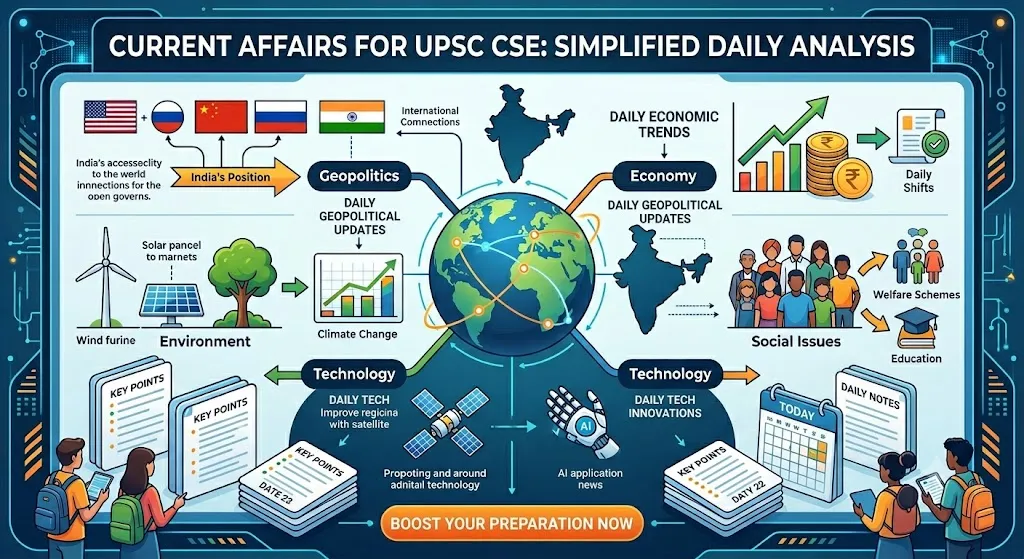

Let’s be honest. Navigating the massive, ever-shifting ocean of news for the Civil Services Examination can feel completely overwhelming. You open a newspaper, and within minutes, you are drowning in editorial opinions, political back-and-forth, and endless statistics. With the Preliminary and Mains stages functioning as strict elimination rounds, managing your daily study time requires absolute precision. If you are a serious civil services candidate, you already know that general conceptual clarity in core subjects is only half the battle. To secure your spot in the next phase, keeping a sharp focus on a high-yielding upsc prelims current affairs analysis will help you filter out low-value information.
By systematically tracking relevant global and domestic trends, you ensure your daily revision remains tightly targeted. Many candidates fail not due to a lack of effort, but because they spread their energy too thin across disconnected resources. Aligning your schedule with verified upsc prelims current affairs patterns allows you to optimize your study hours. Integrating your upsc prelims current affairs routine with core static subjects builds the conceptual confidence necessary to face highly complex question formats under intense pressure.
1. Economy & Financial Infrastructure: High-Yield Frameworks
The economic questions in the screening round are almost entirely driven by micro and macro developments that occurred over the preceding 12 to 15 months. When building your targeted plan for upsc current affairs, look past simple percentage calculations and focus heavily on structural and regulatory changes.
- Monetary Policy Transmission: Pay close attention to how the Reserve Bank of India (RBI) manages liquidity through complex tools like incremental cash reserve ratios (I-CRR) and standing deposit facilities (SDF).
- The Shift in Inflation Metrics: Understand the structural discussions around India moving from the Wholesale Price Index (WPI) to the Producer Price Index (PPI) for a clearer view of economic trends.
- External Sector Realities: Focus on the internationalization of the Rupee, local currency settlement (LCS) frameworks established with global trade partners, and the mechanics of the current account deficit (CAD).
Relying on a reliable source for your daily upsc current affairs revision ensures you do not waste hours guessing which economic indicators matter most. Modern papers prioritize operational logic over static definitions, making an integrated analysis of upsc current affairs absolutely indispensable for modern test-takers. Consistently tracking upsc current affairs helps you notice macro-level trends that standard textbooks fail to capture in real time.
2. Environment, Ecology & Geography: The Selection Drivers
Over the last few examination cycles, the intersection of ecology and geography has emerged as a major factor in determining final qualifying scores. The Commission heavily tests international commitments and fine-grained geographical data, which form a substantial part of the yearly upsc cse current affairs syllabus.
Crucial Ecological Focus Sectors
| Core Domain Topic | Vital Elements to Revise | Strategic Focus Area |
|---|---|---|
| International Treaties | UNFCCC COP decisions, Global Biofuel Alliance protocols | Read the fine print of structural frameworks over surface-level overviews. |
| Conservation Zones | Newly designated Ramsar Sites, Tiger Reserves, Wildlife Sanctuaries | Memorize precise physical geography features (rivers, hills, vegetation). |
| Species in the News | Critically endangered local fauna, invasive species migrations | Understand specific habitat conditions and distinct behavioral adaptations. |
| Geographical Mapping | Conflict-ridden international water corridors, border disputes | Track geopolitical choke points across West Asia, Africa, and the Red Sea. |
Mastering these ecological matrices requires a disciplined tracking of ongoing upsc cse current affairs trends. Candidates who successfully map out spatial data side-by-side with dynamic updates consistently perform better. Keeping your upsc cse current affairs notes highly organized by geographic zone will help you recall complex environmental parameters. Dedicating proper attention to upsc cse current affairs guarantees you grasp the complex administrative policies that are highly tested.
3. Polity & Constitutional Governance: Real-World Applications
When it comes to the governance syllabus inside the comprehensive current affairs for upsc cse ecosystem, questions are rarely pulled from thin air. They are almost always prompted by recent legislative debates, constitutional challenges, or landmark judicial rulings.
- Electoral System Mechanics: Understand the operational realities of the Model Code of Conduct (MCC), laws governing the disqualification of elected representatives under the Tenth Schedule, and the structural management of the Election Commission of India.
- Federal Balance & State Relations: Analyze the constitutional powers of Governors regarding bills passed by state legislatures, the financial distribution frameworks of the Finance Commission, and Article 356 implications.
- Rights & Digital Governance: Study the practical application of data privacy frameworks, online content regulation under information technology guidelines, and the evolving legal boundary of fundamental rights under Article 21.
By rooting your constitutional revisions in recent current affairs for upsc cse, you change your perspective from passive memorization to practical application. The examiner expects you to see the living document behind the legal text, which is why a thorough evaluation of current affairs for upsc cse is vital to answering multi-layered polity statements correctly. Relying on streamlined current affairs for upsc cse notes saves you from getting lost in endless, non-essential administrative details.
4. Science, Technology & Defense Innovation
The science section has completely evolved from basic textbook definitions into an analysis of disruptive technologies shaping global industries. You need a simplified daily framework to track these fields effectively without getting bogged down in pure engineering jargon:
- Artificial Intelligence & Advanced Computing: Deeply analyze the foundational layers of Large Language Models (LLMs), deepfake detection technologies, quantum computing architectures, and semiconductor fabrication supply chains.
- Space Exploration Frontiers: Review regional satellite navigation networks, deep-space exploration missions, and the growing ecosystem of private aerospace ventures in India.
- Public Health & Biotechnology: Master the mechanics of Monoclonal Antibody therapies, CRISPR-Cas9 genetic engineering advancements, and the operational principles of next-generation vaccine delivery platforms.
Insights and Strategies from Your Peers
Transitioning from passive reading to active, structured daily analysis completely changes how you retain complex information under pressure. Here is what successful candidates have to share about maximizing their study cycles:
"During my initial attempt, I made the mistake of memorizing massive 500-page monthly compilation booklets right before the exam, which led to intense confusion. For my next attempt, I shifted my focus to linking daily news back to static topics. Integrating my upsc prelims current affairs plan with core textbooks made all the difference in clearing the GS Paper 1 cutoff safely." > — Abhinav Kulkarni, Pune
"Don't treat science and environment questions as random facts. When you look at the official trend analysis, every single tech or species question is rooted in a major development from the past year. Sticking to a disciplined, theme-based current affairs for upsc cse revision framework prevents you from wasting time on low-yield data points." > — Meera Nair, Thiruvananthapuram
Frequently Asked Questions (FAQs)
How many months of current affairs should I cover for the preliminary round?
A standard, effective preparation cycle requires a deep dive into the preceding 12 to 15 months of news. However, for highly critical core sectors like Environment and Science & Technology, reviewing major institutional updates from up to 24 months prior via specialized upsc current affairs overviews is highly recommended.
Should I prioritize extensive data memorization or conceptual trends?
The Commission consistently prioritizes structural trends and functional purposes over raw, isolated statistics. For example, understanding why a central banking mechanism is being implemented is significantly more valuable than memorizing the specific date or initial currency volumes associated with it in your upsc cse current affairs notes.
How can I effectively balance static subjects with dynamic revisions?
The most efficient approach is to dedicate roughly $70\%$ of your daily revision schedule to cementing foundational static subjects, while allocating the remaining $30\%$ to analyzing how dynamic updates connect to those topics. This integrated method ensures you are prepared for multi-layered questions featured in upsc prelims current affairs segments.
Are international indexing systems and organizational reports still high-yield?
Yes, but the focus has evolved. Instead of simply memorizing the name of an organization and India's specific rank, you must understand the exact underlying parameters, evaluation methodologies, and the specific global bodies responsible for compiling those reference metrics as highlighted in recent current affairs for upsc cse analyses.



























Sign in to leave a comment.