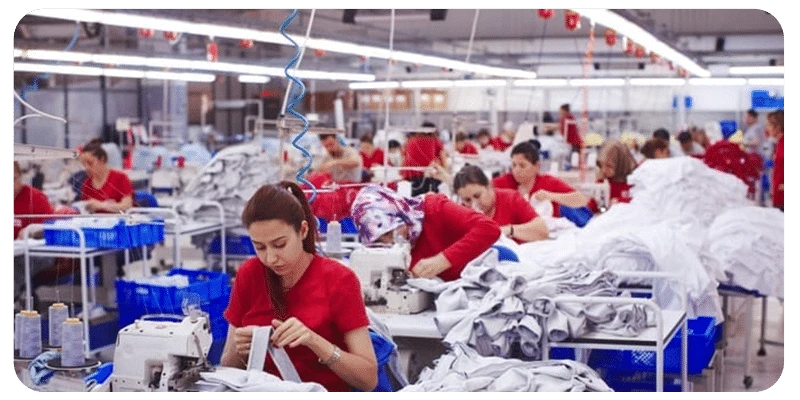

The Harappa culture, which lived in Pakistan four thousand years ago, left the nation with the legacy of spinning and weaving. Since then, Pakistan has kept on this age-old heritage, growing to become Asia's ninth-largest exporter of textile items. After India and China, the country is also the fourth-largest producer of cotton and has the highest spinning capacity in Asia.
The Current State of Textile and Clothing Export
In 2018-2019, the textile sector was Pakistan's largest export industry, with hosiery and ready-made garments contributing 544 billion PKR/3.47 billion USD to overall trade. Textile exports climbed 2.3 per cent year on year during 2MFY20, while overall exports increased 3 per cent.
During the first two months of FY20, the textile group accounted for 61 per cent of overall exports, compared to 62 per cent during the same period last year—a little change. Despite the loss of percentage shares, the textile group's trade balance increased by 10%.
Textile exports that are higher on the value chain, such as knitwear, bed wear, and ready-made clothes, have witnessed growth. These three combined accounts for more than half of the textile group's weight and 38% of total exports.
Experts in the Pakistan textile business believe that the ready-made garment industry has emerged as one of the country's most promising sectors, albeit on a modest scale. There is a high demand for ready-made clothing both locally and internationally. This industry meets most of the local requirements, using machines assembled in the United States.
Here are some of the growing challenges of Pakistan’s textile:
Less skill in synthetic fibre: Pakistan's textile and garment industry is less focused on synthetic fibre and less inventive in this area. Because their whole garment supply chain is still reliant on cotton, they cannot attract the EU and US markets.Power and energy crisis:An uninterrupted energy supply is critical for the production process and smooth industrial expansion. According to a World Bank poll, 66.7 per cent of enterprises in Pakistan saw energy shortages as a significant barrier to doing business than corruption (11.7 per cent) and crime/terrorism (5.5 per cent).Increasing raw material costs:In addition to the electricity issue, the government's incompetence and lack of policy are to blame for rising raw material prices.Lack of R&D institutions:Pakistan's cotton sector has suffered from a lack of R&D, resulting in inferior cotton quality in comparison to the rest of Asia. Because of low profitability in cotton harvests, farmers in Pakistan are migrating to alternative cash crops. Additionally, there is a lack of supporting R&D efforts in fabric to compete with present and rising competitors.Lack of new investments: Due to Pakistan's volatile political situation, no one is interested in investing there.Pakistan's Potential for Development – GSP+ Status
Pakistan was granted GSP+ status in 2014, and since then, the country's exports to the EU have surged by 62%. According to Pakistani media sources, Pakistan's exports to the EU increased dramatically in the early years but remained stagnant at €5.514 billion over the previous three years.
The causes for the static state include shaky political stability and the movement of major retailers and brands' trading houses and purchasing houses to other competing nations.
Experts believe that Pakistan can maximize its textile export to the EU by 15 times higher. Since becoming a recipient of GSP Plus discounts to 28 European nations in 2014, Pakistan's exports to the EU have averaged 32%, up from 25% before this status. Actually, the GSP+ designation represents the highest potential and chance to expand Textile and apparel manufacturers in Pakistan.
Pakistan Government’s Helping Hands Are Also There
The Pakistani government has also made changes to its textile strategy for 2014-2015 in order to encourage and elevate the sector. The modifications include an emphasis on suitable infrastructure, adequate investments, appropriate training centres, and research organisations for generating excellent goods in the textile sector. It would also focus on regional commerce to increase garments manufacturers in Pakistan, especially in Karachi, Islamabad, and Faisalabad.
The Future – The EU Will Assist Pakistan in Increasing Textile Exports
The European Union (EU) and apparel manufacturers in Pakistan have joined forces to work toward the textile sector's long-term prosperity. According to Androulla Kaminara, the EU's nominated ambassador to Pakistan, if the government and industry leaders engage with good perception management, the country's exports to the EU bloc may double its revenue.
"Pakistan must prepare to overcome the challenges of maintaining a generalised system of preferences plus (GSP+) status to capitalise on chances to increase exports to the EU," Kaminara said during a meeting with a delegation from the All Pakistan Textile Mills Association (APTMA).
The Future of Pakistan’s Textile is Bright
Pakistan is the world's fourth-largest cotton grower, with the third greatest spinning capacity in Asia after China and India, accounting for 5% of worldwide spinning capacity. The Spinning Sector (output Yarn) is Pakistan textile’s backbone and apparel clothing manufacturers should understand this.
According to TCO records, it currently has 523 textile units (40 composite units and 483 spinning units) with 13.269 million spindles and 185 thousand rotors installed and 11.083 million spindles and 140 thousand rotors in operation, with capacity utilisation of 84 per cent and 76 per cent, respectively, from July to March of 2017. More than 65 per cent of textile units are located in Punjab, 25 per cent in Sindh, around 5 per cent in KPK, and the remainder in Baluchistan and Azad Kashmir.
0










Sign in to leave a comment.