
Introduction
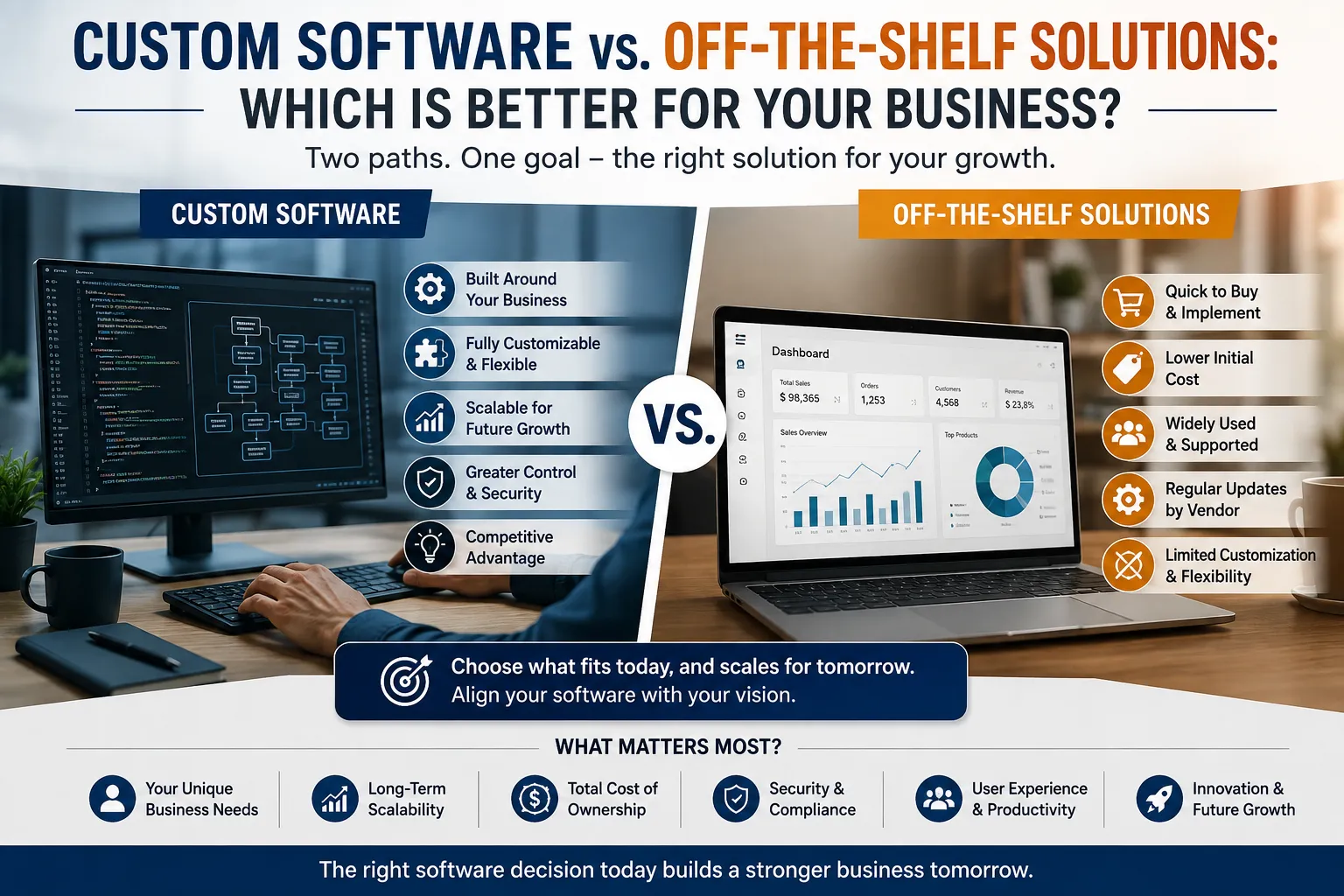
Choosing the right software can have a lasting effect on how efficiently a business operates. From managing customers and finances to processing orders, analyzing data, and communicating with employees, software is now involved in almost every area of modern business. As organizations become more dependent on digital tools, one common question continues to arise: is it better to purchase an existing software solution or invest in software built specifically for the business?
Both options have legitimate advantages. Off-the-shelf software can be affordable, readily available, and relatively simple to implement. Custom software, on the other hand, can be designed around specific workflows, users, and long-term objectives. The right decision depends on the organization's requirements, budget, growth plans, and willingness to invest in technology as a strategic asset. Understanding the differences can help business leaders make a decision based on value rather than simply the initial price.
Understanding Off-the-Shelf Software
Off-the-shelf software is developed for a broad market rather than one specific organization. Examples include accounting applications, customer relationship management platforms, project management tools, communication software, and e-commerce systems.
One of its biggest advantages is speed. A business can generally purchase a subscription or license, configure the available settings, and begin using the product relatively quickly. This can be useful when the organization has standard requirements and does not need highly specialized functionality.
Established software vendors may also provide regular updates, technical improvements, security patches, documentation, and customer support. Businesses do not have to manage every aspect of development themselves.
However, standardized software comes with limitations. Companies may need to adapt their existing processes to match the features offered by the application. When a business has unique workflows, complex integrations, or specialized requirements, these limitations can become frustrating and potentially expensive.
What Makes Custom Software Different?
Custom software is designed and developed specifically for an organization's requirements. Instead of adapting business processes to a pre-built product, the technology is structured around the way the organization operates.
A custom software development company can work with business stakeholders to understand operational challenges, user requirements, customer expectations, and future objectives before designing the solution. This allows functionality to be prioritized according to actual business needs.
For example, a logistics organization may require a platform that combines fleet tracking, maintenance information, driver management, customer notifications, scheduling, and reporting. If existing products cannot bring these processes together effectively, a custom solution may provide a more practical approach.
The major advantage is flexibility. Businesses have greater control over the features, workflows, integrations, user interfaces, and future development of the application.
Comparing the Initial Investment
Cost is often the first point of comparison. Off-the-shelf software usually has a lower initial cost because the product has already been developed and its expenses are distributed among many customers. Subscription models can also make short-term budgeting relatively straightforward.
Custom software generally requires a larger upfront investment because the product must be researched, designed, developed, tested, and deployed specifically for the organization.
However, initial price does not necessarily represent total cost. Businesses should also consider subscription charges, per-user licensing, customization fees, integration costs, data migration, maintenance, and the cost of working around limitations.
A custom system may cost more initially but deliver greater value if it significantly reduces manual work, improves efficiency, supports revenue generation, or eliminates the need for several disconnected applications. The better question is therefore not simply "Which is cheaper?" but "Which option provides better value over the expected lifetime of the solution?"
Flexibility and Customization
Flexibility is one of the clearest differences between the two approaches. Off-the-shelf products generally offer a defined collection of features. Some provide extensive configuration, but businesses remain within the boundaries established by the vendor.
Custom software provides more freedom. A business can prioritize the functionality that matters most to its employees and customers rather than paying for features it may never use.
This can be especially valuable for companies with unique operational processes. A manufacturer, healthcare organization, financial services provider, or logistics business may have workflows that cannot be effectively represented by generic software.
Customization can also extend to the user experience. Interfaces can be designed around different employee roles, customer journeys, and accessibility requirements, making the software more relevant to its intended users.
Integration and Data Management
Modern businesses rarely depend on one application. They often use separate systems for accounting, sales, customer service, inventory, marketing, payments, analytics, and internal operations.
Off-the-shelf products may offer integrations with popular applications, but businesses are limited by the connections supported by the vendor. When an important system does not integrate properly, employees may have to transfer information manually.
Custom applications can be designed with specific integrations in mind. APIs can allow systems to exchange information, helping reduce duplicate data entry and improving consistency across business operations.
Better integration can also improve decision-making. When relevant information is connected and accessible, managers can spend less time collecting data and more time using it to understand performance and identify opportunities.
Scalability and Future Growth
A software solution should ideally support the business beyond its current requirements. As organizations gain customers, employees, transactions, and locations, their technology needs often change.
Off-the-shelf platforms can certainly be scalable, particularly when they are provided by established vendors with strong infrastructure. However, a business may eventually encounter limitations if its requirements become highly specialized.
Custom software can be designed with future growth in mind. Developers can consider expected increases in users, transactions, integrations, and data volumes during the architecture stage.
Scalability should still be approached realistically. Not every business needs a highly complex system from the beginning. A well-planned solution should provide sufficient room for growth without introducing unnecessary technical complexity and expense.
Security and Control
Security is another important consideration when comparing software approaches. Established software vendors may have dedicated security teams, infrastructure specialists, and processes for releasing patches and addressing vulnerabilities.
Custom software can provide greater control over how data, authentication, permissions, and business processes are managed. However, this also means security must be deliberately incorporated into development and ongoing maintenance.
IBM's 2024 Cost of a Data Breach Report estimated the global average cost of a data breach at $4.88 million. While individual incidents vary considerably, the figure highlights the importance of evaluating security as part of any software investment.
Which Option Should a Business Choose?
There is no universal winner between custom and off-the-shelf software. The better choice depends on the business problem.
Off-the-shelf software may be ideal when requirements are relatively standard, implementation speed is important, and the organization can comfortably operate within the available features.
Custom development may make more sense when processes are highly specialized, existing solutions require extensive workarounds, multiple systems need to be integrated, or technology is expected to provide a competitive advantage.
Businesses should also consider their long-term strategy. If the software will become central to operations, customer relationships, or revenue generation, greater control and flexibility may justify the additional investment associated with custom development.
Conclusion
The decision between custom software and off-the-shelf solutions is ultimately a business decision rather than simply a technology decision. Both approaches can be effective when matched with the right circumstances.
Off-the-shelf software provides convenience, established functionality, and faster implementation, making it an excellent choice for many standard business requirements. Custom software offers greater flexibility, control, integration possibilities, and opportunities for long-term scalability.
Before making a decision, businesses should carefully examine their current workflows, future objectives, budget, security requirements, integration needs, and expected growth. Choosing technology based on genuine business requirements rather than short-term convenience can create greater value over time.
The best software is not necessarily the one with the most features or the lowest price. It is the solution that fits the organization, supports its people and customers, and continues to provide value as the business moves forward.
Hashtags:
#CustomSoftware #CustomSoftwareDevelopment #SoftwareDevelopment #OffTheShelfSoftware #BusinessTechnology #DigitalTransformation #SoftwareSolutions #BusinessGrowth #ScalableSoftware #TechnologyStrategy

























Sign in to leave a comment.