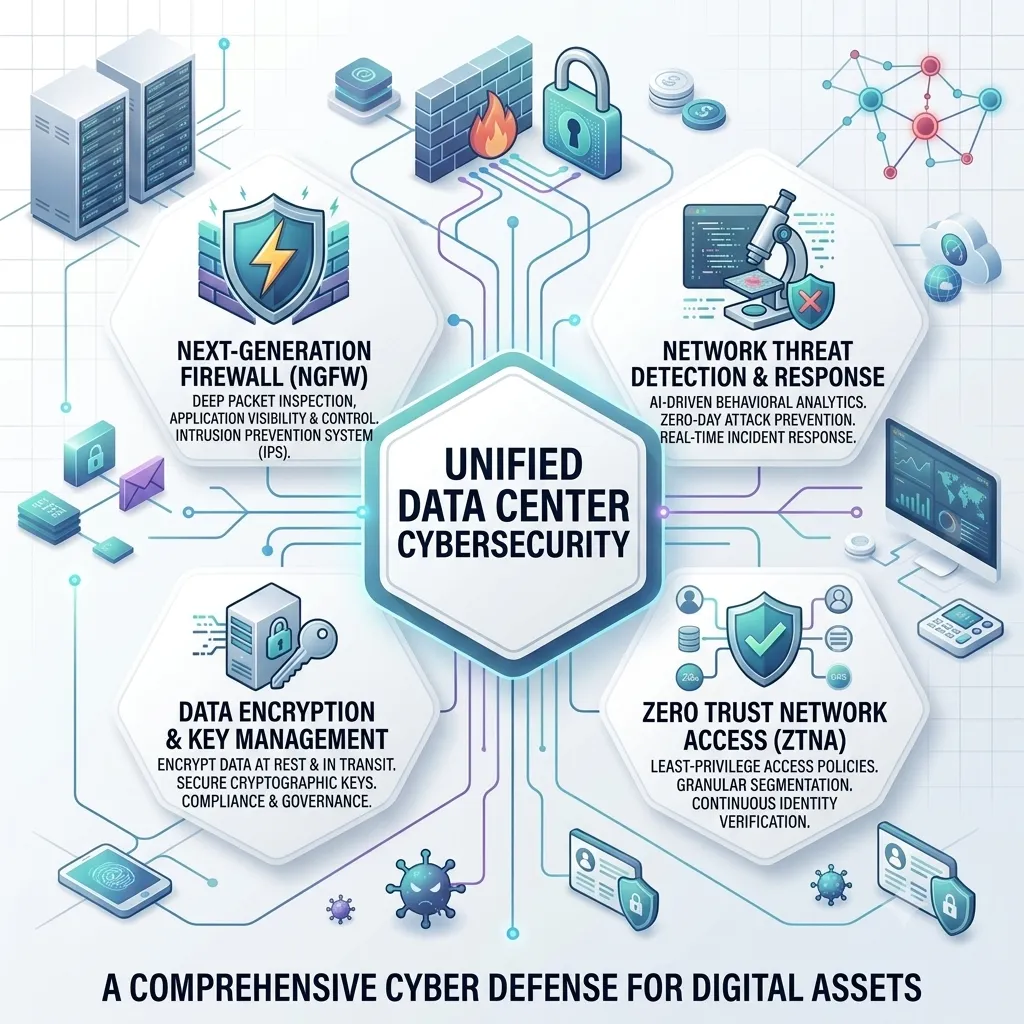

Data Center Security in Qatar and across the wider GCC has moved well beyond a locked door and a camera at the entrance. As Doha, Riyadh, and Dubai compete to host regional cloud, banking, and telecom infrastructure, a single facility now has to defend against physical intrusion, insider misuse, and network-level attacks at the same time, all without interrupting the always-on uptime its tenants expect.
This article walks through the six layers a modern facility needs, how Qatar's regulatory landscape shapes deployment decisions, and what to look for when selecting an integrator for a mission-critical build.
Why Qatar & GCC Data Centers Need a Layered Security Approach
A data center holds a concentration of value — financial records, government systems, telecom backbones, and enterprise workloads — that makes it a target for both physical and digital attackers simultaneously. Relying on a single control point, such as a badge reader at the front door or a firewall at the network edge, leaves the facility exposed the moment that one layer is bypassed or fails.

A layered, defense-in-depth model instead assumes any single control can fail, and builds redundancy so that a breach at one layer is caught by the next. This approach has become the baseline expectation for data centers supporting Qatar's growing digital economy and the GCC's broader push toward regional cloud sovereignty.
The Six Layers of Modern Data Center Security
A well-designed facility stacks physical and digital controls into six coordinated layers, each catching what the previous layer might miss:
Layer 1: Perimeter and Data Center Access Control
The first layer starts at the site boundary — fencing, vehicle barriers, and manned checkpoints — before narrowing down to Data Center Access Control at every internal door: biometric readers at the building entrance, mantraps at the data hall, and cabinet-level locks on individual racks. Each zone requires progressively stronger verification, so a badge that opens the lobby does not automatically open a customer's server cabinet.
Layer 2: Data Center Surveillance
Continuous Data Center Surveillance through high-resolution cameras covering entrances, aisles, and loading docks gives security teams a complete visual record of who moved where and when. Footage retention aligned with local regulatory timelines turns surveillance from a passive deterrent into evidence that can support both incident investigation and compliance audits.
Layer 3: Data Center Intrusion Detection
Beyond cameras, Data Center Intrusion Detection sensors on doors, floor panels, and cabinet enclosures alert security staff the instant an unauthorized opening occurs, even in unmanned sections of the facility overnight. Motion and vibration sensors along the perimeter add an outer ring of detection before an intruder ever reaches the building itself.
Layer 4: Data Center Firewalls
On the network side, Data Center Firewalls segment traffic between tenants, isolate management networks from production workloads, and enforce strict rules on what can communicate with what. Properly segmented firewall zones mean that a compromise in one tenant's environment cannot spread laterally to another customer sharing the same facility.
Layer 5: Data Center Encryption
Physical and network controls protect access to the hardware, but Data Center Encryption protects the data itself, both at rest on storage arrays and in transit between racks and external connections. Even if a storage device were physically removed from the facility, encrypted data on it remains unreadable without the corresponding keys, which are typically managed on separate, hardened key-management infrastructure.
Layer 6: Data Center Threat Detection and Cybersecurity
The final layer ties everything together through continuous Data Center Threat Detection, correlating physical access logs, network traffic anomalies, and system behaviour to spot patterns a single control would miss on its own. This is where broader Cybersecurity for Data Center operations lives — security information and event management (SIEM) tooling, 24/7 monitoring, and incident-response playbooks that turn raw alerts into a coordinated response within minutes rather than hours.
Physical vs. Cyber: Why Data Centers Need Both
It is tempting to treat physical security and cybersecurity as separate budgets managed by separate teams, but a modern facility cannot afford that split. An intruder who defeats a physical control gains a path to plug directly into internal network infrastructure, bypassing perimeter firewalls entirely. Conversely, a cyber attacker who compromises building-management or access-control software can unlock physical doors remotely. Convergence between physical security operations and IT security teams — sharing a single incident-response process and a shared view of alerts — closes that gap.
A Breach Attempt: Six Layers in Action
A single walk-through illustrates how the six layers reinforce one another rather than operating as isolated checkpoints:
- An unauthorized individual attempt to tailgate through the perimeter gate behind an authorized vehicle
- Data Center Access Control at the building entrance rejects the badge attempt, since the individual has no valid credential enrolled
- Data Center Surveillance captures the attempt on camera and flags it for the on-duty security operator to review immediately
- Had the individual reached a server room, Data Center Intrusion Detection sensors on the door and floor panels would trigger an alarm the moment entry was forced
- If the goal was network access rather than physical theft, segmented Data Center Firewalls would still contain any device plugged into the wrong network zone
- Data Center Threat Detection correlates the failed badge attempt with the camera flag, closing the loop as a single logged incident rather than two unrelated alerts
Redundancy and Uptime: Security Without Compromising Availability
Mission-critical facilities in Qatar and the GCC are typically held to strict uptime commitments, which means security controls cannot introduce single points of failure of their own. Access-control panels, surveillance recording infrastructure, and firewall appliances are commonly deployed in redundant pairs, so a hardware fault in one unit fails over to a backup without an operator noticing. The same redundancy principle extends to encryption key management, where keys are backed up across geographically separated, hardened locations rather than a single vault.
This balance between strong security and uninterrupted availability is often the hardest part of a data center build to get right, and it is where an integrator's prior experience with tier-rated facilities becomes most valuable.
Who Relies on Layered Data Center Security in Qatar & GCC
Different tenant types drive different priorities within the same six-layer framework:
- Banks and financial institutions: strict cabinet-level access control and audit-grade surveillance retention for regulatory examinations
- Telecom operators: network segmentation and firewall policy to isolate carrier infrastructure from colocation tenants
- Government and public-sector systems: intrusion detection and encryption aligned with national data-sovereignty requirements
- Cloud and hosting providers: multi-tenant isolation across every layer, from cabinet locks to firewall zones
- Healthcare and insurance: encryption of patient and policyholder records both at rest and in transit
Data Center Security Qatar: Regulatory and Market Context
Qatar's push toward a diversified digital economy under Qatar National Vision 2030 has driven significant data center investment around Doha and the Msheireb Downtown Doha smart-city district. Facilities operating in Qatar Free Zones Authority (QFZA) jurisdictions or serving government and telecom clients are expected to align with guidance from the National Cyber Security Agency (NCSA) and to handle personal data in line with Qatar's Personal Data Privacy Protection Law (PDPPL).
Telecom infrastructure partners such as Ooredoo shape much of the connectivity backbone that Qatar-based facilities rely on, which makes network segmentation and firewall policy coordination with carrier-grade infrastructure a routine part of any Data Center Security Qatar deployment.
Data Center Security GCC: A Shared Regional Standard
Beyond Qatar, facilities across Saudi Arabia, the UAE, Bahrain, Kuwait, and Oman increasingly reference guidance from the GCC Standardization Organization (GSO) when specifying physical and cybersecurity controls, giving regional operators a common baseline to design against even when national regulators differ in the details. For multinational tenants running workloads across more than one GCC market, this shared reference point makes Data Center Security GCC projects easier to standardize than jurisdiction-by-jurisdiction requirements would otherwise allow.
Certifications and Audit Readiness
Facilities serving regulated industries in Qatar and the GCC are frequently required to demonstrate alignment with international standards alongside local regulatory guidance. ISO 27001 certification for information security management, ISO 22301 for business continuity, and Uptime Institute Tier certification for facility design are the credentials tenants and auditors most commonly request during due diligence. An integrator that has supported facilities through these certification processes brings direct experience of what auditors actually check, rather than a general familiarity with the standards on paper.
Conclusion
Data Center Security for Qatar and the GCC now demands six coordinated layers working together, not isolated point solutions. Strong Data Center Access Control and Data Center Surveillance protect the perimeter, while Data Center Intrusion Detection and Data Center Firewalls catch what physical barriers miss. Data Center Encryption and continuous Data Center Threat Detection close the loop with resilient Cybersecurity for Data Center operations. Facilities investing in this model now are best positioned for the demands of Data Center Security Qatar and Data Center Security GCC markets alike.

























Sign in to leave a comment.