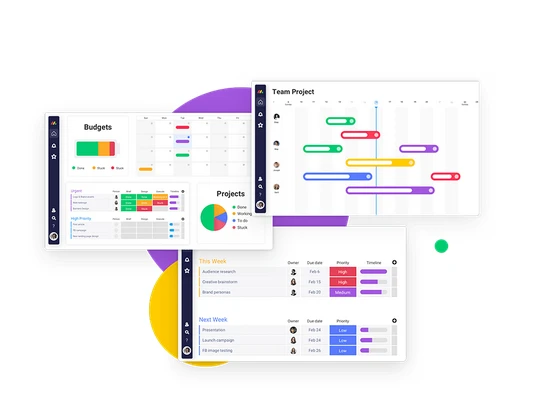

In an era where data is considered a valuable resource, the ability to smoothly harness it has become pivotal for business leaders. monday.com, the leader in work management solutions, has once again raised standards by providing native integration support with Salesforce. This initiative is set to redefine how key stakeholders leverage their data and make decisions.
The centerpiece of this integration is the bi-directional data synchronization. This functionality helps in delivering a holistic view of the customer journey, improving data accuracy, enhancing attribution, and increasing marketing and sales alignment. This integration aims to address emerging challenges while aggregating the details to evaluate huge data volumes and create robust insights.
monday.com Salesforce Integration- A Catalyst for Data-Centric Decision-Making
Proactive decision-making proves to be an effective practice for leaders to maximize business efficiency and profitability. Intuition and personal experience are not going to help business strategists transform their business processes. From sales to customer service operations, every team in an enterprise can make informed decisions by embracing integrations.
The approach of Salesforce integration with monday.com helps experts in continuously analyzing real-time and historical data. This is particularly beneficial in identifying and addressing problems in existing processes before they turn into issues. By making data-driven decisions, businesses can position themselves for sustainable growth.
Essential Requisites for Integration
Before knowing the benefits, business users need to learn a few prerequisites for a smooth integration.
Administrative Accessibility - Leaders should check whether they have active administrative access to both monday.com and Salesforce. This is needed to configure settings, handle user authorizations, and set up the integration.monday.com Pro - For the most effective and comprehensive integration, leaders need access to the premium version, monday.com Pro. This version offers advanced capabilities and unlimited storage options.Sales Cloud - It is the primary Salesforce version that can be integrated with monday.com. This platform is where enterprises organize relationships with customers/clients and collect data. Hence, leaders must ensure that they have access to Salesforce Cloud and its active features.Four Ways monday.com Salesforce Integration Benefits the Business Leaders
Easy Deployment and Fast Adoption
monday.com Salesforce integration is ready to use with a few simple clicks. The deployment guide is entirely available within the monday.com administration and setup tab. Hence, leaders no need to configure data parameters before integration. They can simply set up and distribute access to existing Salesforce users so that everyone can access reliable insights. Unlike traditional CRM tools, which require additional infrastructure to handle an increasing user base, monday.com easily scales, empowering quick adoption without latency problems.
Contextual Analytics
When leaders start optimizing their business’ flow based on data insights, they can attain greater value. monday.com delivers insights, forecasts, and recommendations based on Salesforce data from a single interface. This enables sales and service departments to make every decision on a data-driven approach.
By integrating with Salesforce, monday.com constantly learns what makes the workflow successful, and recommends what actions drive business success. Let’s say, a sales agent is struggling to finish the quarter due to outstanding accounts, and they’d gain from learning how best to spend their time and improve their close rate.
With recommendations that fulfill the goals of business users, it helps teams across an enterprise become data-driven and profitable. Since Salesforce is native to monday.com, users can easily integrate insights and recommendations within existing Salesforce workflows without any coding.
Smart, Integrated Forecasts with In-built AI
Currently, any discussion about advanced analytics also needs to involve Artificial Intelligence (AI). In a recent survey, 79% of respondents agreed that leveraging AI technology has helped them deliver advanced customer experiences. And industry leaders agree that AI adoption by sales and marketing teams helps in increasing business revenue.
However, when it comes to leveraging AI, leaders typically undergo more complications than resolutions. Most project management solutions require a separate AI stack incorporation. This eventually increases coding practices, constant updates, and added expenses.
With monday.com and Salesforce integration, users can have a single tech stack for both AI and analytics. IT leaders don’t have to spend huge resources on programming or added infrastructure, thereby saving operational costs. Analysts can feed the same data they’ve accumulated in Salesforce for creating monday.com dashboards. This way, business users can have AI-powered forecasts and recommendations. Since these insights are derived from monday.com dashboards, business users are more likely to adopt data and AI in their routine decision-making.
Let’s look at a use case of how a leading retailer relied on monday.com Salesforce integration to inform its sales representatives.
Whole Foods, a US-based retailer was looking to increase the productivity of sales workflows. Their delegates were using Salesforce alone for activities like creating and placing orders. Without analytics support, their representatives also spent a lot of time doing administrative tasks.
However, by integrating their Salesforce account with monday.com, their representatives can obtain data-based insights during their pre-call planning programs. “With access to analytics, we were able to deliver approximately 5% higher revenue than before”, says Jamie, Digital Operations Head. The insights generated in monday.com can be extended across all Salesforce users to make data available throughout the enterprise.
Simplified Data Security and Control
Intuitive integration support with Salesforce means that monday.com adheres to all the security standards. Sales administrators or managers need to be as efficient as possible. They want to access the sales data without a separate login step and obtain personalized outlooks in terms of account team, client list, geography, and others. Sales admins must uphold the proper level of accessibility to business data—which gets complex with a huge user base.
monday.com Salesforce integration eliminates this problem. monday.com gets role hierarchy straight from Salesforce and automatically identifies the user, their title, and their authorized access level. This simplifies data control, allowing leaders to focus on varying business requirements as engagement and adoption grow automatically. With this integration, leaders can:
Easily unify and curate data from monday.com and Salesforce data resourcesCreate new identity, safety, and data access procedures in line with Salesforce standardsBuild and launch personalized data modelsAllow the workforce to consume a single source of information that is accurate and relevantFuture Trends in monday.com Salesforce Integration
The launch of Copilot, monday.com’s exclusive Generative AI product is largely attracting Salesforce users. The data is the key constituent to build and train Large Language Models. This is highly beneficial for Salesforce users as it helps to generate quality data based on the prompts. Some other trends that accelerate the integration of monday.com and Salesforce among business users are:
Prediction Builder - This monday.com module allows Salesforce users to make business-centric predictions with zero coding involvement. They only have to know the Salesforce elements like fields, predictions, and objects to build their predictions.Data Management – This extensive tool of monday.com arrives with various governance tools to support connection with Salesforce-related data sources. Some of the tools are Visual Data Prep, Data Mart, and self-regulated ETL, assuring smooth data transfer between the two platforms.Dynamic Visualization Engine – monday.com has specially designed and launched a Visualization Engine for Salesforce data builders and users. This engine will display how one Salesforce-based flow impacts the other. Through dynamic visuals and fast searches, users can identify critical areas to make better.Closing Thoughts
The integration of monday.com with Salesforce is a game-changer for organizational leaders aiming to drive their businesses to new heights. By unifying these platforms, experts can obtain invaluable insights into their marketing campaigns, effectively monitor conversions, and strengthen their sales funnel. With advanced data analysis functionalities, they can make data-driven decisions that will accelerate business growth.










Sign in to leave a comment.