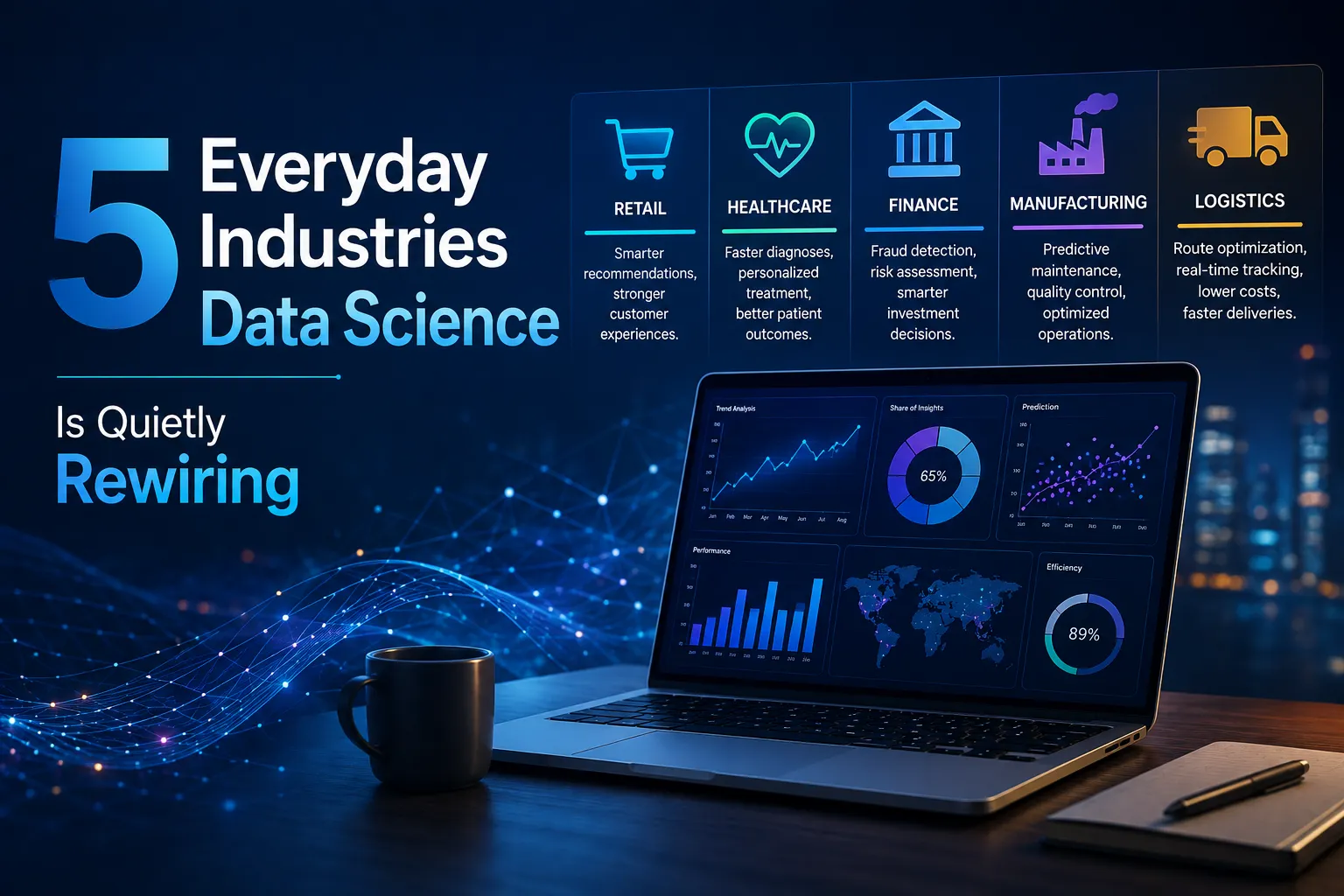

We tend to picture data science happening somewhere far away — inside a tech company's server room, run by people in hoodies staring at code. In reality, it's already reshaping industries most of us interact with every single day, often invisibly. Here's where it's making the biggest difference right now, and why it's becoming one of the most practical skill sets a student can pick up.
1. Retail and E-Commerce: Predicting What You'll Want Before You Do
Every "recommended for you" section, every dynamically priced flight ticket, every "only 3 left in stock" nudge — that's data science at work. Retailers use predictive models to forecast demand down to the store level, personalize offers, and prevent both overstocking and stockouts. The companies that get this right aren't guessing anymore; they're running constant, data-driven experiments on what actually drives a purchase.
2. Banking and Insurance: Catching Fraud Before It Happens
Fraud detection used to mean flagging suspicious transactions after the fact. Now, machine learning models score transactions in real time, comparing them against thousands of behavioral patterns to catch anomalies within seconds — often before money even leaves an account. The same techniques are increasingly used in accounting and financial reporting, where anomaly detection helps catch reporting errors and irregularities that a manual audit might miss entirely.
3. Healthcare: Turning Patient Data Into Earlier Warnings
Hospitals generate enormous volumes of data — vitals, lab results, history, imaging — but historically, most of it sat unused. Data science is changing that by helping clinicians predict which patients are at higher risk of complications or readmission, allowing resources to be allocated before a crisis rather than after. This is one of the areas where the gap between "having data" and "using data well" has the most human consequence.
4. Marketing: Moving Past Guesswork
Marketing has always been part art, part guesswork. Data science is steadily replacing the guesswork half. Instead of broad demographic targeting, teams now build models that predict which specific customers are likely to convert, churn, or respond to a particular message — and causal modeling techniques are increasingly used to figure out whether a campaign actually caused a sales lift, or just happened to run during a good week.
5. Manufacturing and Logistics: Predicting Failure Before It Happens
Sensors on machinery and delivery fleets now generate constant streams of data, and predictive models use that data to flag when a machine is likely to fail or when a delivery route is likely to run late — often days before a human would notice anything wrong. This shift from reactive to predictive maintenance is quietly saving industries enormous amounts in downtime and logistics costs.
Why This Matters for Anyone Choosing a Career Path Right Now
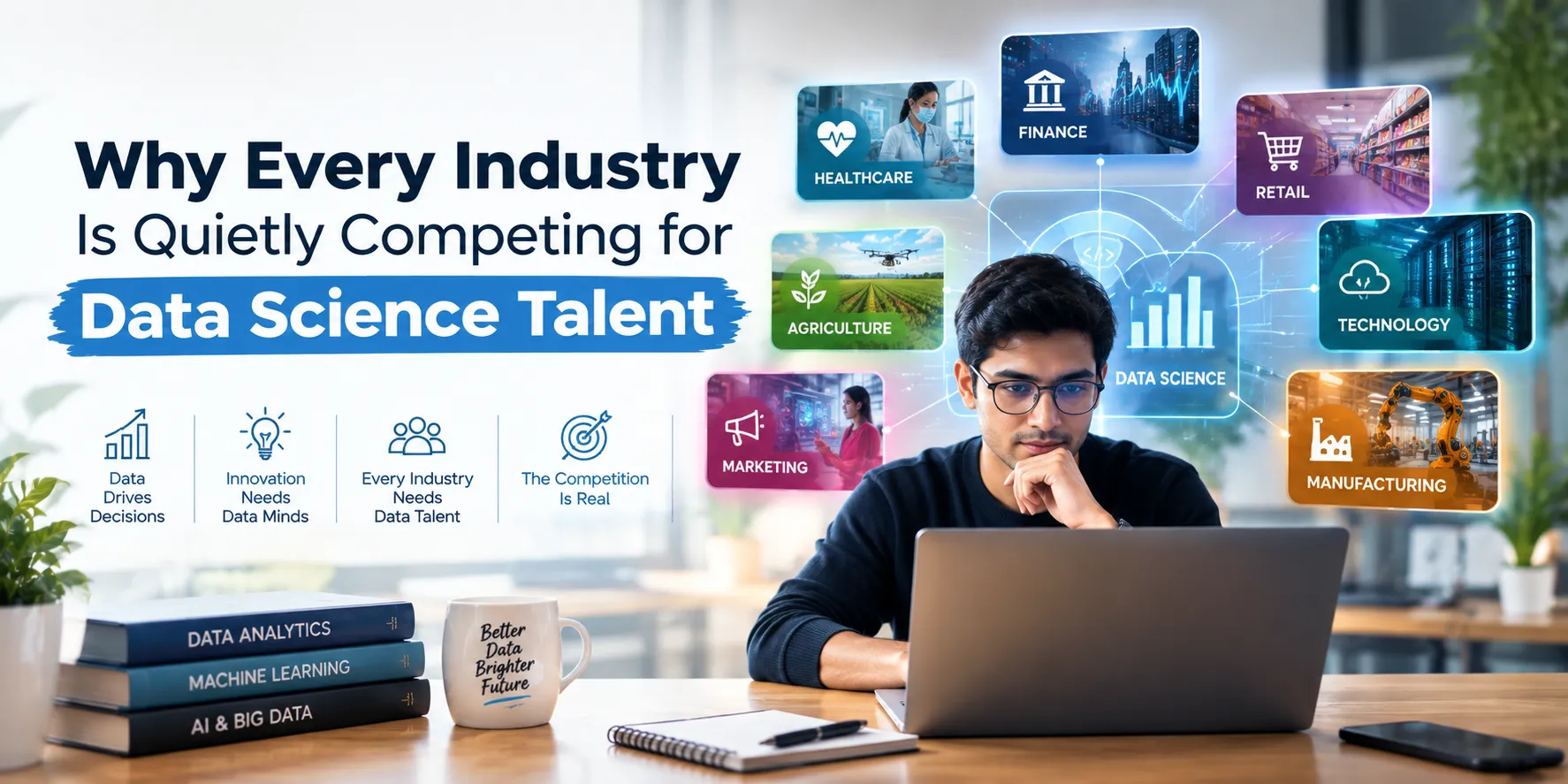
What's notable about all five examples above is that none of them are "tech jobs" in the traditional sense. They're retail jobs, finance jobs, healthcare jobs, marketing jobs, and operations jobs — just increasingly powered by data science skills. That's the real shift happening in the job market: data literacy is becoming a core competency across functions, not a specialization reserved for engineers.
This is also why undergraduate programs in the field are evolving. Rather than teaching data science as a purely technical subject, more institutions are now building it around applied, industry-facing skills — statistics, machine learning, big data, and visualization, taught alongside their real use in functions like marketing and finance. Kumaraguru College of Liberal Arts & Science (KCLAS) in Coimbatore is one example of this approach, with coursework that includes fraud detection, causal modeling, and cloud-based ML deployment as part of its core B.Sc Data Science curriculum — reflecting exactly the kind of cross-functional skill set the industries above are now hiring for.
The Takeaway
Data science isn't a distant, futuristic field anymore — it's already embedded in the everyday systems we interact with: the prices we see, the fraud alerts we get, the ads we're shown, the deliveries that arrive on time. Understanding even the basics of how it works is quickly becoming less of a specialist advantage and more of a baseline literacy, the way spreadsheet skills or basic coding became over the last two decades.
The industries listed here are just the visible tip. The list of sectors being reshaped by data is only getting longer — which is exactly why the skill is worth taking seriously, regardless of which field you end up in.





























Sign in to leave a comment.