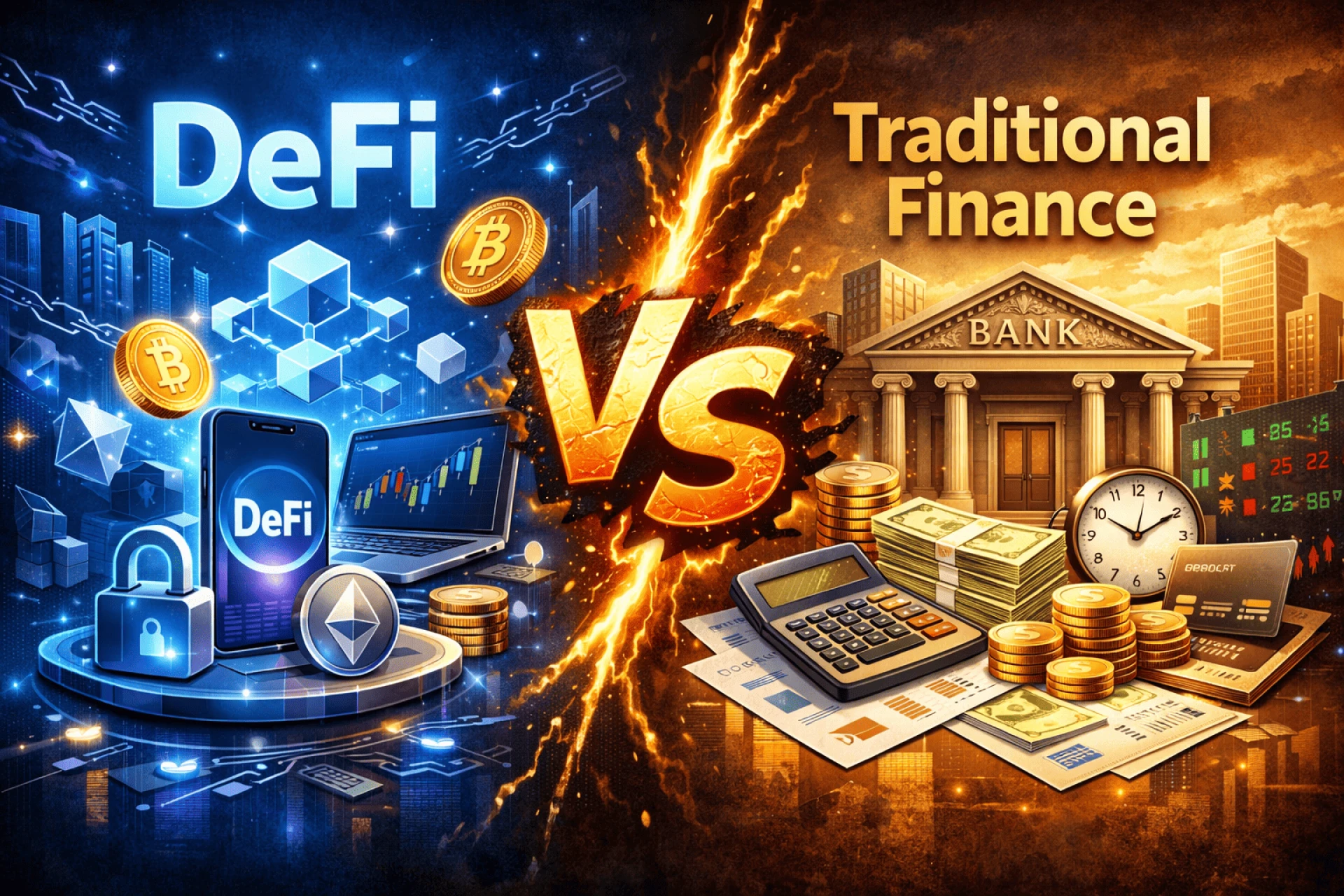

The conventional finance has operated the world economy for decades using banks, paperwork work and middlemen. The Decentralized Finance (DeFi) is an inversion of that paradigm, as it uses blockchain technology to allow individuals to lend, borrow, trade, and earn without using banks in any way. Knowing the main distinctions between DeFi and traditional finance can give you the impression of how money is being transformed, and why it is so popular with users to consider decentralized solutions today.
What Is Traditional Finance (TradFi)?
Traditional Finance (TradFi) is the system that is being operated by banks, brokers, and centralized institutions. It works under highly strict surveillance, where the user must obtain approvals, papers, and intermediaries in order to access financial services of saving, borrowing, and investing.
What Is DeFi (Decentralized Finance)?
Blockchain-based financial services are being facilitated without banks and middlemen and are being called Decentralized Finance, or DeFi. It implies that smart contracts enable any person who is connected to the internet to lend, borrow, trade, or make money. It renders finance transparent, non-authoritative, and decentralized.
To understand the future of Defi, it is important to study the key differences between Defi and Trad-fi.
Key Differences at a Glance
Control:
Under traditional finance, the banks and other financial institutions regulate the money and financial transactions; in the DeFi scenario, all these processes are automated using smart contracts in blockchain technology.
Access:
Traditional finance may limit access depending on the geographic location, identification, or authorization, whereas DeFi can be accessible to anyone in the world as long as they have access to the internet.
Transparency:
Traditional financial systems are based on private registries, whereas DeFi is based on public blockchains in which transactions can be verified and seen.
Speed & Cost:
Operations within traditional finance are typically slower and have higher charges, whereas DeFi allows using faster operations at a lower cost.
Risk:
In Traditional finance, the institutional layer and customer support give the user all the security and decision-making, whilst in DeFi, the user has full responsibility for security and choice.
Which One Is Right for You?
Both Traditional Finance (TradFi) and Decentralized Finance (DeFi) have some advantages and disadvantages of their own, and which to use depends on your needs and risk tolerance. For example, TradFi is stable and has customer service and government regulations in place, and should be used by those users who want safety and familiarity. DeFi instead offers more control, international options and accessibility, transparency, and lower costs, but with the cost comes the full responsibility of the user and the increased threat of technical and security issues. TradFi can be a more suitable option in case you like convenience, regulated protection, and practical help. DeFi can be more attractive to users who want to be independent, innovative, and access financial resources without restrictions on borders.
DeFi and TradFi can Coexist
DeFi and conventional finance may be complementary to one another. TradFi is stable, controlled, and legal to consumers. DeFi is also innovative, transparent, and accessible worldwide without intermediaries. With the ever-changing technology as well as the regulation, the future of finance may be a combination of the two systems. This provides the users with the freedom to choose, flexibility, and control the way to handle their money.

Sign in to leave a comment.