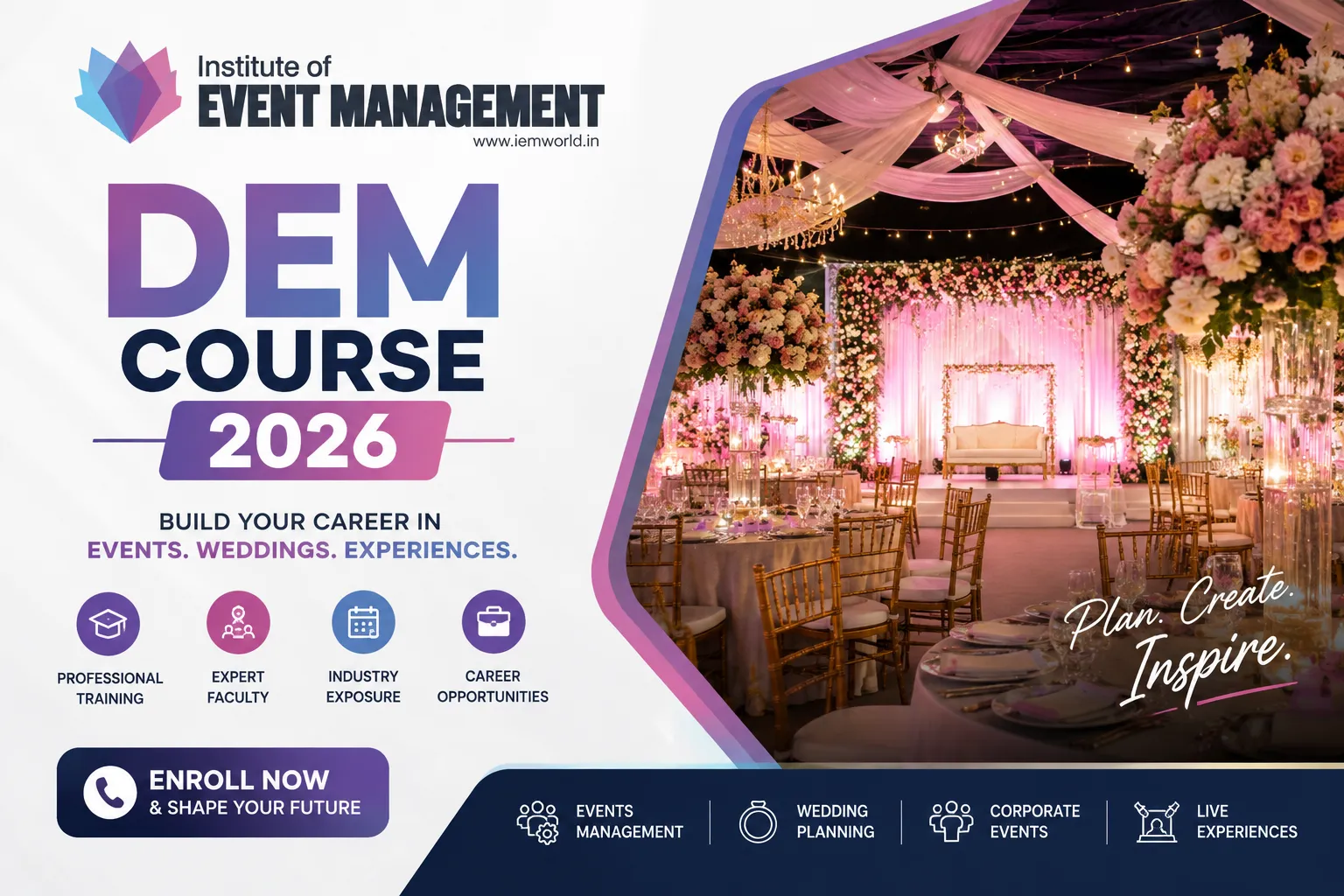

DEM Course 2026: A Practical Guide Before You Join
You search for an event management course, and suddenly every website starts promising the same things — practical training, industry exposure, career opportunities and “future-ready” skills.
That's quite right. However, what will it all entail?
If you are researching a DEM course 2026, then it's natural that you would be interested in knowing about the coursework, the type of exposure you will get, and the job opportunities you can avail yourself of.
That's what we're getting into here.
No fancy promises. Just the things I'd personally check before spending money on an event management course.
What Is a DEM Course 2026 Actually About?
A Diploma in Event Management is designed to teach students how events are planned, organised and executed.
That sounds simple until you think about what happens behind an actual event.
Take a corporate conference. Someone needs to book the venue, manage registrations, coordinate speakers, arrange sound and lighting, communicate with vendors, handle schedules and keep the client updated.
Now add 500 guests.
Suddenly, “planning an event” doesn't sound quite so simple.
A good DEM course 2026 should introduce you to this entire process rather than focusing only on the creative side. Current programme structures commonly include event planning, production, budgeting, marketing, logistics, vendor management and team coordination.
And honestly, that's the part beginners sometimes miss.
Event management isn't just about making an event look good. It's about making sure the event actually works.
What Will You Learn?
The exact syllabus depends on the institute, but there are some subjects worth looking for.
Event Planning
You'll learn how to turn an event idea into an actual plan.
That includes timelines, task allocation, venue requirements, guest planning and coordination.
The creative idea may take five minutes.
Getting 50 different tasks completed on time is the difficult part.
Event Production
Production covers the physical and technical side of an event.
Stage setup, sound, lighting, screens, equipment and coordination with technical teams all come into the picture.
You don't have to become a sound engineer.
But you should know enough to communicate with the people who are handling those areas.
Budgeting and Finance
This is one topic students shouldn't ignore.
Suppose your client gives you ₹4 lakh.
You can't spend half of it on decoration because it looks impressive and then realise there's not enough left for catering, production and transportation.
Event budgeting teaches you how to work within limits.
That's a real-world skill.
Vendor Management
Events depend on vendors.
Decorators. Caterers. Photographers. Transport companies. Production teams.
Sometimes everything goes perfectly.
Sometimes the vendor calls you two hours before the event and says there's a problem.
That's when communication and backup planning become important.
Marketing and Promotion
An event needs an audience.
Depending on the type of event, promotion can involve social media, digital campaigns, email marketing, public relations, sponsorships and partnerships.
The AICTE model curriculum for event management also includes event marketing, sponsorship, brand management and public relations alongside planning and production.
So don't treat marketing as an optional extra.
It is part of modern event work.
Why Practical Training Matters in a DEM Course 2026
Here's the thing.
You can learn event planning from a classroom and still feel completely lost at your first live event.
There's a big difference between writing “vendor coordination” in an assignment and actually calling five vendors because one of them hasn't arrived.
Practical training gives you that reality check.
Some current event-management programmes specifically include practical training, internships, projects or live-event exposure. For example, course structures published by institutions include practical projects, event execution and internship components.
Before enrolling, ask what practical training actually means.
Don't settle for “yes, we provide practical exposure.”
Ask:
- How many live events do students work on?
- Do students receive actual responsibilities?
- Are internships included?
- Are projects assessed?
- Who supervises the practical work?
Those answers are much more useful.
What About Weddings?
Wedding planning is one of the most visible parts of the event industry.
And yes, it can be exciting.
But don't think it's only about flowers, themes and beautiful venues.
Wedding planners deal with guest lists, schedules, hospitality, vendors, décor, entertainment, transportation and family expectations.
Sometimes several functions happen across different locations.
Sometimes the client changes the plan at the last minute.
A DEM course 2026 that introduces students to weddings and social events can give beginners a broader understanding of the industry. Some current course structures specifically include wedding and special-event planning.
If wedding planning is your main interest, check how much of the syllabus actually covers it.
Don't assume the word “events” automatically means detailed wedding training.
Should You Consider a PG Diploma?
If you've already graduated, you may also come across a PG diploma event management India programme while researching your options.
That's worth comparing, but don't choose a programme simply because “PG” sounds more advanced.
Look at eligibility, curriculum, duration, practical training and certification.
The right choice depends on your education and career plans.
| Diploma | Beginners / career starters | Event fundamentals | Practical exposure |
| PG Diploma | Graduates | Advanced professional learning | Eligibility and curriculum |
| Short Certification | Specific skill building | Narrow subject | Recognition and depth |
| Internship | Students / beginners | Workplace experience | Actual responsibilities |
There isn't one route that works for everybody.
That's where most people get it wrong. They compare course names instead of comparing what they'll actually learn.
What Jobs Can You Explore?
A DEM course 2026 can prepare you for different entry-level areas within the event industry.
You could explore roles such as event coordinator, event operations executive, production assistant, wedding planning assistant, client servicing executive or exhibition coordinator.
The exact role depends on your skills, experience and the employer.
Government and university programme descriptions also list roles such as event planner, wedding planner, corporate event manager, venue manager and event coordinator among possible career areas.
Don't expect to manage a huge event independently on day one.
That's not realistic.
Most people start by supporting senior team members, learning vendor coordination and understanding how events actually run.
Then responsibilities grow.
How Much Does an Event Management Course Cost?
Fees can vary a lot depending on the institute, duration, mode of study and programme structure.
Current published examples show a wide range. For instance, IGNOU lists its Diploma in Event Management at ₹8,200 for the full programme, while other private institutions publish considerably higher fees.
So don't decide based only on the lowest fee.
Ask what you're getting for the money.
Does the course include practical projects?
Are internships part of it?
Are there extra examination or certification charges?
Who teaches the classes?
Does the institute have industry interaction?
A cheaper course isn't automatically better value if you finish without any practical experience.
What Should You Look for in an Institute?
I'd start with the syllabus.
Not the Instagram page.
Not the photos.
The syllabus.
A useful DEM course 2026 should cover more than basic event definitions. Look for planning, production, budgeting, marketing, logistics, client servicing and vendor management.
Then investigate the practical side.
You can also look at student reviews, but don't depend entirely on them. Reviews can be useful, but they don't always tell the full story.
If possible, speak to a former student.
Ask what they actually did during the course.
That's usually where you get the most honest answer.
Where Does iemworld Fit In?
If you're researching event management programmes, iemworld may also appear during your search.
If you're considering it, look at the programme details carefully rather than choosing simply because of the name.
Check the syllabus.
Ask about practical training.
Understand the internship structure.
Look at certification details and career support.
And compare those points with other institutes you're considering.
The same checklist should be used for every institute, including iemworld.
That keeps the decision practical instead of turning it into a popularity contest.
Is Event Management Actually a Good Career?
This can suit those who thrive on planning, communication, being creative, and problem-solving under pressure.
However, let us acknowledge the tough part.
Events can require weekends, long hours, travelling, and changes.
You may find yourself planning for many weeks before having just one day to run the event.
And when things go wrong, nobody wants to hear the long story. They want the problem fixed.
If that sounds interesting rather than frightening, event management may suit your personality.
If you prefer predictable work with very few surprises, think about that carefully before joining.
Expert Insight
“Don't choose an event course because the events look glamorous. Ask what students actually do behind the scenes. That's where the useful experience is.”
That is probably one of the most practical questions you can ask.
Before You Enrol
Make a shortlist of two or three institutes.
Compare their curriculum, practical training, internships, faculty, certification and total fees.
If iemworld is one of your options, compare it using the same points.
Don't rush because an admission page says seats are limited.
Take a little time.
One afternoon of proper research can save you months of frustration later.
FAQs
What does DEM course 2026 mean?
It means a Diploma in Event Management course for the year 2026, whether for academic admission or otherwise.
Who qualifies for an event management diploma?
Qualifications will differ from one educational institution to another, but some programs may consider candidates who have just completed their class 12th exams.
Is event management helpful after 12th?
Yes, as a diploma will give basic information and skills to those students who wish to join the event industry.
Can graduates do a PG Diploma in event management?
Yes, there are many PG-level courses which cater to graduates.
Is event management related to weddings?
Yes, many courses offer weddings and social events; however, the level of course content differs.
What jobs can I get after event management?
Possible roles include event coordinator, event planner, production assistant, wedding planner and client servicing executive.
Is practical training necessary?
Yes. Event management is highly execution-focused, so practical projects and real event exposure can be extremely valuable.
Conclusion
Selecting a DEM course 2026 will not be based on which course comes with the most attractive brochure but rather which course offers valuable training.
Consider the course outline, practical experience, internship opportunities, faculty, and total cost involved. In case you are also contemplating joining the PG diploma event management India course, consider the following aspects.
And if iemworld is on your shortlist, ask the same practical questions you'd ask any other institute.
Do the research first. Then choose the course that actually fits where you want to go.
















Sign in to leave a comment.