

Many construction cost overruns do not start when workers arrive on site. They start much earlier.
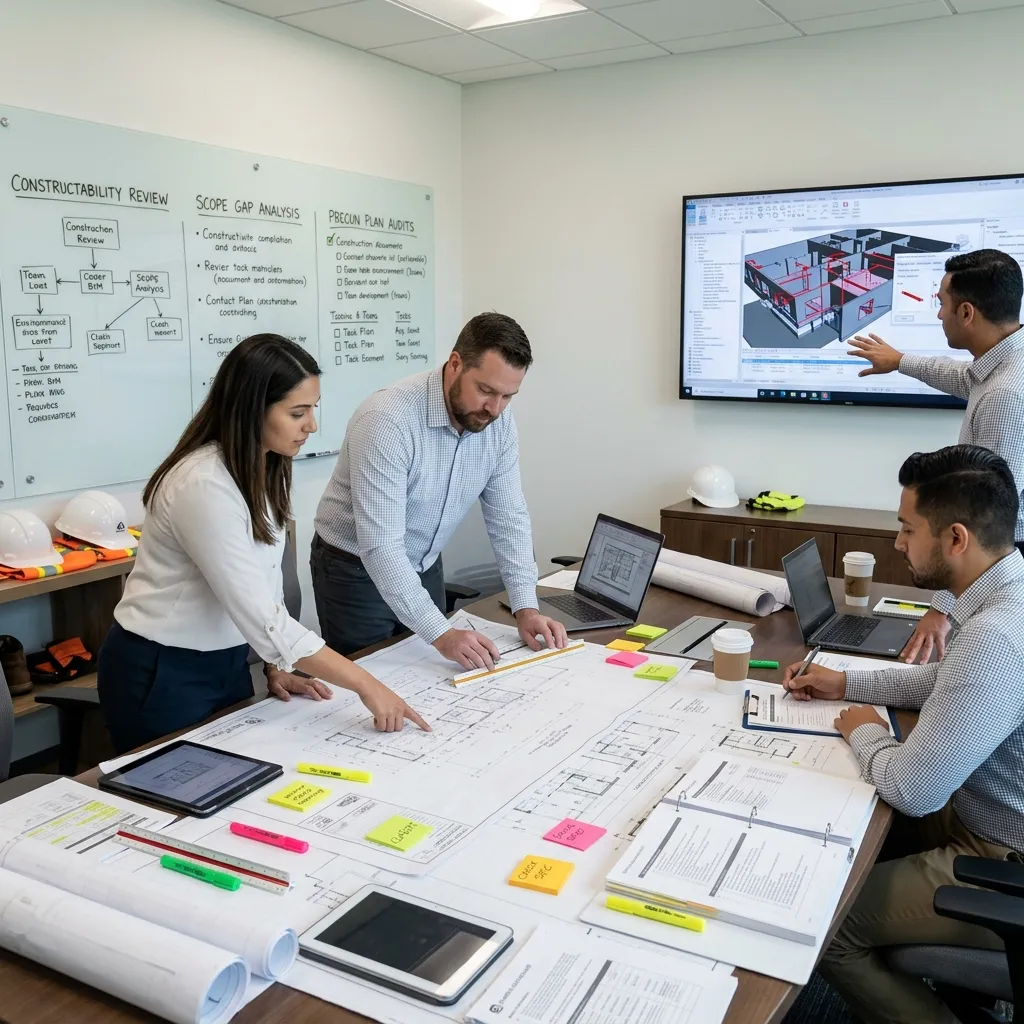
An incomplete drawing, an overlooked scope item, an outdated material price, or an unrealistic labor allowance can create problems long before construction begins. Sometimes these issues remain hidden until a contractor submits a change order and the project team has little choice but to deal with it.
This is where design estimation and preconstruction audits become important.
Design estimation helps the project team understand how much the project is likely to cost as the design develops. A preconstruction audit takes a closer look at the drawings, specifications, estimate, schedule, and overall project plan to find problems before they become expensive.
When these two processes are used together, owners and developers have a much clearer picture of the project’s expected cost and potential risks.
What Is Design Estimation?
Design estimation is the process of calculating expected construction costs while the design is still being developed.
Instead of waiting until the drawings are finished, estimators review the project at different design stages. This gives the team an opportunity to compare the design with the available budget and make changes while those changes are still manageable.
A typical estimating process may include the following stages:
Conceptual Estimate
This is usually the first cost estimate. It may be based on square-foot costs, unit prices, previous projects, and basic information about the proposed building.
At this stage, the estimate is useful for determining whether a project appears financially realistic. However, there is still a significant amount of uncertainty because many project details have not been finalized.
Schematic Design Estimate
Once preliminary floor plans, building layouts, and basic systems are available, the estimate can become more detailed.
Costs may be organized by major building components, including foundations, structural work, exterior walls, roofing, finishes, plumbing, electrical, and HVAC.
Design Development Estimate
At this stage, more information is available about materials, equipment, structural systems, and mechanical layouts.
Estimators can begin replacing broad allowances with actual quantities and more specific pricing.
Construction Documents Estimate
This estimate is prepared from detailed drawings and specifications that are close to the final construction package.
Detailed quantity takeoffs, current pricing, subcontractor feedback, and project-specific requirements can provide a much more accurate picture of the expected construction cost.
The important part is not simply producing a new number at every stage. The real value comes from comparing each estimate with the approved budget and understanding why the cost has changed.
If the project is becoming too expensive, the team can adjust the design, scope, materials, or budget before those changes become difficult and costly.
What Makes a Design Estimate Reliable?
A reliable construction estimate requires more than adding quantities and multiplying them by unit prices.
Several factors have a direct impact on its quality.
1. A Clear Basis of Estimate
The estimate should explain what information was used to prepare it.
Drawings, specifications, assumptions, exclusions, allowances, and other pricing conditions should be documented. This makes it easier for the project team to understand exactly what the estimate covers.
2. Realistic Contingency
Some uncertainty is unavoidable, particularly during the early design stages.
A reasonable design contingency can account for items that have not yet been fully defined. As the design becomes more complete, that contingency should generally become smaller.
Construction contingency serves a different purpose and should account for risks that may still exist during construction.
3. Current Market Pricing
Construction prices change regularly.
Labor rates, material costs, equipment prices, transportation costs, and subcontractor pricing can all affect the final project cost. An estimate should use current market information and clearly identify any escalation expected before construction begins.
4. Input From Trades
Early input from subcontractors and suppliers can improve an estimate significantly.
A trade contractor may identify installation requirements, material availability issues, or current pricing conditions that are difficult to capture through historical data alone.
5. A Clear Revision History
Design changes should be reflected in the estimate.
When the project team can see what changed, how much it affected the budget, and why the change occurred, it becomes much easier to control costs.
What Is a Preconstruction Audit?
A preconstruction audit is a detailed review of the project before construction starts.
While design estimation primarily focuses on the question, “What will this project cost?”, a preconstruction audit asks a broader question:
“Is the project ready to move forward, and can we rely on the information being used to build it?”
An audit reviews the major parts of the preconstruction package to identify missing information, conflicting documents, unrealistic assumptions, and potential risks.
Common areas of review include:
Scope Completeness
Are all trades included?
Are there gaps between subcontractor scopes? Are responsibilities clearly assigned, or could two parties assume that the other contractor is responsible for the same work?
Drawing and Specification Coordination
Do the architectural, structural, electrical, mechanical, and plumbing documents agree?
A conflict between drawings and specifications can lead to RFIs, delays, additional costs, and change orders once construction begins.
Estimate Review
Are the quantities reasonable?
Are the unit prices supported by current market conditions? Are allowances realistic? Does the contingency reflect the risks that remain?
These questions can reveal problems that are difficult to notice when simply reviewing the total project cost.
Schedule Review
A construction schedule should reflect actual project conditions.
The review should consider permitting, inspections, procurement, long-lead materials, weather, site conditions, and the sequence in which different trades need to complete their work.
Procurement Strategy
Long-lead equipment and materials should be identified early.
If critical items are not available when needed, even a well-prepared construction schedule can quickly fall behind.
Site and Permitting Conditions
Site conditions can have a major effect on construction costs.
The project team should consider geotechnical information, utilities, environmental requirements, site access, permitting, and other conditions that could affect construction.
Contracts and Risk Allocation
Contract responsibilities should be clear.
An audit can help identify situations where project risks have been assigned to a contractor without properly accounting for the associated cost.
How Design Estimation and Preconstruction Audits Work Together
Design estimation and preconstruction auditing serve different purposes, but they work best as part of the same process.
Design estimation is an ongoing conversation about project cost. As the design changes, the estimate changes with it.
The preconstruction audit provides an independent checkpoint. It examines whether the drawings, specifications, estimate, schedule, and contracts are complete and consistent before the project moves into construction.
Without regular cost estimating, a project can gradually move away from its original budget without anyone noticing until it is too late.
Without an independent review, the project team may overlook problems simply because they have been working with the same drawings and assumptions for months.
Together, these processes create a useful feedback loop:
Design changes → estimate is updated → risks are reviewed → problems are corrected → project moves forward.
This approach gives owners more control before construction costs become difficult to change.
Common Problems a Preconstruction Audit Can Find
Although every project is different, many audits uncover similar problems.
Some common examples include:
- Allowances that are too low or not clearly defined
- Work that is missing because each contractor assumes another party is responsible
- Conflicts between architectural, structural, and MEP drawings
- Material or labor escalation that has not been properly considered
- Schedule durations based on old projects rather than current conditions
- Contingency being consumed before the design is fully developed
- Value-engineering savings included in the budget even though the related design changes have not been completed
- Long-lead materials that have not been identified early enough
- Missing scope items that could later become change orders
- Pricing based on outdated supplier or subcontractor information
These issues are not necessarily signs of poor project management. Construction projects involve a large amount of information, and small gaps are easy to miss.
The purpose of an audit is to find those gaps while there is still time to correct them.
A Practical Approach to Preconstruction Planning
If you want to improve cost control on your next project, a few steps can make a significant difference.
1. Establish the Budget Early
Set a realistic budget before the design becomes too advanced.
Then review that budget whenever the design reaches a major milestone.
2. Document the Basis of Estimate
Make sure the estimate clearly explains what has been included, excluded, or assumed.
A total project cost without supporting information is difficult to evaluate.
3. Review the Project Before Bidding
A detailed review before bidding or contract award gives the team an opportunity to correct problems before contractors price the work.
The earlier a problem is found, the easier and cheaper it usually is to fix.
4. Use an Independent Reviewer
Fresh eyes can be extremely valuable.
Someone who was not involved in preparing the drawings or estimate may notice an issue that the original project team has become accustomed to overlooking.
5. Track Every Finding
Identifying a problem is only the first step.
Each audit finding should have an owner, a required action, and a clear resolution. The issue should then be checked again to confirm that it has actually been addressed.
The Bottom Line
Construction will always involve some level of uncertainty. However, many costly surprises can be reduced through better planning and review.
Design estimation keeps the project budget connected to the design as it develops. A preconstruction audit then provides another layer of review to make sure the drawings, estimate, schedule, scope, and contracts are ready for construction.
Spending more time on these steps before construction begins can help reduce change orders, disputes, delays, and unexpected costs later.

Read more: Design Estimation: 10 Powerful Ways Construction Estimating Services Improve Cost Control
For owners and project teams, the goal is simple: understand the cost, identify the risks, and fix the problems before construction starts.




















Sign in to leave a comment.