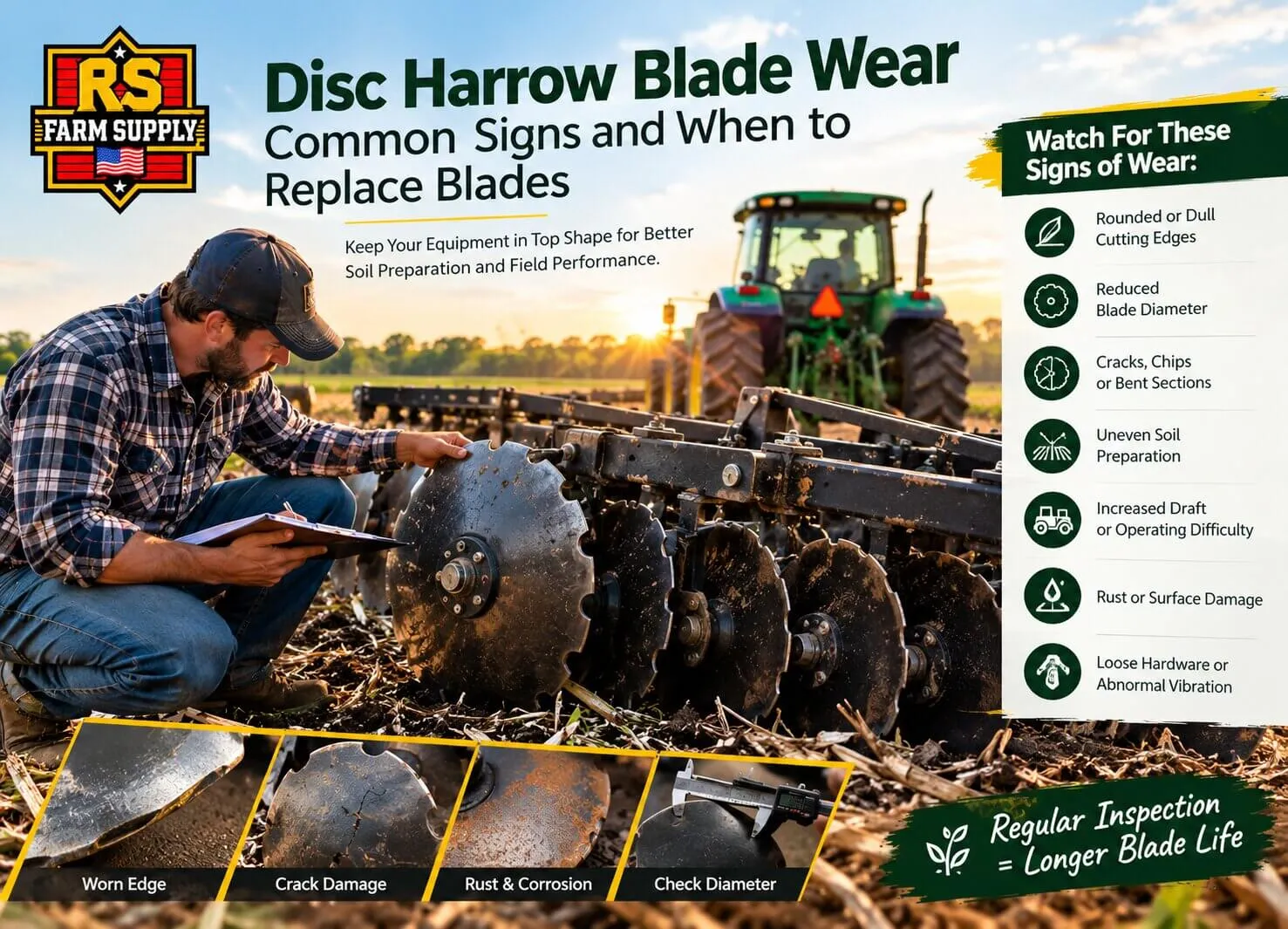

Disc harrow blades are essential agricultural equipment components that help break up soil, incorporate crop residue, and prepare fields for planting. Over time, regular use in demanding field conditions causes wear that can affect tillage performance. Knowing how to identify worn disc harrow blades and when to replace them helps agricultural operators maintain consistent soil preparation and equipment efficiency.
Why Disc Harrow Blade Condition Matters
Disc harrow blades work in direct contact with soil, crop residue, and sometimes stones or other abrasive materials. These conditions gradually wear down the cutting edges and change the blade profile.
Worn blades may struggle to penetrate the soil effectively, cut residue consistently, or maintain the desired tillage depth. Regular inspection helps operators identify problems early and determine when replacement is necessary.
7 Common Signs of Disc Harrow Blade Wear
1. Rounded or Dull Cutting Edges
One of the most noticeable signs of wear is a rounded cutting edge. New or serviceable blades have a profile designed to cut into the soil. As the edge wears down, penetration may become less effective.
If the blades no longer cut through soil and residue as expected, inspect their condition and compare them with the manufacturer's replacement guidelines.
2. Reduced Blade Diameter
Disc harrow blades gradually become smaller as their edges wear away. A reduced diameter can affect working depth and soil engagement, even when the machine's settings remain unchanged.
Measure blade diameter during routine maintenance and compare the result with the manufacturer's minimum recommended size. Replace blades that fall outside the specified limits.
3. Cracks, Chips, or Bent Sections
Visible cracks, chipped edges, and bent sections can indicate impact damage or excessive stress. Damaged blades may compromise tillage quality and create safety risks during operation.
Do not continue using blades with significant structural damage. Replace them according to the equipment manufacturer's instructions and inspect related components for possible damage.
4. Uneven Soil Preparation
If a field shows inconsistent cutting, uneven soil disturbance, or strips of residue left behind, worn or damaged blades may be contributing to the problem.
However, blade wear is not the only possible cause. Incorrect working depth, unsuitable operating speed, soil moisture, misalignment, and other equipment issues can also affect results. Inspect the entire setup before deciding which parts need replacement.
5. Increased Draft or Operating Difficulty
Worn blades can change how a disc harrow interacts with the soil. In some conditions, operators may notice that the equipment does not penetrate as expected or requires adjustments to maintain the desired performance.
Check blade condition alongside machine settings, soil conditions, and the tractor's operating requirements. Avoid assuming that replacing blades alone will resolve every performance issue.
6. Excessive Rust or Surface Damage
Surface rust does not automatically mean a blade needs replacement. However, deep corrosion, pitting, or damage that compromises the blade's structural integrity should be investigated.
Clean the blade sufficiently to inspect its surface and follow the manufacturer's guidance when deciding whether it remains serviceable.
7. Loose Mounting Hardware or Abnormal Vibration
Loose fasteners, damaged hubs, worn bearings, or incorrectly installed blades can cause movement and vibration during operation.
Stop the equipment if unusual vibration or noise occurs. Safely inspect the assembly, secure or replace components according to the manufacturer's instructions, and do not operate the machine until the cause has been addressed.
When Should You Replace Disc Harrow Blades?
There is no single replacement interval that applies to every disc harrow. Blade life depends on soil type, abrasive conditions, operating hours, blade material, working depth, and maintenance practices.
Consider replacing disc harrow blades when:
- Their diameter reaches the manufacturer's minimum allowable size.
- The cutting edge is excessively worn and no longer performs effectively.
- Cracks, severe chips, bends, or other structural damage are present.
- The blades no longer meet the equipment's performance requirements.
- The manufacturer recommends replacement based on inspection or service limits.
Regular measurements and maintenance records can help operators make replacement decisions based on actual wear instead of relying only on appearance.
How to Inspect Disc Harrow Blades
A consistent inspection routine can help identify wear before it causes major fieldwork disruptions.
Step 1: Secure the equipment. Park the machine on stable ground, shut down the tractor, disengage the power source, and secure the equipment according to the manufacturer's safety procedures.
Step 2: Check each blade visually. Look for rounded edges, cracks, chips, bends, corrosion, and other signs of damage.
Step 3: Measure blade diameter. Use an appropriate measuring tool and compare the measurements with the manufacturer's specifications.
Step 4: Inspect the mounting assembly. Check fasteners, hubs, bearings, and related components for wear, looseness, or damage.
Step 5: Record the results. Keep a maintenance log of blade measurements, replacement dates, and any recurring equipment issues.
Always use suitable protective equipment and follow the machine manufacturer's service instructions. Never inspect or service moving machinery.
Tips to Extend Disc Harrow Blade Service Life
Although normal wear cannot be eliminated, proper operating and maintenance practices can help support longer service life.
- Choose compatible blades: Match blade dimensions, design, mounting specifications, and part references to the equipment.
- Inspect regularly: Check blades before demanding fieldwork and at the intervals recommended by the manufacturer.
- Use appropriate settings: Follow recommended operating depth and speed for the machine and field conditions.
- Address damage early: Replace structurally damaged blades before further operation.
- Maintain related components: Check hubs, bearings, fasteners, and other parts that affect blade alignment and performance.
- Store equipment properly: Follow recommended cleaning and storage practices to limit unnecessary corrosion.
How to Choose Replacement Disc Harrow Blades
When purchasing replacement disc harrow blades, start with the equipment manufacturer's specifications. Confirm the blade diameter, thickness, center-hole dimensions, blade profile, and mounting requirements where applicable.
Also consider the type of work being performed. Different soil conditions and tillage applications may call for different blade designs. The correct selection should balance equipment compatibility, intended use, and the manufacturer's recommendations.
Avoid selecting replacement blades based on price or appearance alone. An incorrectly sized blade may not fit properly or deliver the performance expected from the machine.
Find Disc Harrow Blades at RS Farm & Harvest Supply Inc.
Agricultural operators looking for replacement disc harrow blades need components that match their equipment and fieldwork requirements. RS Farm & Harvest Supply Inc., based in Fresno, California, supplies agricultural parts and farm equipment components.
Before ordering, have your equipment make and model, existing blade measurements, and part number available where possible. This information can help you identify a suitable replacement.
Frequently Asked Questions
Q1. How can I tell if disc harrow blades are worn out?
Look for rounded edges, reduced diameter, cracks, chips, uneven field performance, and other signs of damage. Measure the blades and compare them with the manufacturer's service limits.
Q2. How often should disc harrow blades be replaced?
Replacement frequency depends on soil abrasiveness, operating hours, field conditions, blade design, and maintenance. Inspect blades regularly rather than relying on a universal replacement schedule.
Q3. Can worn disc harrow blades affect tillage quality?
Yes. Excessively worn blades can reduce soil penetration and cutting effectiveness. However, operating settings, soil moisture, and other equipment conditions can also affect tillage results.
Q4. Should all disc harrow blades be replaced at the same time?
Follow the equipment manufacturer's recommendations. Depending on the machine design and wear pattern, replacing blades in a consistent set or arrangement may help maintain balanced operation and uniform performance.
Q5. Can I use any disc blade as a replacement?
No. Replacement blades must match the equipment's dimensions, mounting requirements, design, and manufacturer specifications.
Conclusion
Disc harrow blade wear is a normal part of agricultural fieldwork, but recognizing the warning signs can help operators avoid poor tillage results and unexpected downtime. Regular inspections, accurate measurements, and timely replacement of damaged or excessively worn blades support reliable soil preparation.
For agricultural operators seeking disc harrow blades, RS Farm & Harvest Supply Inc. provides a dedicated product page to review available information and inquire about suitable agricultural replacement parts.

















Sign in to leave a comment.