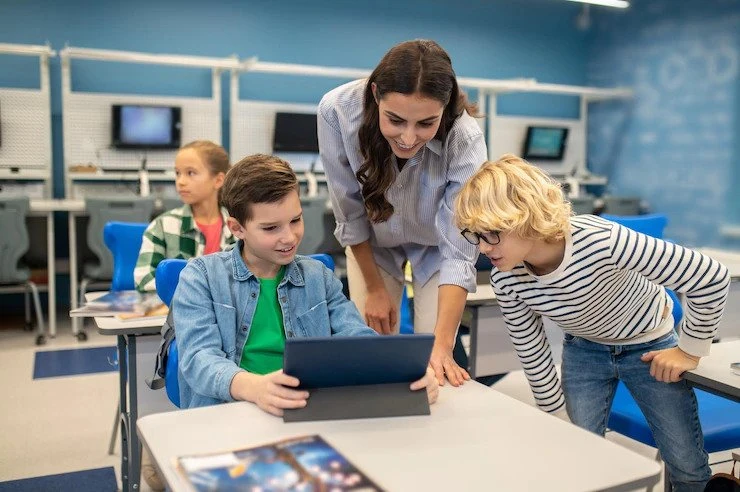

Students might easily become sidetracked from studying in the digital age if the subject matter is not engaging. Teachers must put a lot of effort into creating a syllabus that will improve students' learning results. With the right guidance and tools, teachers can help students focus on the material, whether they find it interesting or not.
It has been noted that student performance results have improved as a result of the use of technology in the classroom. Students learning results are enhanced by the progressive change in teaching strategies and the use of digital technology in the classroom. The integration of technology into the classroom has allowed for more interactive, engaging, and collaborative learning experiences for students.
Therefore, we must identify some of the key benefits of the digital education system.
Learners get smarterThrough the use of technology in the classroom, students can access a variety of online resources that can help them become better learners. Students can develop good self-directed learning skills by using educational technologies and learning resources. They can evaluate what they need to know to use internet resources and search for information. They are more productive and efficient thanks to digital education.
Digital learning methods and technology also help students develop their analytical thinking abilities, which are the cornerstone of the development of systematic reasoning. Additionally, digital learning provides students with an opportunity to develop their problem-solving skills.
By employing transforming education technologies to discover fresh knowledge and abilities, students also experience positive sensations of development, which gives them the belief they need to be eager to discover far more interesting concepts. Through digital learning, students gain access to a range of tools that help them become more productive and efficient.
Improve learning motivation
Digital education helps students become motivated learners by providing them with the opportunity to explore and discover different areas of knowledge, acquire new skills, and gain an understanding of concepts through interactive, engaging, and self-directed learning experiences.
The transforming education system greatly improves transparency and formability in students' assessments by analyzing their performance in real time and automatically generating results. Furthermore, digital learning also encourages collaboration and peer-to-peer learning, as students can collaborate to complete tasks and participate in discussions.
It allows students to evaluate their progress in depth and develop appropriate responses.
Digital learning allows for self-direction, allowing students to discover at their own pace while doing extensive web research to get the most relevant knowledge possible.
Customized Learning
Customized learning also plays a role in digital learning, as it allows students to work at their own pace, focusing on areas that need more attention while passing over those topics they have already mastered.
The main benefit of the digital education model is the chance to help students study at the time and on the course that is ideal for them. The most effective type of customized learning is one-to-one instruction.
When learners are unable to keep pace with the remainder of the class, the traditional learning approach causes a lag in their holistic development and frequently results in a reduction of interest on their part one-to-one instruction eliminates this issue, allowing students to focus on the topics they need more time to understand.
With a digital medium, teachers may adapt the syllabus to each learner's academic style and aptitude. This personalized approach helps to create a dynamic and engaging learning experience, allowing learners to develop a deep and meaningful understanding of the material while progressing at their own pace.
Enhanced Learning Possibilities
The increased learning possibilities for learners provided by transforming education are one of its main benefits. To help students understand that learning happens at different times and in different places, digital learning is expanding the range of learning possibilities available to them. Students benefit greatly from technological advancements and digital technologies. Students are no longer confined to the traditional learning environment and instead have a variety of tools and resources available to them that can be accessed anywhere. Digital learning has revolutionized the way that students approach their studies.
Increased Engagement Ratio
Digital technologies have enabled students to become more engaged with their studies than ever before by allowing them to have access to a wealth of information and resources that would not have been possible in the past.
Due to the characteristics of a traditional classroom, which includes students, textbooks, and teachers for instruction, conventional learning provides students with limited opportunities for participation. However, digital learning allows students to take an active role in their learning, as they can make choices about how they want to consume content and resources.
The digital education structure, on the other hand, offers learners a wide range of learning alternatives.
The endless supply of photos and videos, dynamic lessons, virtual reality (VR), and a variety of other features make the e-learning approach more captivating and simple for learners to comprehend. This creates an environment where students can be more engaged and motivated to learn.
Regular Feedback
There must be a procedure by which learners can get useful criticism. Learners can make adjustments to their learning styles and take action to improve student learning outcomes using e-learning by getting continual feedback from lecturers. By providing regular feedback, lecturers can allow students to identify any areas of difficulty and take action accordingly. Regular feedback also allows lecturers to monitor students' progress and provide support as needed.
Conclusion
The education system of the 21st century has been revolutionized by technology. Each student can now receive the same basic content because educators can now reach the whole classroom via digital displays. Students today have access to an infinite amount of knowledge. Additionally, the physical barriers to education have been reduced as well. When we consider how far learning has progressed over the last decades, we are astounded by how significantly the field has evolved. The technology available to us has opened up the doors of education in previously unimaginable ways.
The greatest way to grab learners' interest, keep them interested, boost their engagement levels, and improve their performance is to create an active, technologically enhanced educational space.
0



























Sign in to leave a comment.