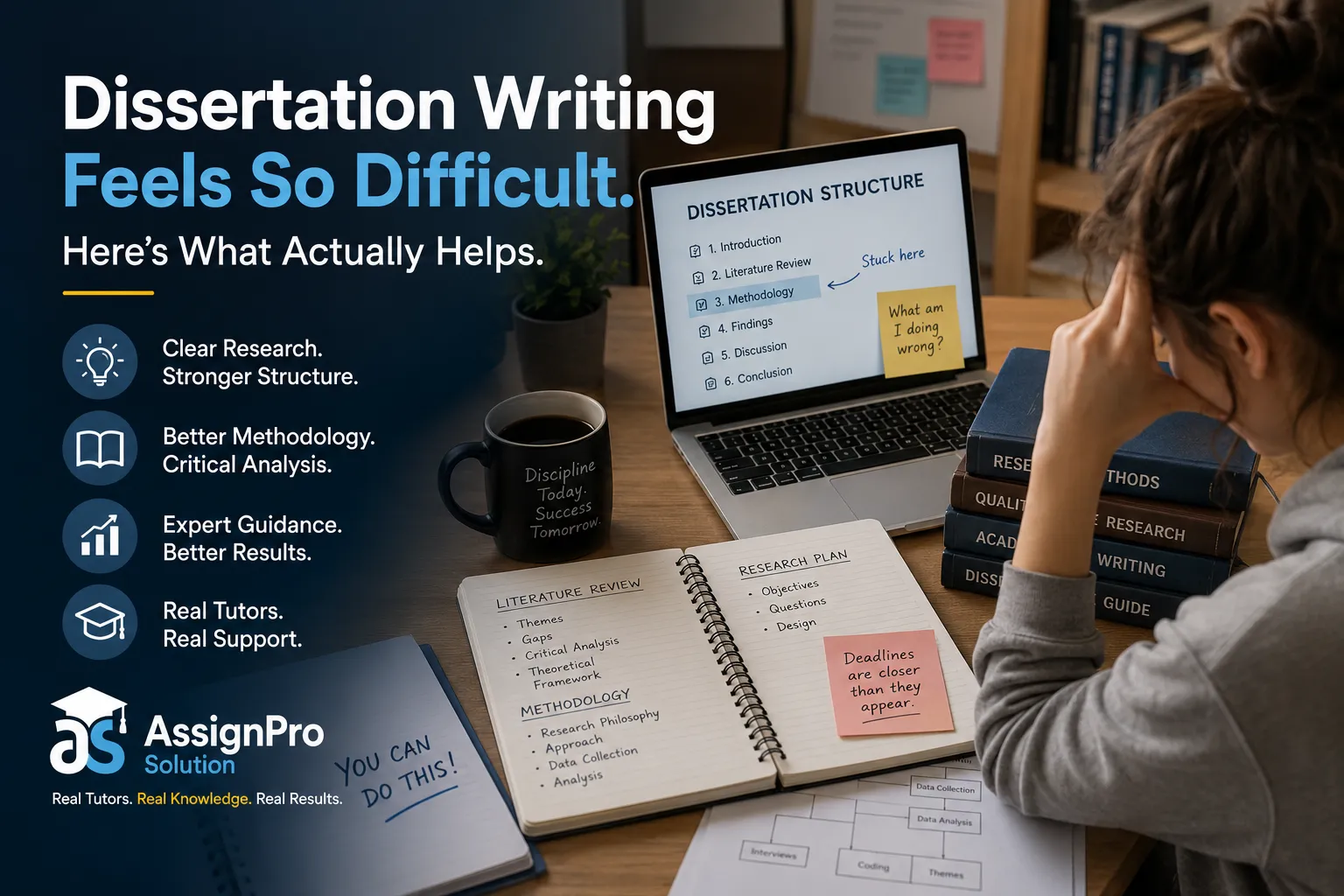

Many students only start looking for dissertation help when they realise the challenge isn't their topic, but knowing how to structure and justify a full research project.
Everyone warns you the dissertation is long. Nobody warns you about the
part where it stops making sense.
You can know your subject. You can have a clear research question. You
can have a supervisor who seems satisfied with your direction. And then
you open the methodology chapter and realise you have no idea what you're
doing.
That's not a sign you chose the wrong topic. It's a sign that the
dissertation asks for a different kind of thinking than most students have
been trained for — and that the jump from coursework to a 10,000-word
research project is steeper than anyone really tells you upfront.
Why the Dissertation Feels Different From Everything Else
A coursework essay has a question. You answer it. The structure is
familiar, the sources are often provided, and the word count is manageable
enough to get through in a few intense sessions.
A dissertation has a research question you partly chose yourself, a
literature review that needs to be critical rather than descriptive, a
methodology chapter that has to justify every decision you made, and a
findings section that connects back to everything that came before it.
None of those pieces are like coursework. Each one has its own logic,
its own conventions, and its own way of going wrong.
The students who struggle most aren't the ones who don't understand their
topic. They're the ones who understand the topic but can't figure out how
to build a research project around it. That's a different skill. And most
universities don't teach it directly — they expect you to pick it up.
The Methodology Problem
If there's one chapter that derails more students than any other, it's
the methodology.
The introduction can be worked through with a clear structure. The
literature review is hard but manageable once you understand what critical
synthesis means. The findings are difficult but at least tied to data you
have in front of you.
The methodology chapter requires you to justify things most students have
never been asked to justify before. Why qualitative and not quantitative?
What is your research philosophy — positivist, interpretivist, pragmatist?
Why semi-structured interviews instead of a survey? Why thematic analysis
instead of content analysis? Why this sample size?
These are real academic questions with real answers. But finding those
answers requires knowing the vocabulary of research design well enough to
write in it — and knowing what your supervisor is actually looking for when
they read that chapter.
A methodology that just describes what you did will get sent back. One
that justifies why you did it, in the right language, with the right
theoretical grounding, is what passes.
What the Literature Review Is Actually Asking For
Most students write their first literature review like an annotated
bibliography. Source by source. What this study found, what that study
found, what the third study found.
That's not a literature review. That's a summary.
A real literature review organises existing research around themes,
debates, and gaps. It shows how the field has developed. It identifies
where your research question fits into conversations that are already
happening. It builds toward your methodology — because the gap in the
literature is the reason your research question exists.
That's a harder piece of writing than most coursework asks for. And it's
the one supervisors send back most often with the note: "too descriptive,
needs to be more critical."
Critical doesn't mean negative. It means evaluating — what the studies
got right, where they have limitations, how they relate to each other,
and what they leave unanswered. That's the skill the literature review
is testing.
When Supervisor Feedback Isn't Enough
Supervisors are researchers. They know what a good dissertation looks like.
What they don't always have time for is explaining, in detail, how to get
from your current draft to that standard.
"Strengthen your methodology justification" is technically correct feedback.
It's not always actionable if you don't know what stronger justification
looks like in practice.
"Be more critical in your literature review" tells you what the problem is.
It doesn't tell you how to restructure the section to fix it.
This is the gap most dissertation students find themselves in. The feedback
is accurate, the direction is clear, but the path from here to there
isn't obvious. And the deadline is moving regardless.
Getting targeted support at that point — from someone who has read enough
dissertations to recognise exactly what the feedback means and how to
address it — is often what gets a stuck chapter unstuck. Not because
someone else writes it, but because the problem becomes visible enough to
fix.
Students who access specialist dissertation help at that stage tend to turn
chapters around faster than students who try to interpret supervisor
feedback alone and revise in circles.
The Chapters Most Students Need Help With
Every student's dissertation is different. But the same chapters come up
most often as the ones where people get stuck.
The literature review, because it requires a level of critical engagement
that coursework rarely builds toward.
The methodology, because the philosophical justification feels abstract
until someone explains the vocabulary in terms that actually connect to
your study.
The findings and discussion, because presenting data and interpreting it
in relation to your research question and literature review at the same
time is genuinely complicated.
The proposal, for students who haven't written one before — because getting
the research rationale, objectives, and outline methodology right from the
start saves significant time later.
Chapter-by-chapter support exists precisely because you don't always need
help with the whole dissertation. Sometimes you need one section sorted
so you can move forward.
What Country-Specific Support Changes
A dissertation submitted at a UK university is marked differently from
one at an Australian university. The conventions around critical analysis,
the weight given to different chapters, the referencing expectations —
Harvard at one institution looks slightly different from Harvard at another.
A student at BPP Law School working on an LLM dissertation is operating
in a different system from a student at the University of Melbourne writing
a Masters thesis. Same broad category, very different practical requirements.
Tutors who know your country's university system, and ideally your
institution specifically, catch things that a general academic writing
guide won't. They know what QAA standards mean in practice for UK students.
They know what the AQF expects at postgraduate level in Australia. They
know the difference between how OSCOLA is applied in UK law dissertations
versus how AGLC works in Australian ones.
That specificity is the difference between feedback that sounds right and
feedback that actually improves the chapter.
What to Do When the Deadline Is Close
If the deadline is close and the dissertation isn't where it needs to be,
the worst thing to do is keep revising without a clear direction.
The second worst thing is to assume there isn't enough time to fix it.
A focused session on the weakest chapter — identifying exactly what's
wrong with the argument structure, the methodology justification, or the
critical depth of the literature review — usually reveals that the
problem is more specific than it felt. Specific problems have specific
fixes. Specific fixes take less time than unfocused revision.
Most students who've been stuck on a chapter for a week find that one
targeted conversation gets them further than the previous seven days of
working alone.
The dissertation isn't finished when you've written all the words. It's
finished when the argument holds, the methodology is justified, and the
chapters connect the way they're supposed to. Getting clear on what's
missing is the fastest route to finishing.
If you're at the stage where the chapter is written but something isn't
working, that's the right time to get a second perspective — not after
submission.






























Sign in to leave a comment.