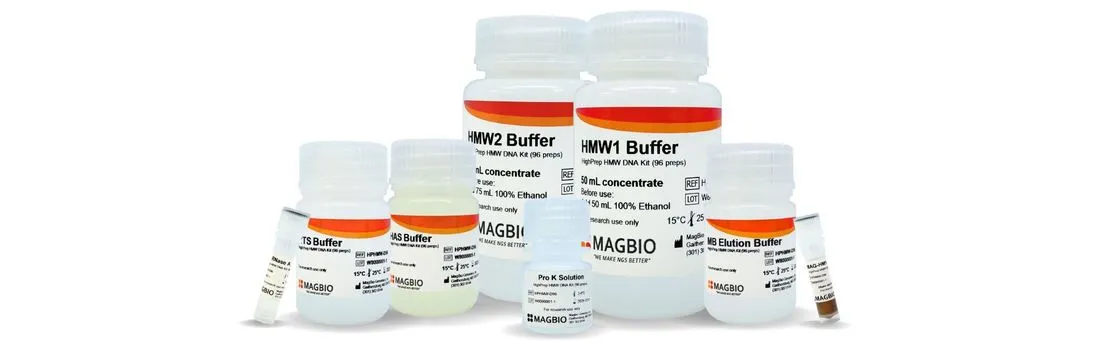

Degraded DNA is one of the most expensive problems in genomics, not because it's hard to detect, but because it's often detected too late. By the time a sequencing run underperforms, the damage happened days earlier, somewhere between extraction and the final library cleanup.
Why Degradation Often Goes Unnoticed Until It's Too Late
Most labs check DNA quality once, right after extraction, and assume it holds steady from there. But degradation doesn't always happen all at once; it can accumulate quietly across several handling steps.
Mechanical stress, repeated freeze-thaw cycles, and rough pipetting all contribute to shearing, even when a sample looks perfectly intact on its first quality check. This is especially damaging for workflows depending on High Molecular Weight DNA Isolation, where fragment length is the entire point. A single rough handling step can undo hours of careful extraction work without producing any obvious warning sign until sequencing metrics come back.
It's worth remembering that degradation is cumulative, not instantaneous. A sample rarely goes from intact to unusable in one event. Instead, small stresses at each handling step add up, and the final library QC simply reveals the total damage, long after any single cause could be isolated or corrected.
Gap Between Extraction QC and Final Library QC
Many labs treat the initial post-extraction QC as the final word on sample quality, but library prep involves multiple additional steps where degradation can still occur.
Between initial extraction and final library QC, samples pass through fragmentation, size selection, ligation, and multiple cleanup rounds. Each step introduces handling risk. A sample that passed High Molecular Weight DNA Isolation checks with excellent fragment length can still degrade during downstream processing if temperature, shear force, or reagent exposure isn't carefully controlled at every stage.
This gap matters most for long-read applications, where a few kilobases of unnoticed shearing can meaningfully shorten average read length. Short-read workflows tolerate this kind of drift far better, which is part of why degradation issues are frequently underestimated until a lab moves toward long-read sequencing for the first time.
Early Warning Signs Worth Watching For
Catching degradation early means checking at multiple points rather than relying on a single quality gate at the start of the workflow. A few consistent signals tend to show up before a run is fully compromised.
Watch for these indicators throughout your workflow, not just at the beginning:
- Shifting fragment size distributions - a gradual leftward shift on repeated Bioanalyzer or TapeStation traces often signals ongoing shearing.
- Lower-than-expected 260/280 or 260/230 ratios - these point to contamination or degradation products interfering with downstream enzymatic steps.
- Inconsistent recovery after cleanup - unexpectedly low yield following a routine cleanup step can indicate the sample was already compromised going in.
- Smearing on gel or capillary electrophoresis - visible smearing, rather than a tight band, is a strong sign of active degradation.
- Failed library amplification - poor PCR performance downstream is sometimes the first visible clue that upstream degradation already occurred.
None of these signs is conclusive on its own, but together they build a pattern. Labs that track more than one indicator across a run tend to catch problems earlier than those relying on a single QC checkpoint, since degradation rarely announces itself through just one metric.
How Purification Method Affects DNA Integrity
The technique used to purify DNA at each stage has a direct, measurable impact on how much shear stress the sample experiences. Some methods are inherently gentler than others.
This is where Magnetic bead DNA purification plays a protective role. Bead-based methods avoid the vacuum pressure and centrifugal force associated with column-based purification, both of which can physically shear long DNA fragments. For labs running long-read sequencing or any protocol sensitive to fragment length, this difference in mechanical stress is often the deciding factor between a clean run and a degraded one.
Choosing Gentler Protocols by Design
Not every purification method treats DNA the same way, and the difference becomes more visible as fragment length increases. Long fragments are simply more vulnerable to physical stress than short ones.
Reagents built specifically for Magnetic bead DNA purification allow for controlled, gentle mixing and elution, reducing the repeated physical stress that spin-column formats can introduce. Labs handling particularly long or fragile DNA, such as samples destined for long-read platforms, often see measurably better integrity retention simply by switching to a bead-based workflow at the extraction and cleanup stages.
The elution step deserves particular attention here, since it's one of the last chances to damage a sample after careful Magnetic bead DNA purification earlier in the workflow. Aggressive vortexing or forceful pipetting during elution can shear exactly the fragments a lab worked hardest to preserve. Gentle resuspension, adequate incubation time, and controlled mixing speed all protect fragment length in ways that are easy to overlook once a protocol becomes routine.
Practical Steps to Catch Degradation Before It Costs a Run
Once you know where degradation tends to occur, building in a few extra checkpoints costs little time but can save an entire sequencing run. These steps work well alongside existing QC protocols rather than replacing them.
Consider building these checkpoints into your standard workflow:
- Run a QC check after extraction and again after the first cleanup step, rather than assuming the initial result holds.
- Minimize freeze-thaw cycles by aliquoting samples before long-term storage instead of repeatedly thawing a single stock.
- Standardize pipetting technique across operators, since inconsistent mixing force is a common and underestimated source of shearing.
- Log fragment size trends over time for recurring sample types, making it easier to spot a workflow-level issue versus a one-off sample problem.
- Choose gentler purification chemistry for high-value or long-read samples where fragment integrity directly determines usable output.
Building these checks into a standard operating procedure doesn't require significant extra time, but it does require treating degradation as an ongoing risk rather than a one-time check. Labs that catch fragmentation early save both reagents and sequencing time that would otherwise be spent on a compromised run.
Making Degradation Checks Part of Routine Practice
Turning these checkpoints into habit, rather than a special troubleshooting exercise, is what actually prevents repeat problems. This matters most for labs running High Molecular Weight DNA Isolation protocols, where the cost of undetected shearing is highest, and the margin for error in fragment length is smallest. A lab that only checks fragment integrity after a run fails is always working backward from damage that's already done.
Building a simple tracking sheet, noting fragment size at each checkpoint, operator, and reagent lot, turns degradation from a mystery into a pattern. Over a few months, most labs can pinpoint exactly which step, operator habit, or reagent batch tends to introduce the most variability, and correct it directly instead of guessing after every failed run.
FAQs
How can I tell if my DNA degraded during library prep rather than extraction?
Compare fragment size traces at multiple points in the workflow. If integrity looked good right after extraction but declined by final library QC, degradation likely occurred during downstream handling.
Does the purification method really affect DNA fragment integrity?
Yes. Methods involving high centrifugal force or vacuum pressure introduce more mechanical shear than gentler bead-based approaches, which matters most for high molecular weight or long-read applications.
What's the earliest sign of DNA degradation to watch for?
A gradual shift toward smaller fragment sizes on repeated QC traces is often the earliest reliable signal, frequently appearing before yield or downstream enzymatic performance is affected.
Can freeze-thaw cycles really cause noticeable degradation?
Yes. Repeated freeze-thaw cycles are a well-documented source of shearing, especially for long fragments, and are easy to reduce simply by aliquoting samples before storage.
Protect your DNA integrity from extraction to sequencing. MagBio Genomics offers gentle, reliable magnetic bead purification solutions built for genomics labs. Explore our full product range today. For expert guidance, call (301) 302-0144 or email now.































Sign in to leave a comment.