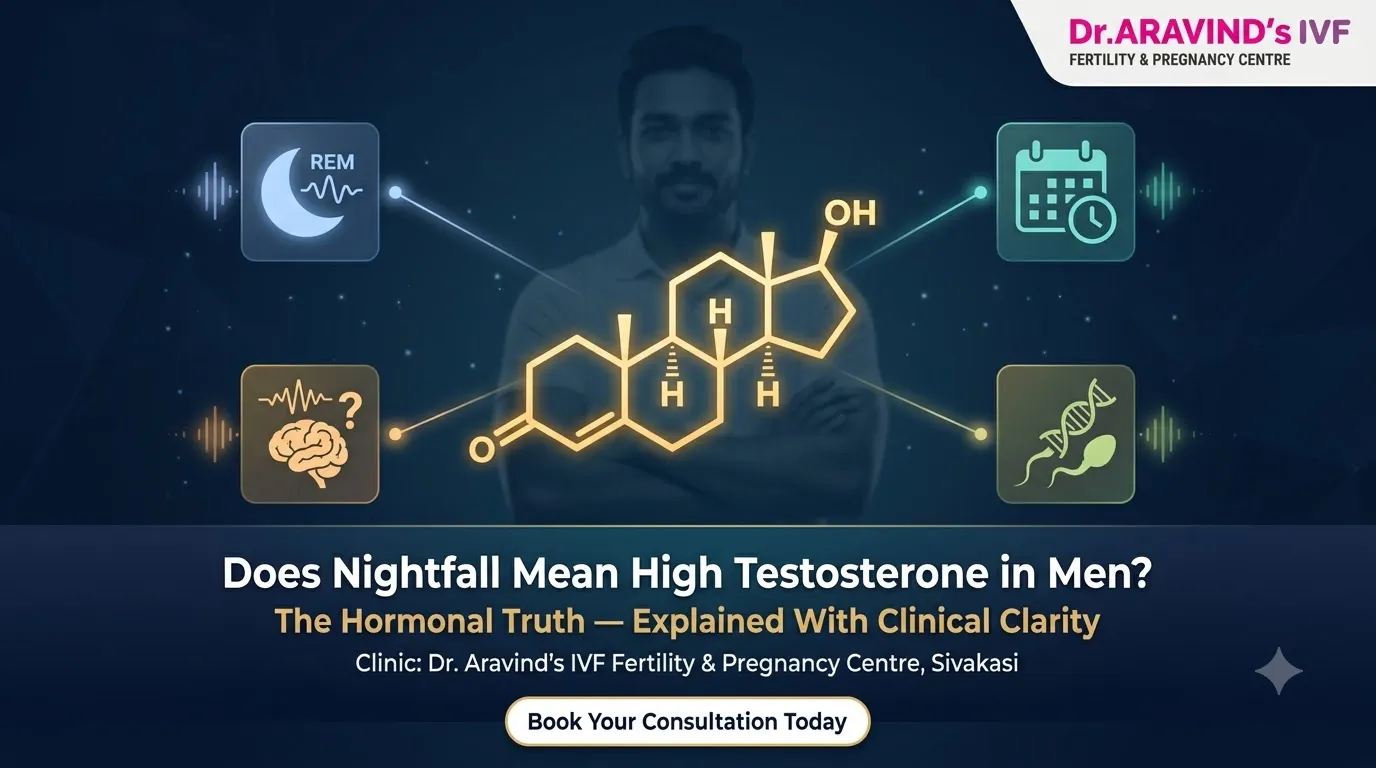

One of the most commonly asked questions about nightfall in men is whether it signals high testosterone. It is a reasonable question — and the honest answer is more nuanced than a simple yes or no. Understanding the real relationship between testosterone, nightfall, and overall male reproductive health is genuinely useful, both for men curious about their own bodies and for couples navigating fertility concerns.
At Dr. Aravind's IVF Fertility & Pregnancy Centre, a trusted fertility centre in Sivakasi, this question comes up regularly — and it always deserves a clear, evidence-based answer rather than a vague reassurance.
What Is the Connection Between Testosterone and Nightfall?
Testosterone is the primary male sex hormone. It drives sperm production, regulates libido, governs muscle mass and energy, and plays a central role in the body's reproductive cycle. It is also the hormone most directly responsible for how actively the male reproductive system operates day to day.
Here is the connection that makes the question reasonable. Higher testosterone levels increase semen production, heighten sensitivity in the reproductive system, and raise the frequency of sexual arousal — including the spontaneous arousal that occurs during REM sleep. Men with higher testosterone output, particularly adolescents and young adults in their peak hormonal years, do tend to experience nightfall more frequently than men with lower testosterone levels.
So in a general, population-level sense, yes — higher testosterone is associated with more frequent nightfall in men. But this association is not a direct diagnostic relationship. It does not mean that every episode of nightfall confirms high testosterone, and it certainly does not mean that the absence of nightfall indicates low testosterone.
Why Testosterone Alone Does Not Explain Nightfall
Nightfall is influenced by multiple overlapping factors — not testosterone alone. Sexual inactivity is one of the most significant. A man with completely average testosterone levels who has not ejaculated in several days is far more likely to experience nightfall than a man with high testosterone who ejaculates regularly. The body's semen accumulation and release mechanism operates independently of whether testosterone is high, normal, or borderline.
REM sleep activity is another independent factor. During REM sleep, the brain generates arousal responses that can trigger ejaculation regardless of testosterone levels. This is why nightfall can occur in older men with naturally declining testosterone, in men on testosterone-suppressing medications, and in adolescents whose testosterone has not yet fully peaked.
Psychological factors — erotic dreams, accumulated arousal from sexual content, stress — all contribute to nightfall frequency without necessarily reflecting anything about the body's testosterone output.
The honest clinical picture is this: testosterone creates a physiological environment in which nightfall is more likely to occur. But it is one variable among several, not the single determining factor.
When Nightfall Frequency Does Reflect Hormonal Health
While occasional nightfall does not reliably indicate specific testosterone levels, certain patterns do carry hormonal relevance worth noting.
Men in their adolescent and early adult years — where testosterone is highest — experience the most frequent nightfall. This is a normal reflection of peak hormonal activity and requires no intervention. As testosterone naturally declines with age, nightfall frequency typically reduces alongside it — again, a normal hormonal pattern.
Sudden significant increase in nightfall frequency in a man whose pattern was previously stable may reflect a temporary hormonal shift — for example, following changes in exercise habits, diet, sleep quality, or stress levels, all of which influence testosterone output. This is worth noting but rarely requires clinical concern on its own.
Where hormonal evaluation becomes genuinely relevant is when nightfall frequency changes are accompanied by other symptoms — reduced libido, unexplained fatigue, mood shifts, or changes in body composition — that together suggest a broader hormonal picture worth investigating.
Does High Testosterone Always Mean Better Sperm Health?
This is an important clinical distinction that connects directly to couples exploring IVF treatment in Sivakasi or fertility care more broadly. High testosterone supports sperm production, but extremely high testosterone — particularly when artificially elevated through testosterone supplements or anabolic steroids — can actually suppress sperm production significantly.
The hypothalamic-pituitary-gonadal axis regulates testosterone and sperm production together. When external testosterone is introduced, the brain detects high circulating levels and reduces its own signalling to the testicles — which reduces sperm production rather than increasing it. Men who have used testosterone replacement therapy or anabolic steroids sometimes present with severely reduced sperm count or azoospermia despite having high testosterone levels.
This is one of the most important facts for men in the best IVF centre in India patient population to understand: testosterone level and sperm production are related but not interchangeable. A high testosterone reading does not confirm healthy sperm, and a normalised testosterone does not mean infertility.
What Nightfall Frequency Actually Tells You
Rather than reading nightfall as a hormonal report card, it is more useful to understand it as a reflection of the body's current reproductive activity level. Frequent nightfall in a young healthy man with no other symptoms simply means the reproductive system is active, semen is accumulating faster than it is being released, and the body is functioning normally.
It does not confirm high testosterone specifically. It does not signal exceptional sperm quality. And it does not require treatment or intervention unless accompanied by symptoms that suggest otherwise.
For men with genuine fertility concerns — those trying to conceive without success, those with known risk factors, or those wondering whether their hormonal health is affecting their sperm — the right answer is always a proper evaluation rather than interpreting nightfall frequency as a clinical indicator.
A semen analysis, sperm DNA fragmentation test, and full hormonal panel at a trusted fertility centre in Sivakasi gives the actual clinical picture that nightfall frequency alone can never provide.
Conclusion
Nightfall in men and testosterone are connected — but not in the simple, direct way most men assume. Higher testosterone creates conditions where nightfall is more likely, but it is not the only factor, and frequent nightfall cannot be used as a reliable indicator of testosterone levels or sperm health. For couples exploring fertility options including IVF treatment in Sivakasi, understanding this distinction matters — because accurate information leads to better clinical decisions.
As one of the leading fertility centres in Sivakasi and a trusted name among the best IVF centres in India, Dr. Aravind's IVF Fertility & Pregnancy Centre provides the complete male reproductive health evaluation that gives every man and every couple the answers they actually need.
FAQ
Q1. Does nightfall mean you have high testosterone?
Not necessarily. Higher testosterone creates conditions where nightfall is more frequent, but nightfall is also influenced by sexual inactivity, REM sleep patterns, and psychological factors. It cannot be used as a reliable indicator of testosterone levels without a proper hormonal blood test.
Q2. Is frequent nightfall a sign of good hormonal health?
Frequent nightfall in men — particularly in younger men — generally reflects an active reproductive system and is often associated with healthy testosterone levels. However, it is not a diagnostic marker. A proper hormonal panel is the only accurate way to assess testosterone and related hormone levels.
Q3. Can high testosterone cause nightfall in older men?
Yes. Men who maintain higher testosterone levels into their forties and beyond — through consistent exercise, healthy weight, and good sleep — may continue to experience occasional nightfall. This is a normal reflection of sustained hormonal activity, not a medical concern.
Q4. Does nightfall affect sperm count or IVF treatment outcomes?
No. Occasional nightfall does not reduce sperm count or affect IVF treatment in Sivakasi outcomes. Sperm production is continuous and is not meaningfully depleted by nocturnal emission. Men preparing for IVF are not advised to restrict normal physiological processes like nightfall.
Q5. When should a man in Sivakasi get his testosterone levels checked?
Seek hormonal evaluation at a trusted fertility centre in Sivakasi if you experience reduced libido, persistent fatigue, mood changes, unexplained weight gain, or fertility challenges alongside questions about nightfall frequency. Dr. Aravind's IVF Fertility & Pregnancy Centre offers comprehensive male hormonal health evaluation as part of every fertility consultation.



























Sign in to leave a comment.