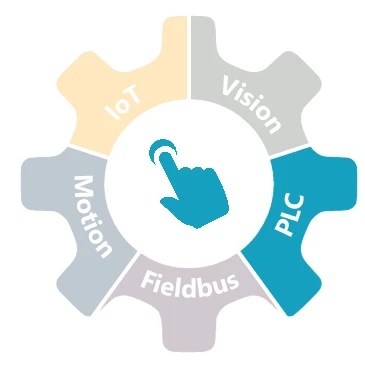

In the industrial automation market, motion control is a key development. But, many people don’t understand this. It’s said that motion control affects and impacts various operations through machines, avoiding countless human errors, speeding up production efficiency, and increasing effectiveness, across the value supply chain. A motion-controlled device is used to control the same.
A motion controller controls the motion devices dynamically by signaling and executing commands. It controls the power triggers to move the motors or any mechanical devices that are required in the process of assembly lines, machines, robotic devices, etc.
Which is the most widely-used controller in automation?
Most widely, a PLC or programmable logic controller is used in automation. There are three PLC types based on the output. They are Relay output, Transistor output, and Triac output PLC.
Commonly, the PLC motion control is utilized with the popular market share of Siemens Simatic PLC, Rockwell Automation Allen Bradley PLC, Mitsubishi Melsec PLC, Schneider Modicon PLC, and Omron Sysmac PLC.
The PLC motion controller varies and ranges from small modular devices to large rack-mounted modular devices. There is a huge difference between smaller-range devices and large-scale devices. Small-range devices facilitate 2-digit inputs and outputs (I/O) whereas large-scale devices complement with thousands of I/Os.
Why should you use PLC-based motion control for industrial automation?
PLC motion control offers better reliability as moving parts are absent. Such devices are more flexible, require little maintenance, and are available at a lower cost. The devices help in easy communication, and simple troubleshooting, give faster response time, have built-in error diagnostics, and consume less power. Other than this, the PLC motion control gives the benefit of easy logic changing and documentation. With this, the counter, time, and comparator can be programmed with an easy operator interface.
Other things to know about PLC-based motion control
In the beginning, PLC helped the industrial automobile market by replacing hard-wired relay logic systems. But, after decades, development and improvements took place in the PLC. Today, it is identified as a suitable controller in harsh or rigorous environments.
PLC creates a hard output real-time system that increases productivity response with limited time for input conditions. This keeps the timeframe and production KPIs of the operation.
The best part is that the scope of PLC programming is continuously increasing, providing greater flexibility, memory, smaller size, and higher GB speed with Ethernet and built-in wireless features through USB technology applications. This marks online programming and remote monitoring easier.
Today, PLC motion control devices monitor and control multi-user applications/distributed servers as well that provide accurate supervision of operations. Also, monitoring and control are based on multiple stakeholders’ demands, maintenance, engineering, operations, and production IT.
By now you might have understood that the industrial automation market needs motion control. So, choose PLC motion control.







Sign in to leave a comment.