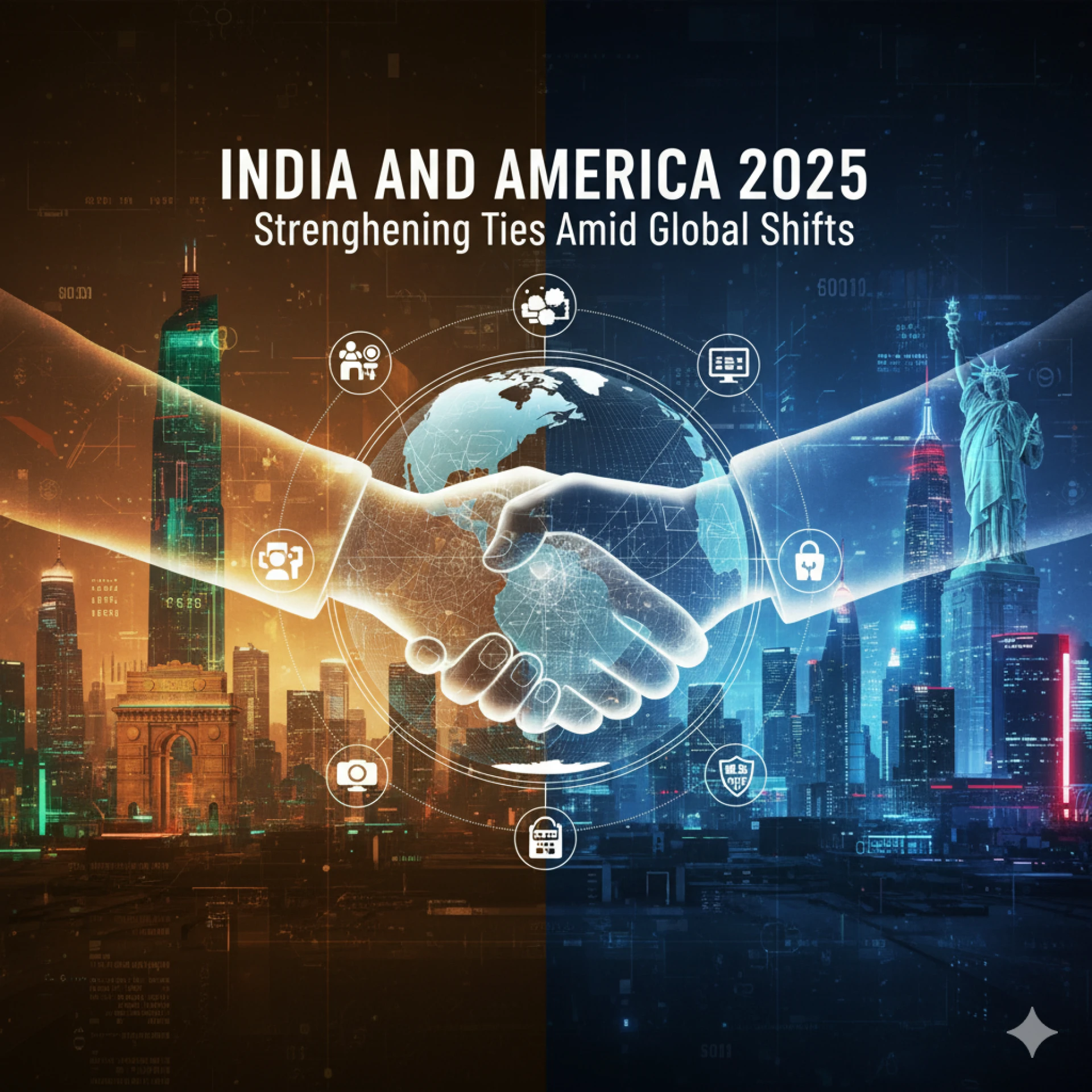

In 2025, the partnership between India and the United States stands at a historic turning point. What began as a strategic handshake in the early 2000s has evolved into one of the most dynamic, multifaceted relationships shaping global politics, technology, defense, and the economy. The world is undergoing rapid transformation—from shifting power structures to emerging digital ecosystems—and both nations are leveraging this moment to redefine their global influence together.
1. A Partnership Forged by Shared Interests
India and the U.S. have long shared democratic values, but their cooperation in 2025 is driven more by strategic pragmatism than ideology alone. As the geopolitical map reshapes with the rise of China, instability in Europe, and challenges in global supply chains, both countries find themselves aligned in promoting a free, open, and secure Indo-Pacific region.
For Washington, India represents a stabilizing democratic force in Asia—a counterbalance to authoritarian power. For New Delhi, the U.S. is a vital partner in technology, defense, and trade, offering the economic and strategic leverage needed to fuel its ambitions as a global power.
2. The Economic Equation: Trade, Technology, and Talent
The U.S.-India economic partnership in 2025 has matured into a tech-driven powerhouse. Bilateral trade has crossed record highs, with a focus on high-value sectors like artificial intelligence, renewable energy, defense manufacturing, and semiconductors.
Indian tech firms are expanding their footprint in Silicon Valley, while American companies are setting up innovation hubs in Bengaluru, Hyderabad, and Pune. The synergy between India’s vast digital talent pool and America’s capital investment is driving a new digital industrial revolution.
Moreover, India’s rise as a manufacturing alternative to China is gaining traction. With global supply chains being restructured, American corporations are looking to India as a long-term, stable base for production and innovation. Initiatives like the U.S.-India Critical and Emerging Technology (CET) partnership are not only strengthening collaboration but also positioning both nations as co-creators of the next generation of global technology.
3. Defense and Security: Building Trust Through Strategy
Defense has become one of the most robust pillars of U.S.-India relations. From joint naval exercises like Malabar to the increasing interoperability of their armed forces, both countries are committed to ensuring peace and security in the Indo-Pacific.
In 2025, defense cooperation has expanded beyond traditional hardware purchases to joint research and development in cyber defense, drone warfare, and space security. India’s inclusion in advanced U.S. defense frameworks and technology-sharing agreements underscores the deepening trust between the two nations.
The Quad Alliance (India, the U.S., Japan, and Australia) continues to play a central role in this strategy. Although not a formal military alliance, it signals a shared commitment to ensuring that the Indo-Pacific remains open, inclusive, and rules-based.
4. Climate and Clean Energy Cooperation
Another cornerstone of the evolving relationship is climate action. As the effects of global warming become more visible, both India and the U.S. are stepping up collaboration in renewable energy, green technology, and sustainable development.
In 2025, India has made remarkable progress toward its clean energy goals, supported by American investment in solar and hydrogen infrastructure. Joint ventures in green hydrogen, electric mobility, and carbon capture reflect a shared vision for a sustainable future.
Through platforms like the U.S.-India Clean Energy Initiative, both nations are combining innovation and policy reform to reduce emissions while ensuring economic growth.
5. The People-to-People Bridge
At the heart of this relationship lies a powerful human connection. The Indian diaspora in the United States—over 4 million strong—continues to be a bridge between the two democracies. From leading Fortune 500 companies to shaping American academia, politics, and entrepreneurship, the Indian-American community has become a cornerstone of bilateral goodwill.
Student exchanges, startup collaborations, and cultural diplomacy have also strengthened ties. In 2025, educational partnerships are at an all-time high, with joint research initiatives between Indian Institutes of Technology (IITs) and top U.S. universities tackling everything from AI ethics to renewable innovation.
6. Political Dynamics and Global Diplomacy
Geopolitically, India and the U.S. are navigating a complex landscape. While the partnership is strong, it is not without its challenges. Issues such as trade tariffs, data privacy, and differing stances on global conflicts continue to test diplomatic finesse.
Yet, both nations have learned to focus on the larger strategic picture. India’s position as a voice for the Global South and America’s leadership in the Western world often complement each other. Joint efforts in global forums like the G20, United Nations, and World Trade Organization showcase a partnership grounded in mutual respect and shared goals.
India’s growing defense ties with Russia and its non-aligned stance in global conflicts sometimes create friction, but both countries have shown a remarkable ability to balance differences through dialogue and cooperation.
7. Technology, AI, and the Digital Future
If there’s one area defining the India-U.S. relationship in 2025, it’s technology. Artificial intelligence, cybersecurity, and digital governance are now central to bilateral talks.
The U.S.-India AI Alliance, launched in 2024, is a pioneering framework that promotes ethical AI development, data sharing, and innovation in sectors like health, agriculture, and defense. India’s digital public infrastructure—recognized globally for its scale and inclusivity—is being integrated into global models with U.S. collaboration.
Together, both nations are not only building economic value but also setting global standards for technology ethics and digital democracy.
8. The Road Ahead: Partnership of Equals
The India-America partnership of 2025 is no longer about aid or assistance—it’s about mutual growth and strategic balance. As both democracies face the twin challenges of technology-driven disruption and geopolitical realignment, their partnership serves as a stabilizing force for the global order.
The years ahead promise even deeper collaboration in defense, digital innovation, and climate resilience. The relationship is evolving from one of strategic convenience to one of strategic convergence—where shared values and shared ambitions intersect.
Conclusion
In 2025, India and America are not just allies—they are architects of a new world order. Bound by democracy, strengthened by innovation, and driven by mutual respect, their partnership continues to redefine what global cooperation looks like in an age of uncertainty.
As global shifts challenge existing norms, the India-U.S. relationship stands as a testament to the power of trust, technology, and timeless diplomacy.
Sign in to leave a comment.