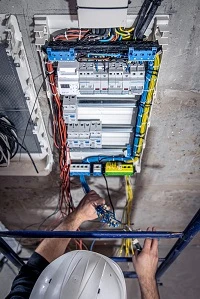

You don’t see exposed wires running around your house or office. Why? Because electrical fittings are encased in safe conduits. Electrical conduits are used to protect electrical wiring, and they also serve an aesthetic purpose. In both concealed and open wiring systems, electrical conduits are used. These conduits are long tubes and pipes that house electrical wires.
Electrical conduits are of many types. Metallic conduits are quite popular, as they are available in various designs such as rigid metal conduit, intermediate metal conduit, galvanized rigid conduit, etc.
Electrical Fittings for Metallic Conduit
An electrical conduit also needs various electrical fittings, which help efficiently route and change the direction of electrical wiring. Different electrical fittings for metallic conduits are discussed below:
Couplings
The most common type of electrical conduit is coupling. As the name suggests, these conduit types join two different tubes or materials to form a long line of conduits. The different types of couplings are:
Set-Screw Couplings- A set-screw coupling conduit has set-screws in place. Once the tube is inserted, the screws are tightened to lock the tube in place.
Threaded Couplings- A threaded coupling is a small metallic tube with internal threads. The metallic conduit tubes can be easily inserted and fitted in place.
Compression Couplings- A compression coupling uses compression and locknuts to fix a conduit. There is a locknut in the middle with a conduit on both ends. These conduits have inner gaskets. Just slide in the electrical conduit tube, and compress the metal to tighten around the conduit.
Couplings can be used to connect both threaded and unthreaded metal conduits to lengthen the same circuit. However, threaded couplings are more commonly used since they are easy to install.
Straps and Strut Clamps
Electrical tubes running along the walls must be fixed in their places. For fixed surfaces, struts and strap clamps are used. Both are used for achieving the same result, i.e., fixing an electrical conduit on the surface, but their designs differ.
Straps are C-shaped metal conduits with holes on both sides for screws. The strap is fixed around the metallic conduit, and screws allow it to fix on the wall.
Strut Clamps are two-piece, U-shaped clamps that are fixed into a strut; both pieces are joined and tightened with a screw. Both the clamp types have distinct functions and are used based on the electrical installation.
Connectors
Connectors are not very different from couplings, but the major difference lies in the fact that they are used for joining metallic conduits and junction boxes, pull boxes, etc. A connector has one side, allowing metallic conduits to be fixed. It is the same as a coupling conduit. The other side has a thread and locknut to attach it to an electrical or pull box. Junction boxes, pull boxes, and electrical boxes have a knockout hole where connectors can be fixed.
Elbows
Elbow conduits are generally used for direction change where a 90-degree turn is not possible by bending pipe. These are conduit pieces which are installed using couplings. Elbows are a more suitable type of conduit for rigid conduits or larger segments of circuits, bending which can be fatal to the metal.
T-Shaped Conduits
T-shaped conduits are used in cases where two circuits need a change of direction despite having the same axis.
Types Of Electrical Conduits
The discussion above includes electrical fittings for metallic conduits, but what are the different types of electrical conduits?
There are four types of electrical conduits, which are discussed below:
Rigid Metal Conduits
These metal conduits are strong and can bear every situation. Thus, these are installed outdoors.
Electrical Metal Conduits
Another strong form of electrical conduits is EMCs which are strong but are not a match against RMCs discussed above. These are made of galvanized steel or aluminum and are lightweight. Their specialty is the thin wall which makes them best-suited for installation in residential dwellings. These are generally used for exposed indoor wiring.
Flexible Metal Conduit
As the name suggests, a flexible metal conduit has a spiral design which makes it suitable for small conduits, such as between two electrical boxes. They are available in various materials, such as aluminum, plastic, lightweight metals, etc.
Electrical Non-Metallic Tubing Conduit
These non-metallic conduits are used in under-the-wall installations and wooden or metal frames. These are made of corrugated plastic and are moisture-resistant. These are also called smurf tubing.
Conclusion
There are multiple electrical fitting types differentiated based on their material and usage. Therefore, different electrical fittings are installed in different project types. The responsible electrician must be qualified to choose the right electrical fitting type.
Conduits are important components for successful electrical installations. They save material and are prone to errors due to their versatility. Thus, choosing an experienced electrician is imperative for successful electrical fittings.
0










Sign in to leave a comment.