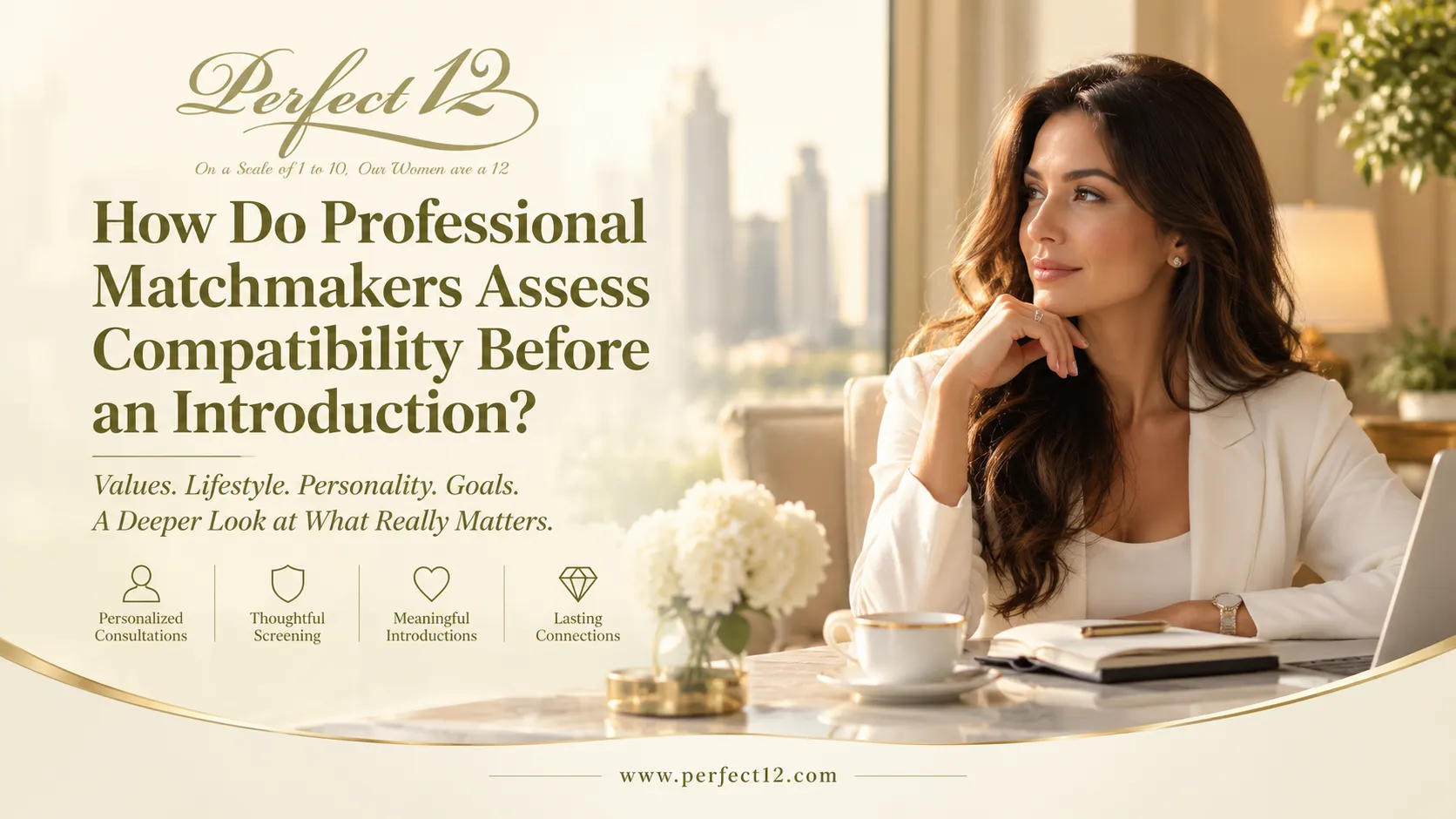

An elite matchmaker assesses compatibility by looking beyond age, appearance, occupation, and basic preferences. A professional evaluation typically considers a person's values, personality, lifestyle, communication style, relationship goals, interests, location, family expectations, and the qualities they genuinely need in a long-term partner.
That distinction matters because compatibility is multidimensional. Research published in 2026 using data from 41,606 partnered individuals across 74 countries found that similarity does not operate identically across every trait: perceived similarity was particularly relevant for value-based traits, while other characteristics showed different relationships with relationship quality.
For elite matchmaking services, the practical implication is clear: a good introduction should be based on meaningful compatibility criteria rather than simply matching two profiles that look similar on paper.
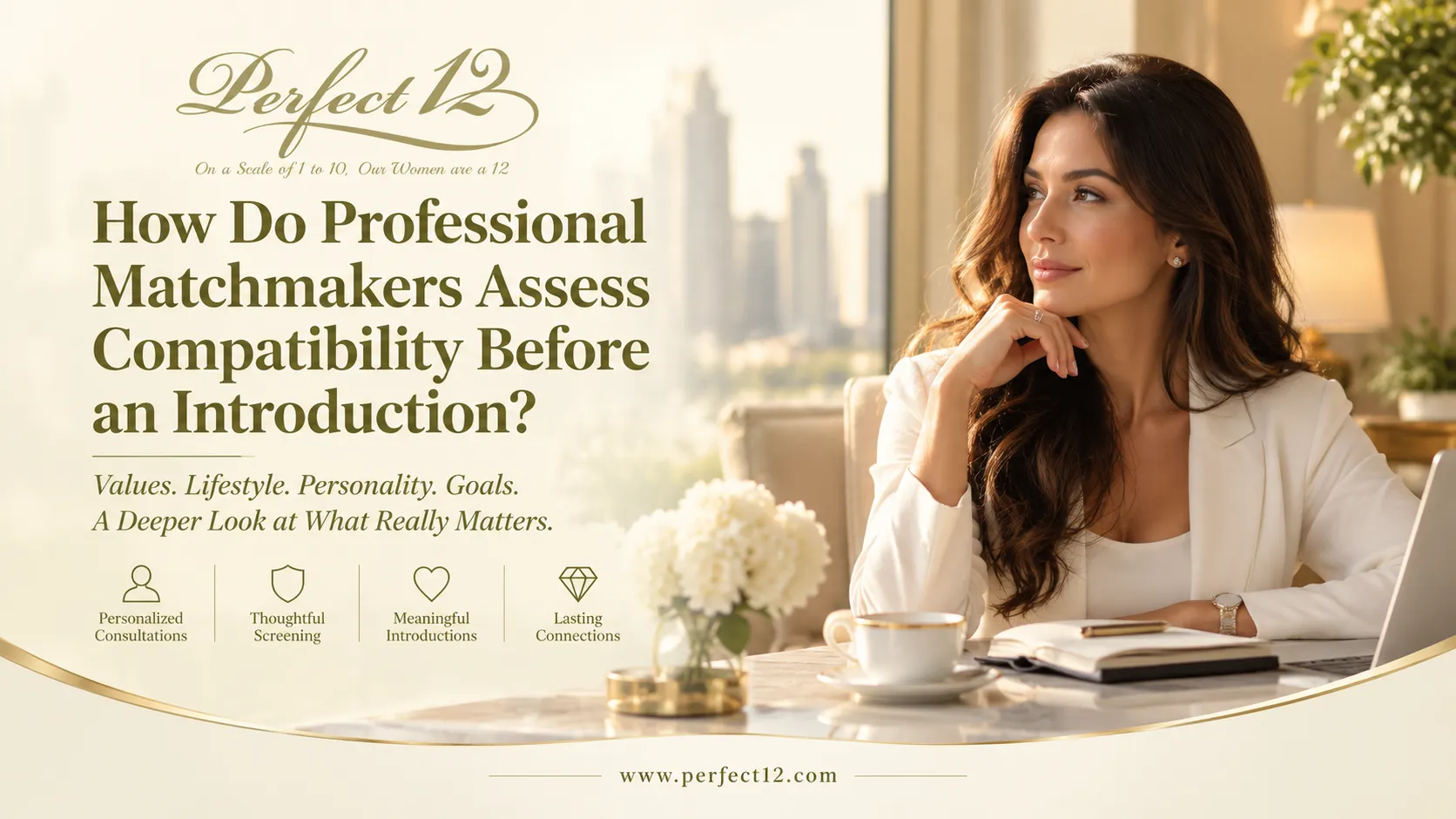
Key Takeaways
- Professional matchmaking evaluates compatibility across multiple dimensions rather than relying on a single matching score.
- Values, relationship goals, lifestyle, personality, communication, and practical circumstances can matter more than superficial similarities.
- An effective assessment distinguishes non-negotiables, preferences, and flexible attributes.
- Compatibility is not necessarily about finding someone identical; complementary qualities can also matter.
- Feedback after introductions can improve the matchmaker's understanding of what actually works for the client.
- Perfect 12 describes a personalized process involving lifestyle, personality, interests, values, goals, location, and other individual criteria.
How Does an Elite Matchmaker Assess Compatibility?
An elite matchmaker generally begins by building a detailed understanding of the client before considering potential introductions. This can involve a personal consultation, relationship history, lifestyle assessment, discussion of values and goals, and clarification of the qualities the client considers important in a partner.
Perfect 12 states that its consultations consider factors including lifestyle, personality, interests, values, goals, age, religion, education, previous marital status, children, and other personal considerations. It also says its clients are personally met and that accepted clients are carefully screened and verified.
The purpose is not to create a perfect checklist. It is to understand which characteristics actually influence the client's ability to build a satisfying relationship.
What Factors Do Professional Matchmakers Evaluate?
A useful compatibility assessment can be organized into several connected dimensions.
1. Values and relationship goals
Values establish the foundation for major relationship decisions. A matchmaker may explore attitudes toward commitment, family, children, faith, lifestyle, career, finances, personal growth, and long-term partnership.
Research supports treating values as a meaningful compatibility dimension. A longitudinal study of 3,674 heterosexual couples found small positive associations between similarity in specific life goals, values, and personality dimensions and relationship satisfaction, although individual partner characteristics generally predicted outcomes better than similarity alone.
This is why two people do not need identical personalities or interests to be compatible. Their fundamental expectations about the relationship need to be workable together.
2. Personality and communication
Personality affects how people communicate, socialize, handle disagreement, express affection, and respond to stress.
A professional matchmaker may therefore consider whether someone is highly social or private, spontaneous or structured, direct or diplomatic, independent or highly collaborative.
The objective is not to diagnose personality or predict relationship success from a label. Instead, these characteristics provide context for evaluating whether two people are likely to communicate comfortably.
3. Lifestyle compatibility
Lifestyle determines whether compatibility can function in everyday life.
An executive who travels frequently, for example, may need a partner who is comfortable with periods of independence. Someone who prefers quiet weekends may be poorly suited to a partner whose ideal lifestyle revolves around constant social activity.
Perfect 12 specifically describes custom-tailored searches around factors such as location, lifestyle, values, culture, religion, social status, desires, and hobbies.
This makes lifestyle assessment particularly important for luxury matchmaking services, where clients may have demanding careers, extensive travel, unusual schedules, or highly specific social environments.
Why Is Compatibility More Than Similarity?
One of the biggest misconceptions about matchmaking is that the ideal partner must be almost identical.
Relationship research suggests a more nuanced picture.
A 2025 worldwide study involving 10,358 participants across 43 countries found evidence that matching between ideal partner preferences and perceived partner characteristics can matter, but the effects varied considerably by trait.
Similarly, 2026 research across 74 countries found that perceived similarity was especially relevant for value-based characteristics, while traits such as kindness and attractiveness followed different patterns.
For an elite matchmaker, this means compatibility should not be reduced to "same interests = good match." A successful assessment can distinguish between:
- Core compatibility: values, relationship intentions, family expectations, and fundamental lifestyle requirements.
- Strong preferences: characteristics that significantly influence attraction or comfort.
- Flexible preferences: qualities that may be desirable but are not essential.
- Complementary traits: differences that may enhance rather than undermine the relationship.
That framework creates more useful introductions than simply counting similarities.
How Do Private Matchmaking for Women and Men Differ in Assessment?
The fundamental compatibility principles are similar, but the individual's circumstances and requirements should determine the assessment.
For example, private matchmaking for women may involve understanding career demands, independence, family goals, privacy expectations, and the type of partner who complements an established lifestyle. For men, the process may involve many of the same dimensions while accounting for different personal circumstances and relationship preferences.
The important principle is individualization rather than assuming that gender alone determines compatibility.
Perfect 12 describes its service as a boutique, hands-on approach and says its founder personally meets clients while limiting the number of clients accepted. Its stated process is designed to understand clients at a deeper level before making introductions.
How Does a Matchmaker Move From Assessment to Introduction?
A useful process can be understood as:
Client discovery → Compatibility profile → Candidate search → Screening → Match evaluation → Introduction → Feedback → Refinement
The feedback stage is particularly important.
An introduction that looks highly compatible on paper may reveal unexpected chemistry—or an important incompatibility. Feedback can therefore help distinguish between what a client says they want and what actually creates a comfortable, engaging connection.
Perfect 12 describes a process in which clients review hand-selected matches, meet introductions, and provide feedback that helps refine subsequent searches.
This creates a feedback loop rather than treating the original intake questionnaire as a permanent specification.
What Should You Ask Before Choosing an Elite Matchmaker?
Someone considering professional matchmaking should ask how compatibility is actually evaluated.
Useful questions include:
- How deeply do you assess lifestyle and relationship goals?
- How do you distinguish preferences from genuine deal-breakers?
- How are potential matches screened?
- How do you evaluate values and communication compatibility?
- How does feedback from previous introductions affect future searches?
- How is personal information protected?
Privacy is particularly relevant for high-profile and affluent clients. Perfect 12 states that client information is confidential and that consent is required before sharing information with a potential match; its published privacy policy also addresses limits on disclosure of personal information.
The answers to these questions reveal whether a service is genuinely personalized or primarily operating as a profile-matching database.
Conclusion
An elite matchmaker assesses compatibility by connecting multiple dimensions: values, personality, communication, lifestyle, relationship goals, family expectations, interests, geography, and practical circumstances.
The strongest assessment does not assume that two people need to be identical. Instead, it identifies where alignment is essential, where preferences are flexible, and where differences may be complementary.
For clients considering elite matchmaking services, this distinction is important. The quality of an introduction depends not simply on how many attributes two people share, but on whether the underlying relationship expectations and lifestyles can work together.
Perfect 12 describes its matchmaking approach as personalized, hands-on, and based on factors such as lifestyle, personality, interests, values, goals, and other individual criteria.
Ultimately, professional matchmaking is most useful when compatibility is treated as a multidimensional relationship assessment, not a simple checklist.
FAQs
What does an elite matchmaker look for in a potential partner?
An elite matchmaker may evaluate values, personality, communication style, lifestyle, relationship goals, family expectations, interests, location, and other individual preferences. The relative importance of each factor depends on the client's circumstances rather than a universal formula.
Is compatibility based mainly on having similar interests?
No. Shared interests can create common ground, but compatibility also involves values, communication, lifestyle, relationship expectations, and long-term goals. Research suggests that similarity can matter differently depending on the trait being considered.
How do professional matchmakers know whether two people are compatible?
They combine information gathered during client consultations with their assessment of potential candidates. The process can also incorporate screening, contextual judgment, introductions, and feedback from previous meetings to refine subsequent matches.
Can a matchmaker identify compatibility that a client may overlook?
A professional matchmaker can provide an outside perspective by comparing stated preferences with lifestyle, relationship goals, and observations from the matchmaking process. However, no assessment can guarantee romantic chemistry or the outcome of a future relationship.
How important is privacy when choosing an elite matchmaker?
Privacy can be especially important for executives, public figures, and high-net-worth individuals. Prospective clients should understand who can access their information, when information is shared, what consent is required, and what the firm's written privacy policy says.


























Sign in to leave a comment.