
TL;DR
Employee self-service portals help businesses reduce repetitive HR tasks by allowing employees to access pay slips, update personal information, submit leave requests, and track attendance independently. By connecting everyday HR activities through digital workflows, organizations can improve accuracy, save administrative time, and give HR teams more opportunities to focus on employee engagement and business growth.
Introduction
Imagine an HR manager starting the day with dozens of messages asking for salary slips, leave balances, attendance corrections, and updates to personal information. Before the manager can begin recruitment planning or employee development, hours have already disappeared into routine administrative work.
This is a common challenge for growing businesses. As employee numbers increase, managing everyday HR requests manually becomes more complicated, time-consuming, and prone to errors.
An Employee Self-Service portal offers a practical solution by giving employees direct access to essential HR services through a centralized digital platform. Instead of contacting HR for every small request, employees can complete routine activities independently, while HR professionals gain better visibility into workforce operations.
Let's explore how these portals reduce everyday HR workloads and help businesses build more efficient, employee-friendly workplaces.
What Is an Employee Self-Service Portal?
An employee self-service portal is a digital platform that allows employees to access and manage their employment-related information without depending entirely on HR personnel.
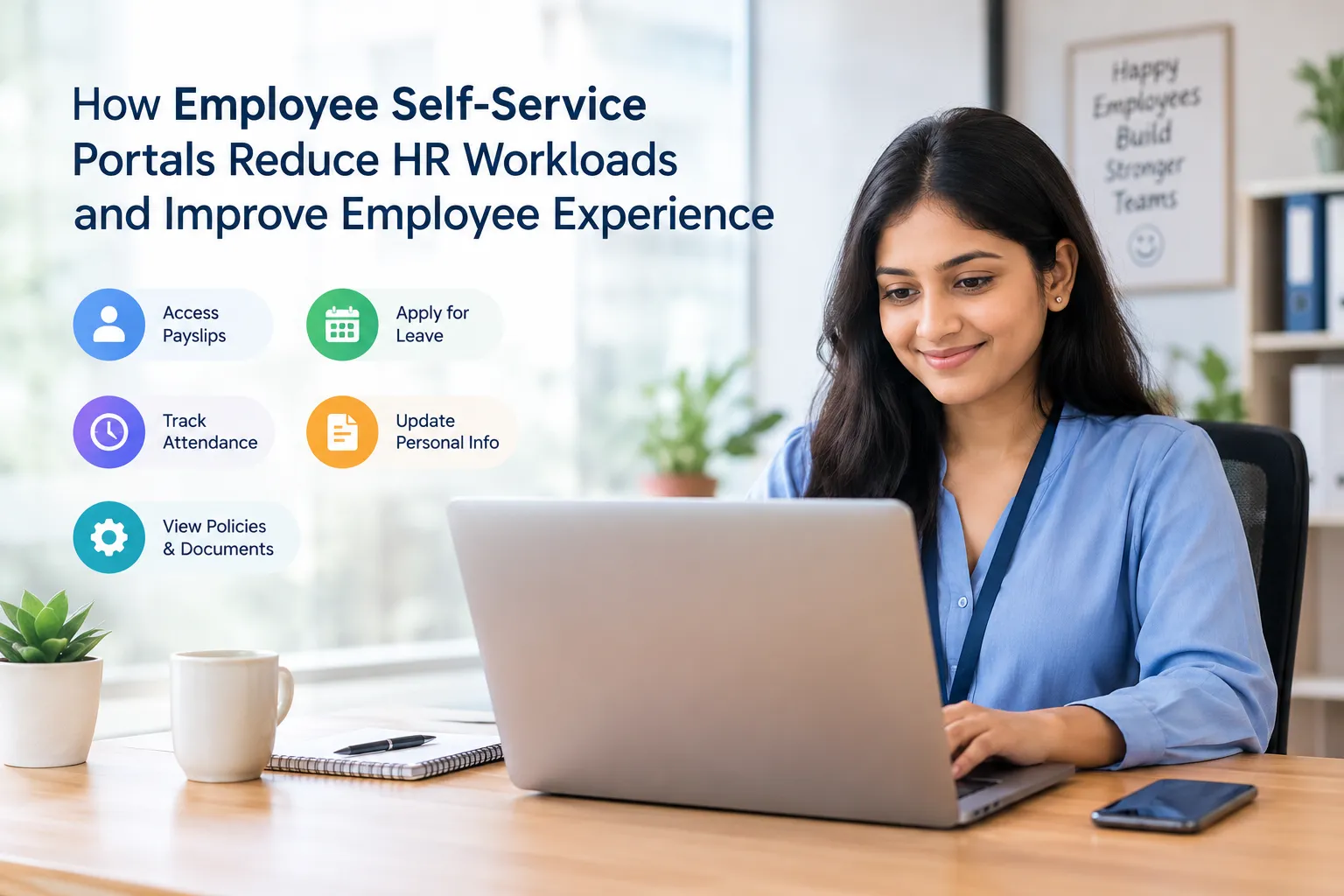
Depending on the system, employees can view salary details, download pay slips, apply for leave, check attendance records, update contact information, and monitor request approvals.
Modern portals often connect with HRMS ESS capabilities, enabling employee information to flow between HR, attendance, leave, and payroll functions. This reduces the need to maintain separate records or repeatedly enter the same information.
For employees, the experience is straightforward: access the portal, select a service, submit a request, and track its progress. For HR teams, it means fewer repetitive questions and more organized administrative processes.
7 Ways Employee Self-Service Portals Reduce Everyday HR Workloads
1. Reduce Repetitive Employee Queries
HR teams frequently answer the same questions about pay slips, leave balances, company policies, attendance records, and employment details.
Although each question may take only a few minutes, answering hundreds of similar queries can consume a significant portion of the workday.
An Employee Self-Service portal provides employees with access to frequently requested information in one place. They can retrieve documents, check balances, and review relevant details whenever they need them.
This reduces interruptions, improves access to information, and allows HR professionals to spend more time addressing complex employee concerns.
2. Simplify Leave Requests and Approvals
Traditional leave management often involves emails, spreadsheets, verbal requests, and repeated follow-ups with managers. This creates unnecessary administrative work and makes it difficult to maintain accurate leave records.
With Leave Management Software, employees can submit leave applications online, check their available balances, and track approval status. Managers can review requests digitally, while HR teams can access updated leave records without manually consolidating information.
Automated notifications and approval workflows also reduce delays and improve coordination between employees, managers, and HR.
The result is a more transparent process with fewer missed requests and less paperwork.
3. Improve Payroll Information Access
Payroll-related queries can place considerable pressure on HR and finance teams, particularly around salary-processing dates.
Employees may need clarification about deductions, earnings, reimbursements, tax declarations, or pay slip availability. Without a centralized system, resolving these questions can require repeated emails and manual document sharing.
Integrating employee portals with Payroll Software allows employees to access available pay slip, review salary information, and consult relevant payroll records through a secure interface.
This improves transparency and reduces routine document requests. Employees can also identify discrepancies earlier and submit questions through a more structured process.
However, self-service access does not replace payroll verification. HR and payroll professionals remain responsible for reviewing discrepancies and ensuring accurate salary processing.
4. Reduce Attendance Tracking and Correction Work
Attendance management becomes challenging when employees work across multiple locations, shifts, or hybrid arrangements. HR teams may spend hours checking punch records, correcting missed entries, and following up with managers.
An employee portal can allow staff to review their attendance records, identify missing punches, and submit correction requests according to company policy.
When connected with attendance devices or time-tracking systems, the portal can provide a more consistent view of working hours and attendance information.
Automated routing sends correction requests to the appropriate approver, while digital records make it easier to track decisions.
This reduces manual coordination and helps HR teams identify attendance issues before they affect payroll calculations.
5. Digitize Employee Information Updates
Employees change their contact details, residential addresses, emergency contacts, and other personal information over time. When these updates arrive through informal messages or paper forms, HR teams must manually enter the information and verify that records remain consistent.
A self-service portal enables employees to submit updates directly through designated forms. Depending on the organization's rules, certain changes may be updated automatically, while sensitive information requires HR approval or supporting documentation.
This approach reduces repetitive data-entry tasks and encourages employees to keep their records current.
It also supports better record management by maintaining structured information and an auditable history of changes where the system provides those capabilities.
6. Automate Document Access and HR Requests
Employees regularly request employment letters, policy documents, salary certificates, and other work-related records. Handling every request individually can create unnecessary delays.
A centralized portal can provide access to approved documents and standard request forms. Employees can submit requests digitally and receive notifications when documents become available.
Businesses using HRMS Software for Small Businesses can benefit particularly from this approach because smaller HR teams often manage multiple responsibilities with limited administrative support.
Rather than increasing paperwork as the workforce grows, organizations can establish repeatable digital processes that are easier to manage and monitor.
Access permissions should be configured carefully to ensure employees can view only the documents and information they are authorized to access.
7. Improve HR Productivity Through Integrated Workflows
The biggest benefit of employee self-service comes when different HR activities work together instead of operating as isolated processes.
For example, an employee submits a leave request through the portal. The manager approves it, the leave balance is updated, and the relevant attendance records reflect the approved absence. Depending on the integration and payroll configuration, the approved information can then be used during payroll processing.
Without integrated workflows, HR personnel may need to transfer information between spreadsheets, systems, and email conversations.
A well-configured HR Management Software platform connects these activities, reduces duplicate data entry, and improves access to consistent workforce information.
This gives HR teams more time for recruitment, workforce planning, employee development, and other activities that require human judgment.
Emerging Employee Self-Service Trends to Watch in 2026
Employee expectations are changing as digital workplace tools become more common. Several developments are making self-service platforms more useful for modern organizations.
- Mobile-first HR services: Employees increasingly expect to access pay slips, leave applications, and attendance records through mobile-friendly interfaces.
- AI-assisted HR support: AI-powered assistants can help employees find policy information, navigate routine processes, and locate answers to common HR questions when appropriately configured.
- Automated approval workflows: Rules-based notifications and approval routing help reduce delays and manual follow-ups.
- Integrated workforce systems: Connecting HR, attendance, leave, and payroll information reduces duplicate work and improves consistency.
- Stronger data privacy controls: Role-based access, secure authentication, and appropriate audit records help protect sensitive employee information.
Businesses should evaluate these capabilities according to their workforce requirements, data protection responsibilities, and implementation budgets rather than adopting technology simply because it is trending.
How to Implement an Employee Self-Service Portal Successfully
Introducing a portal is not just a software installation exercise. Employees must understand how to use it, and HR processes must be configured correctly.
Follow these practical steps:
- Identify repetitive HR tasks: Review the most frequent employee queries and administrative activities that consume HR time.
- Prioritize essential features: Begin with high-demand services such as pay slips, leave applications, attendance records, and employee information updates.
- Integrate existing systems: Where practical, connect the portal with attendance, leave, and payroll systems to minimize duplicate data entry.
- Establish clear permissions: Define which information employees, managers, and HR administrators can view or change.
- Train employees and managers: Provide simple instructions, demonstrations, and support during the initial rollout.
- Measure results: Monitor request volumes, resolution times, portal adoption, manual corrections, and employee feedback.
Starting with a few high-impact processes and expanding gradually can make implementation more manageable.
Conclusion:
Everyday HR administration may seem routine, but repetitive requests can consume valuable time that could otherwise support employee engagement and organizational growth.
An employee self-service portal helps businesses simplify these activities by giving employees convenient access to information, digitizing common requests, and connecting essential HR workflows. When implemented effectively, it can improve transparency, reduce administrative effort, and support more consistent workforce operations.
For growing organizations, the goal is not to remove the human element from HR. It is to reduce avoidable manual work so HR professionals can focus on people, performance, and business priorities.
Ready to simplify everyday HR operations?
Explore employee self-service capabilities that fit your organization's needs and build a more efficient, employee-friendly workplace.























Sign in to leave a comment.