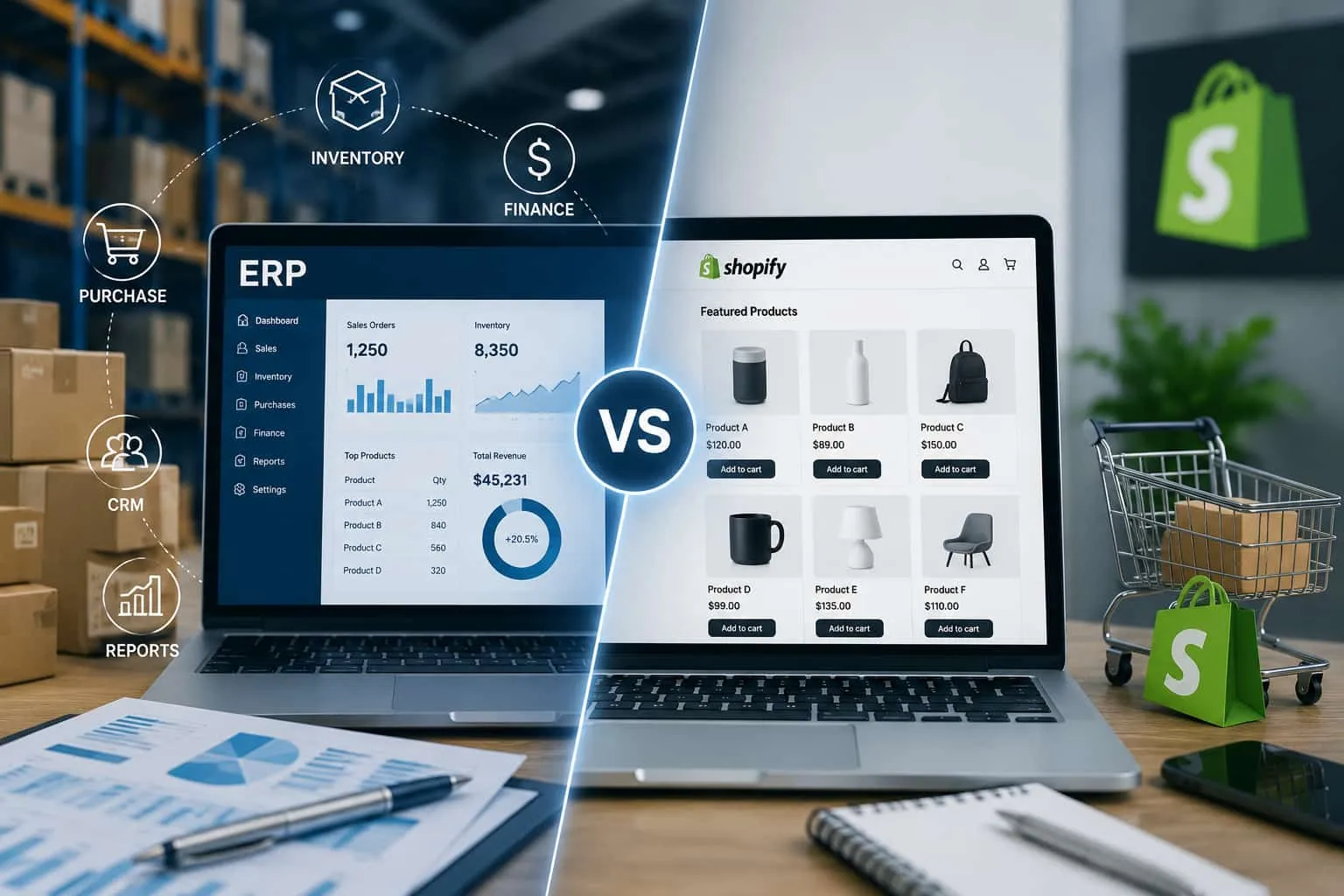

Ask any wholesaler or distributor who's tried to run their trade business off a standard Shopify store, and you'll usually get the same story. It looked great during the demo. It was quick to set up. And then, about three months in, someone was back to manually re-keying orders into the accounting system every night because the two platforms simply weren't talking to each other.
This is the question a lot of NZ businesses end up wrestling with once they move past pure retail selling: do you stick with a platform like Shopify and patch it together with apps and workarounds, or do you build around a properly ERP connected ecommerce store NZ businesses can actually run their whole operation through?
There's no universally right answer, but there is a right answer for B2B. Let's get into why.
What Shopify Does Well
To be fair to Shopify, it didn't become the default choice for online selling by accident. It's fast to launch, the checkout experience is polished, and there's an enormous app ecosystem for almost anything you want to bolt on. For a retail brand selling a handful of product variants directly to consumers, it's genuinely hard to beat on speed and ease of use.
The trouble starts when B2B requirements get layered on top.
Where Shopify Starts to Struggle for B2B
Pricing complexity. Trade customers rarely pay list price. There are tiered discounts, negotiated rates, minimum order quantities, and account-specific catalogues. Shopify can handle some of this with the right combination of apps, but it's rarely native, and it often means stitching together three or four third-party tools just to replicate what a proper trade pricing engine does out of the box.
Stock accuracy. If your stock data lives in a separate inventory or ERP system and Shopify is just a storefront sitting on top, someone needs to keep both in sync. Without a genuine two-way integration, that sync is either manual or built on a patchwork of apps that update on a delay - which is exactly the kind of gap that leads to overselling and order errors.
Order-to-invoice matching. For B2B customers working from purchase orders, an invoice that doesn't precisely match what was ordered and delivered is a real problem, not a minor annoyance. When the storefront and the accounting system aren't genuinely connected, discrepancies are almost inevitable.
Account-based selling. B2B buyers often need their own login, their own pricing, their own order history, and sometimes approval workflows before an order goes through. Shopify can get partway there with B2B-specific features and apps, but a lot of it still feels like retail software wearing a trade hat.
What an ERP Connected Setup Does Differently
An ERP connected ecommerce store isn't really a separate category of storefront - it's the same idea as any online store, but built so the website is one part of a single connected system rather than a bolt-on. Stock, pricing, customer accounts, and invoicing all live in the ERP, and the storefront simply reflects that data in real time.
Practically, that means:
- Stock levels shown online are exactly what's on the shelf, because there's no delay between a sale happening and the ERP knowing about it.
- Trade pricing and customer-specific discounts apply automatically at checkout, without anyone needing to maintain a separate pricing app.
- Orders flow straight into fulfillment and accounting, so nobody's re-typing anything, and nothing gets missed or duplicated.
- Invoices match orders precisely, because they're drawn from the same data rather than reconciled after the fact.
For a genuine B2B ecommerce platform NZ wholesalers and distributors can build their operation around, that level of connection tends to matter more than checkout polish.
So Which Is Actually Better?
Honestly, it depends on where your business sits.
Shopify still makes sense if:
- You're primarily selling to consumers, with B2B as a smaller side of the business
- Your product catalogue and pricing are relatively simple
- You're happy to manage a handful of integrations and don't have complex fulfilment needs
- Speed to launch matters more than long-term operational efficiency
An ERP connected setup makes more sense if:
- B2B is the core of your revenue, not an add-on
- You've got tiered pricing, trade accounts, or negotiated rates
- Order accuracy and invoice matching genuinely affect your customer relationships
- You're already running (or planning to run) an ERP for stock and accounts, and don't want a storefront that's disconnected from it
- You're scaling order volumes and can't afford manual re-entry to keep pace
A lot of businesses actually start on Shopify and migrate once the manual workarounds become more expensive than the platform itself. That's a completely reasonable path - but it's worth going in with eyes open about where the ceiling is.
The Real Question to Ask
Rather than asking "which platform is better" in the abstract, it's more useful to ask: where do you want the single source of truth to live? If it's the ERP - which, for most established B2B operations, it should be - then the ecommerce platform needs to be built to reflect that system faithfully, not work around it.
That's really the whole case for going with an ERP connected ecommerce store NZ trade businesses can rely on: it's not about chasing a fancier storefront, it's about making sure the front end and the back office are finally telling the same story.
The Bottom Line
Shopify is a strong platform, and for plenty of businesses it's the right call. But B2B selling has different demands to retail - complex pricing, stock accuracy, and invoice-order matching aren't nice extras, they're the things that keep trade customers coming back. If those are core to how your business operates, a properly integrated, ERP-connected approach is usually going to serve you better in the long run than trying to make a retail-first platform do a trade-first job.


























Sign in to leave a comment.