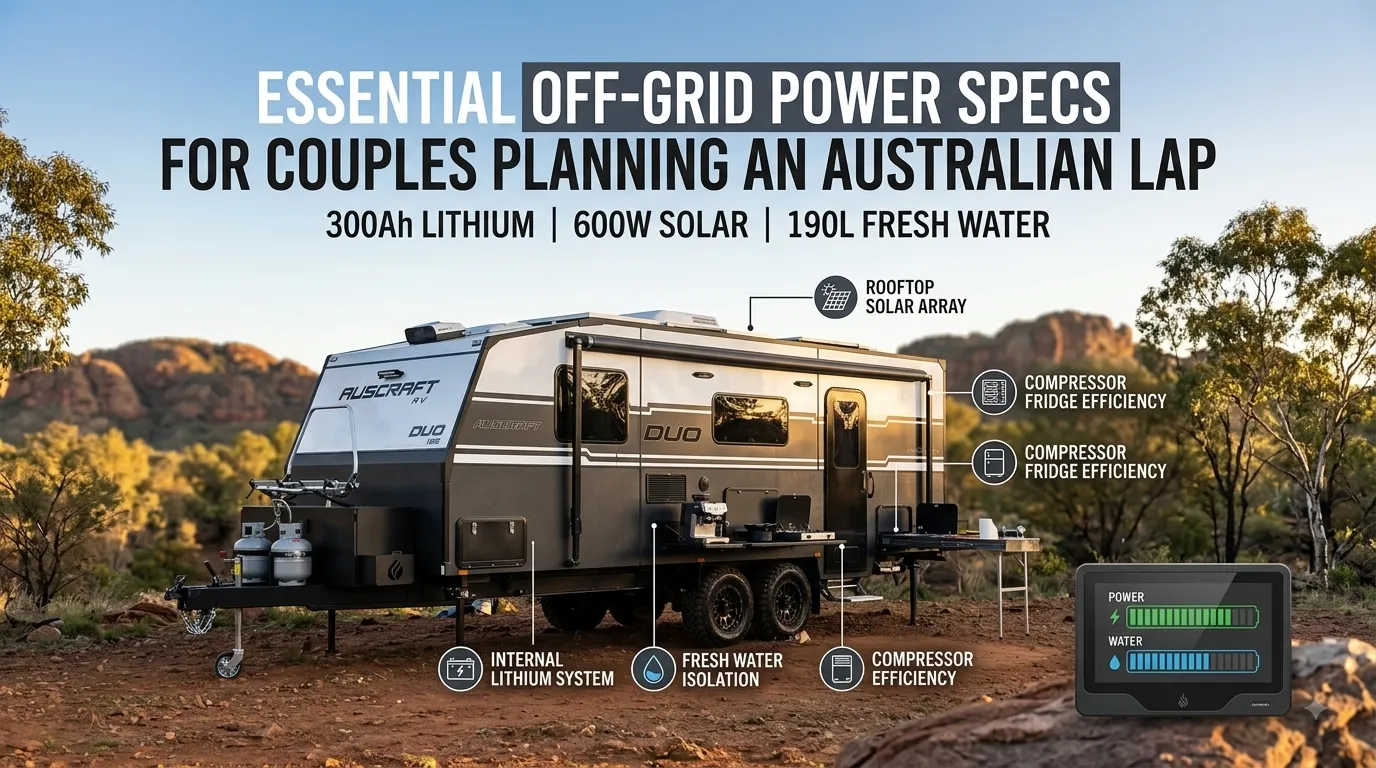

Planning an extended lap of Australia as a couple raises one practical question early on: how much power and water do two people actually need to travel comfortably off-grid, without relying on a noisy generator or constant caravan park stopovers?
Anyone researching an off road caravan for couples in Australia will eventually land on this exact question, since it's the power and water setup — not just the layout — that determines how self-sufficient a trip can really be. Getting this right comes down to understanding how lithium battery capacity, solar output, battery management, and water tank sizing work together.
This guide breaks down what each of these systems does and how they're typically specified in an off-road caravan built for two.
Why Off-Grid Power Planning Matters for Couples
Off-grid touring means running everything — lighting, refrigeration, charging, water pumps, and appliances on board — from stored and generated power rather than mains electricity. For a couple travelling in an off-road caravan for an extended period, this system needs to be reliable enough to handle days or weeks without access to power hookups, particularly on remote stretches of a lap around Australia.
Getting the balance right between battery capacity, solar input, and water storage is what determines how long you can stay off-grid comfortably, and how much you'll need to plan around generator use or park stopovers. It's also one of the most overlooked factors when comparing the best caravans for couples in Australia, since off-grid capability is often judged on layout and finish alone rather than on what's actually powering the trip.
For couples starting their search closer to home, this same question comes up when comparing the best caravans for couples in Melbourne or looking at an off road caravan for couples in Melbourne more specifically — the fundamentals of battery, solar, and water sizing stay the same no matter where the search begins.
Lithium Battery Capacity
How Battery Capacity Is Measured
Caravan battery capacity is typically measured in amp-hours (Ah), which indicates how much current a battery can supply over time. Lithium (LiFePO4) batteries have become the standard choice for off-grid touring because they offer a higher usable capacity than older AGM or lead-acid batteries of a similar physical size, along with a longer cycle life.
A Typical Setup for Two
A couples-oriented off-road caravan build commonly runs on a 300Ah lithium battery. For two people, this is generally enough capacity to run a compressor fridge, lighting, water pump, and everyday device charging for extended stretches without needing to recharge from mains power, provided the solar input keeps pace with daily use.
Solar Output and Battery Management
The Role of Solar Panels
Solar panels are what allow a battery system to recharge without needing to plug into mains power or run a generator. Output is measured in watts, and the amount of usable solar energy collected each day depends on panel wattage, hours of usable sunlight, and how much shading or cloud cover you encounter.
A couples-oriented setup is commonly specified with 600W of solar, paired with a 300Ah lithium battery. This pairing is designed to keep the battery topped up under typical touring conditions without relying on a generator as the primary charging source.
Battery Management Systems
A battery management system (BMS) monitors and regulates how power moves between the solar input, battery, and appliances — helping protect battery health and manage charging efficiently. Off-grid setups commonly use a dedicated power management unit for this purpose, rather than leaving solar and battery charging unmanaged.
Water Tank Setup for Two
Fresh Water Capacity
Water independence matters just as much as power when travelling off-grid. A couples-oriented off-road caravan is commonly fitted with two 95-litre fresh water tanks, giving a combined fresh water capacity of around 190 litres. This is generally sized to support extended stays in remote locations without needing frequent refills.
Grey Water Storage
Grey water tanks store used water from sinks and showers, which matters for remote travel where dumping grey water directly onto the ground isn't appropriate or permitted. A 95-litre grey water tank is a common pairing alongside dual fresh water tanks, helping balance how often fresh and grey water need to be managed.
Hot Water and Outdoor Washing
An instantaneous gas hot water system is a common inclusion in off-grid caravan builds, providing on-demand hot water without needing to store and reheat a fixed volume. An external hot and cold shower is also a frequent addition, useful for rinsing off after a swim, a hike, or a dusty day on the road without tracking sand or dirt inside.
Refrigeration and Everyday Power Draw
A compressor fridge is the standard choice for off-grid touring, since it runs efficiently on 12V power and doesn't require the caravan to be level to operate properly, unlike older absorption fridge designs. Fridge running time is one of the more significant ongoing power draws in an off-grid system, which is part of why battery and solar sizing are considered together rather than in isolation.
Bringing the System Together
None of these components work in isolation — battery capacity, solar input, battery management, and water storage all need to be considered together based on how you plan to travel. A 300Ah lithium battery paired with 600W of solar and around 190 litres of fresh water storage reflects a setup commonly specified for two people touring off-grid for extended periods, though actual day-to-day performance still depends on appliance use, weather, and travel style.
Understanding how these systems interact is one of the most useful things to research before setting off, since it directly affects how self-sufficient you can be on the road — and how often you'll need to plan around a generator, a caravan park, or a town stopover.
Resource: AusCraft RV DUO Model for Couples























Sign in to leave a comment.