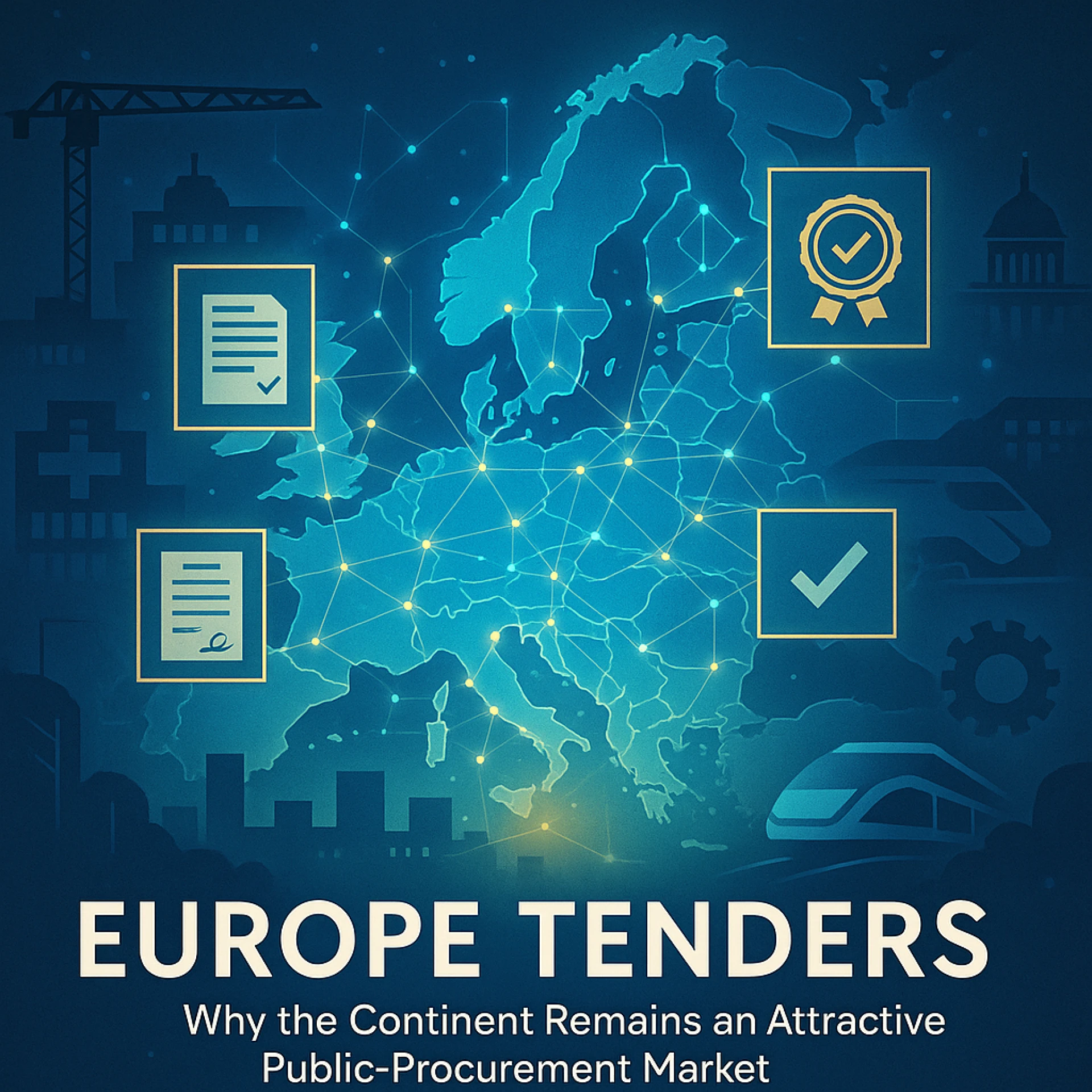

Europe’s public sector buys almost everything: railway carriages, AI-enabled CCTV, solar panels, hospital gowns, even biscuits for state-school lunches. On any given day, endless opportunities circulate across Europe’s electronic procurement portals. For companies that know how to navigate this ecosystem, the rewards are substantial. Yet many firms still sit on the sidelines, daunted by language barriers, complex rules, and the sheer volume of notices. For teams that want a head start without reinventing the wheel, Tender Impulse blends technology with hands-on legwork to surface relevant Europe tenders fast, so effort flows into winning rather than searching.
This blog demystifies Europe’s tender landscape and explains how specialised intelligence services turn a seemingly bureaucratic maze into a predictable stream of revenue.
Whether you manufacture precision components in Pune or deliver cloud security from Lisbon, understanding Europe tenders unlocks growth in 2025 and beyond.
A Market Defined by Scale and Transparency
- Trillion-euro spend: The EU estimates public procurement at roughly €2 trillion annually - about 14% of GDP.
- Mandatory e-publishing: Since October 2018, EU directives require most contracts above the threshold value to be published electronically on Tenders Electronic Daily.
What Makes European Contracts Worth Chasing?
- Prompt payment culture: The EU’s Late Payment Directive obliges public bodies to pay within 30 days (60 days in healthcare), dramatically reducing cash-flow risk.
- Reputation dividend: Delivering to, say, Germany’s Bundeswehr or France’s SNCF instantly enhances credibility when courting private clients.
The Challenges - Why “Leg-Work” Matters
- Information overload: With five languages dominating the continent, and dozens of minority tongues, daily monitoring of 30-plus portals is virtually impossible without automation.
- Hidden intelligence: Pre-tender market consultations, supplier days, and advance notices often appear only on niche bulletins or ministry webpages. Missing these early signals means reacting rather than influencing.
- Document retrieval: Some authorities publish only abridged notices online. Full specifications, BOQ sheets, or BIM models might sit behind paywalls or require in-country registration numbers.
- Cultural codes: A Slovene municipality may demand hard-copy submissions; an Italian province may score social-value criteria heavily; Dutch buyers routinely hold “competitive dialogues” where solution design shapes the final scope. One size never fits all.
A dedicated tender-intelligence partner tackles these pain points by:
- Curating opportunities that match your CPV codes, turnover ceilings, and past performance.
- Fetching original documents, including annexes and technical drawings, often within hours of release.
- Translating essential sections into crisp business English, saving you from machine-translation mishaps.
- Alerting you to upcoming frameworks months before publication, so you can align references and forge consortia.
- Providing bid-writing support that converts raw compliance data into persuasive narratives.
When the stakes are high and timelines are tight, Tender Impulse’s mix of curated data and hands-on support helps teams stay ahead, without drowning in portals, passwords, and PDFs.
Anatomy of a Winning European Bid
While evaluation models vary, four pillars recur across jurisdictions:
Eligibility & Compliance
- Legal: Certificates of incorporation, tax-clearance statements, workers’ compensation proofs.
- Technical: References demonstrating similar scope, often limited to the past five years.
Technical Merit
- Methodology: Work-flows, risk registers, quality-assurance plans.
- Innovation: Digital twins, IoT sensors, ESG monitoring - buyers reward forward-looking solutions.
- Staffing: CVs of key personnel, language skills, and local presence.
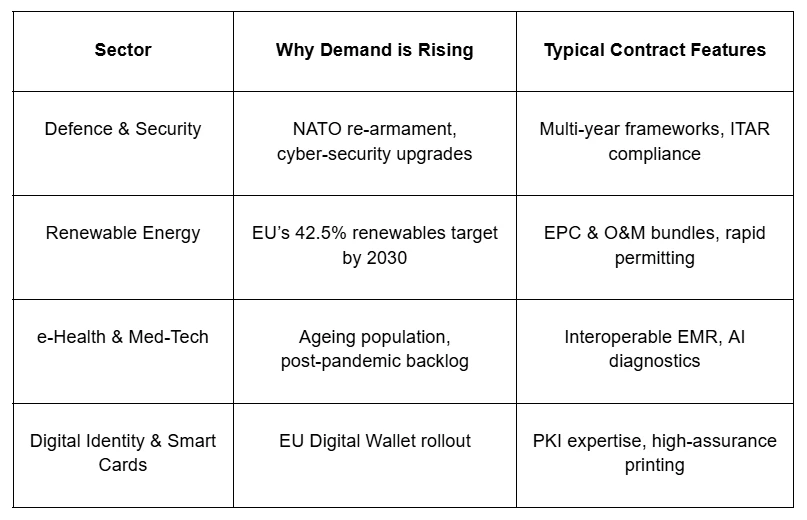
Hot Sectors for 2025–26
Five Practical Steps to Enter Europe’s Tender Arena
- Define a micro-niche. Instead of “IT services,” target “ISO 27001-certified SOC monitoring for regional hospitals.”
- Test the waters via subcontracting. Many primes seek niche subcontractors to meet localisation or diversity quotas - an easier entry than prime bidding.
- Invest in CPV intelligence. Map your products to CPV codes; misalignment means you will never see relevant notices.
- Attend buyer briefings, virtually or live. European authorities increasingly live-stream supplier days; asking smart questions signals credibility.
- Leverage tender-intelligence services. Automate monitoring, document retrieval, translation, and deadline alerts so your team can focus on strategy and pricing.
Why Partnered Leg-Work Outperforms DIY Scanning
A mid-size engineering firm recently subscribed to a Europe-wide tender portal but still missed a €12 million framework because the early-market engagement session was posted only in Finnish on a municipal site. A consultancy specialising in “leg-work” would have surfaced that notice, provided an English precis, and obtained the slide deck, giving the firm four extra months to position itself. Multiply such gaps across 30 countries, and the ROI from professional tender intelligence becomes obvious. Key value drivers include:
- Coverage breadth: From TED to niche provincial gazettes, reducing blind spots.
- Speed: Same-day alerts and urgent document pickup prevent last-minute scrambles.
- Contextual advice: Which tenders are worth chasing? Tactical guidance prevents bid fatigue.
- Bid-writing backup: Story-boarding, compliance matrices, graphic design - transforming technical credentials into winning narratives.
Final Thoughts
Europe’s tender market rewards those who combine strategic focus with operational discipline. The old image of dense paperwork and opaque award decisions is fading, replaced by digitised portals, clear evaluation grids, and greener procurement standards. Yet opportunity still favours the prepared. By outsourcing tasks like monitoring, translating, and retrieving documents, businesses of any size can compete fairly with established entities.































Sign in to leave a comment.